
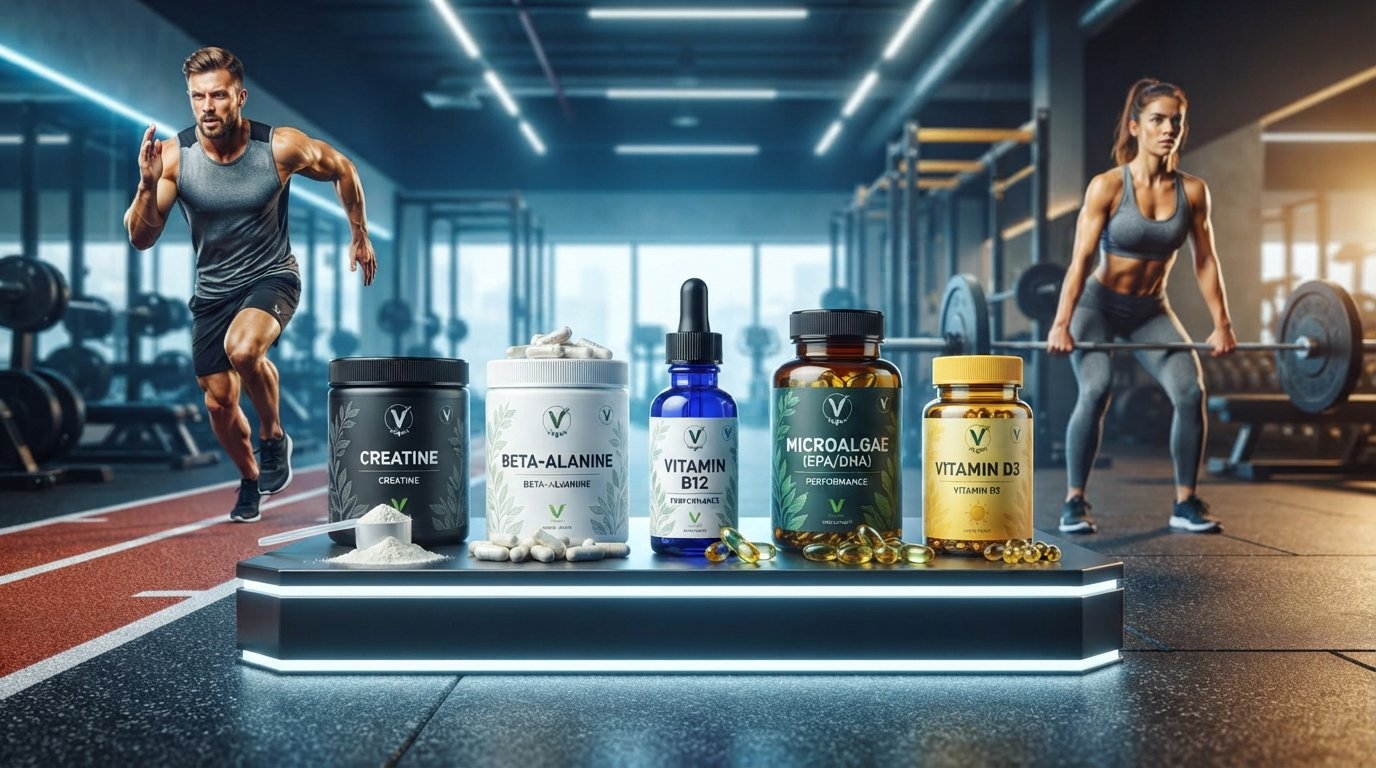
A well-planned, whole-food plant-based diet provides abundant antioxidants, complex carbohydrates, and anti-inflammatory phytonutrients that optimize recovery and long-term cardiovascular health. However, because certain non-essential ergogenic compounds and micronutrients are found primarily or exclusively in animal tissues, vegan athletes naturally register lower baseline intramuscular stores of phosphocreatine, carnosine, active vitamin B12, long-chain omega-3 fatty acids (EPA/DHA), and vitamin D3.
Rather than viewing this as a disadvantage, understanding these metabolic gaps allows plant-based lifters and endurance competitors to turn them into a distinct performance edge. Targeted supplementation with essential supplements for vegan athletes super-saturates cellular stores, yielding greater relative strength, power, and high-intensity stamina gains compared to omnivorous peers.
The Ergogenic Gap: Baseline Differences in Plant-Based Athletes
                     THE INTRAMUSCULAR DEPLETION MATRIX
│                                                                        │
│  Omnivorous Baseline ──► Constant Meat Intake Maintains Partial Stores │
│                                                                        │
│  Vegan Baseline      ──► Absence of Meat Drops Muscle Creatine &       │
│                          Carnosine Stores by 20–40%                    │
│                                      │                                 │
│                                      ▼                                 │
│  Targeted Supps      ──► GREATER HYPER-COMPENSATORY RESPONSE           │
│                          (Greater relative % jump in strength & power) │
When an athlete eliminates animal flesh, dietary intake of pre-formed creatine, carnosine precursors (beta-alanine), and pre-formed EPA/DHA drops to near zero. While the human body can endogenously synthesize small amounts of these molecules from amino acids, baseline tissue saturation remains significantly lower in vegans.
When plant-based athletes introduce synthetic or microalgae-derived supplements, their muscle tissues experience a dramatic hyper-compensatory uptake curve, leading to notable improvements in high-power output, fatigue resistance, and cognitive processing under stress.
Head-to-Head Performance Supplement Matrix
| Supplement | Target Baseline Deficit | Primary Ergogenic Mechanism | Optimal Daily Protocol | Evidence Grade |
| 1. Creatine Monohydrate | Low muscle phosphocreatine (PCr) | Rapid ATP resynthesis; cellular hydration & mTORC1 activation | 3-5 g/day (synthetic monohydrate) | Grade A (Gold Standard) |
| 2. Beta-Alanine | Reduced intramuscular carnosine | Buffers hydrogen ions (H+); delays acidosis in 60-240s efforts | 3.2-6.4 g/day (divided 1.6g doses) | Grade A (Gold Standard) |
| 3. Vitamin B12 (Cobalamin) | Absent in unfortified plant foods | Erythropoiesis (RBC formation), myelin sheath & ATP synthesis | 250 μg/day (Cyanocobalamin / Methylcobalamin) | Grade A (Essential) |
| 4. Microalgae EPA/DHA | Low conversion of ALA to EPA/DHA | Suppresses EIMD, reduces IL-6/TNF-α, boosts muscle protein synthesis | 1,000-2,000 mg/day total EPA+DHA | Grade B+ (High Priority) |
| 5. Lichen Vitamin D3 | Limited sun exposure & dietary D3 | Neuromuscular firing speed, calcium kinetics, testosterone support | 2,000-5,000 IU/day (Cholecalciferol) | Grade A (Essential) |
—–
Deep Dive: The Top 5 Ergogenic & Health Powerhouses
1. Creatine Monohydrate (Intramuscular Energy & Hypertrophy)
Creatine donates phosphate groups to ADP to rapidly regenerate ATP during short-burst, explosive efforts like heavy lifting or sprinting. Because plant diets contain no direct creatine, supplementation increases muscle creatine stores in vegans by up to 20-40%, driving superior fat-free mass gains and maximal strength output compared to omnivorous controls.
2. Beta-Alanine (Intramuscular Buffering Capacity)
Beta-alanine is the rate-limiting precursor to carnosine, a dipeptide that acts as an intracellular buffer against lactic acid accumulation (H+ ions). Chronic supplementation (4-6 weeks) elevates muscle carnosine levels by 60-80%, extending time to exhaustion during high-intensity intervals lasting 1-4 minutes.
                      BETA-ALANINE BUFFERING MECHANISM
│                                                                          │
│  High-Intensity Effort ──► Accumulation of H+ Ions (Muscle Acidosis)     │
│                                       │                                  │
│                                       ▼                                  │
│  Intramuscular Carnosine──► Binds H+ Ions & Preserves Enzymatic Function │
│                                       │                                  │
│                                       ▼                                  │
│  Performance Result    ──► Delayed Fatigue & Higher Power Output         │
3. Vitamin B12 (Cobalamin: Oxygen Transport & Nervous System)
Essential for red blood cell formation and neurological function, B12 deficiency leads to megaloblastic anemia, weakness, and paresthesia. Because B12 is produced exclusively by microorganisms, every plant-based athlete must supplement with cyanocobalamin or methylcobalamin to maintain oxygen carrying capacity and athletic stamina.
4. Microalgae EPA & DHA (Anti-Inflammatory & Neuromuscular Recovery)
While plant foods contain alpha-linolenic acid (ALA), human conversion rates of ALA into eicosapentaenoic acid (EPA) and docosahexaenoic acid (DHA) are low (<5-10%). Supplementing directly with microalgae-derived oil delivers pre-formed EPA and DHA, suppressing exercise-induced muscle damage (EIMD) and improving muscle cell membrane fluidity.
5. Lichen-Derived Vitamin D3 (Muscle Function & Bone Mineralization)
Vitamin D3 acts as a secosteroid hormone, influencing type II fast-twitch muscle fiber size, calcium release in sarcoplasmic reticulum, and immunity. Plant-based cholecalciferol (derived from wild lichen) is identical to animal-derived D3 and is superior to D2 at raising serum 25(OH)D levels.
Actionable Daily Supplement Protocol
                     ATHLETE DAILY STACK TIMING
│                                                                      │
│  Morning (With Meal)   ──► Vitamin B12 (250μg) + Lichen D3 (3000 IU) │
│                            + Microalgae Omega-3 (1000mg)             │
│  Pre/Post-Workout      ──► Creatine Monohydrate (5g)                 │
│  Split Doses (2x/day)  ──► Beta-Alanine (1.6g dose x 2)              │
Daily Maintenance Base: Take your fat-soluble supplements (Lichen D3 and Microalgae Omega-3s) alongside a meal containing healthy fats (avocado, nuts, chia seeds) to maximize intestinal absorption.
Post-Workout Co-Ingestion: Consume 5g of creatine monohydrate alongside a carbohydrate-protein recovery meal, such as our High-Protein Berry-Spinach Anabolic Recovery Smoothie, to leverage insulin-mediated creatine transport into muscle tissue.
Integrating Supplement Science with Training & Recovery
A structured ergogenic stack yields optimal results when paired with progressive resistance protocols, whole-food plant nutrition, and smart recovery tracking:
Creatine Saturation Protocols: Learn how to maximize intramuscular phosphocreatine stores in Creatine Monohydrate Saturation for Plant-Based Athletes.
Progressive Muscle Hypertrophy: Fuel your strength sessions using guidelines from How to Build Vegan Muscle: The Complete Science-Backed Guide.
Daily Protein Science & EAAs: Review essential amino acid targets in How Much Protein Do Plant-Based Athletes Really Need?.
Evaluating Whole Foods vs. Analogues: Select clean nutritional foundations alongside your stack in Processed Vegan Meats vs Whole Foods: Performance & Health Audit.
Ready to fine-tune your ergogenic stack, macro ratios, and athletic performance with evidence-based coaching? Explore how Online Fitness Coaching can help you achieve your goals today!
References
Burke, D. G., Chilibeck, P. D., Parise, G., Candow, D. G., Mahoney, D., & Tarnopolsky, M. (2003). Effect of creatine and weight training on muscle creatine and performance in vegetarians. Medicine & Science in Sports & Exercise, 35(11), 1946–1955.
Holick, M. F. (2007). Vitamin D deficiency. The New England Journal of Medicine, 357(3), 266–281.
Lane, K., Derbyshire, E., Li, W., & Brennan, C. (2014). Bioavailability and potential uses of algal-derived omega-3 fatty acids. Critical Reviews in Food Science and Nutrition, 54(5), 572–579.
Rogerson, D. (2017). Vegan diets: Practical advice for athletes and exercisers. Journal of the International Society of Sports Nutrition, 14(1), Article 36.
Trexler, E. T., Smith-Ryan, A. E., Stout, J. R., Hoffman, J. R., Wilborn, C. D., Sale, C., Kreider, R. B., Jäger, R., Earnest, C. P., Bannock, L., Campbell, B., Kalman, D., Ziegenfuss, T. N., & Antonio, J. (2015). International Society of Sports Nutrition position stand: Beta-alanine. Journal of the International Society of Sports Nutrition, 12(1), Article 36.