
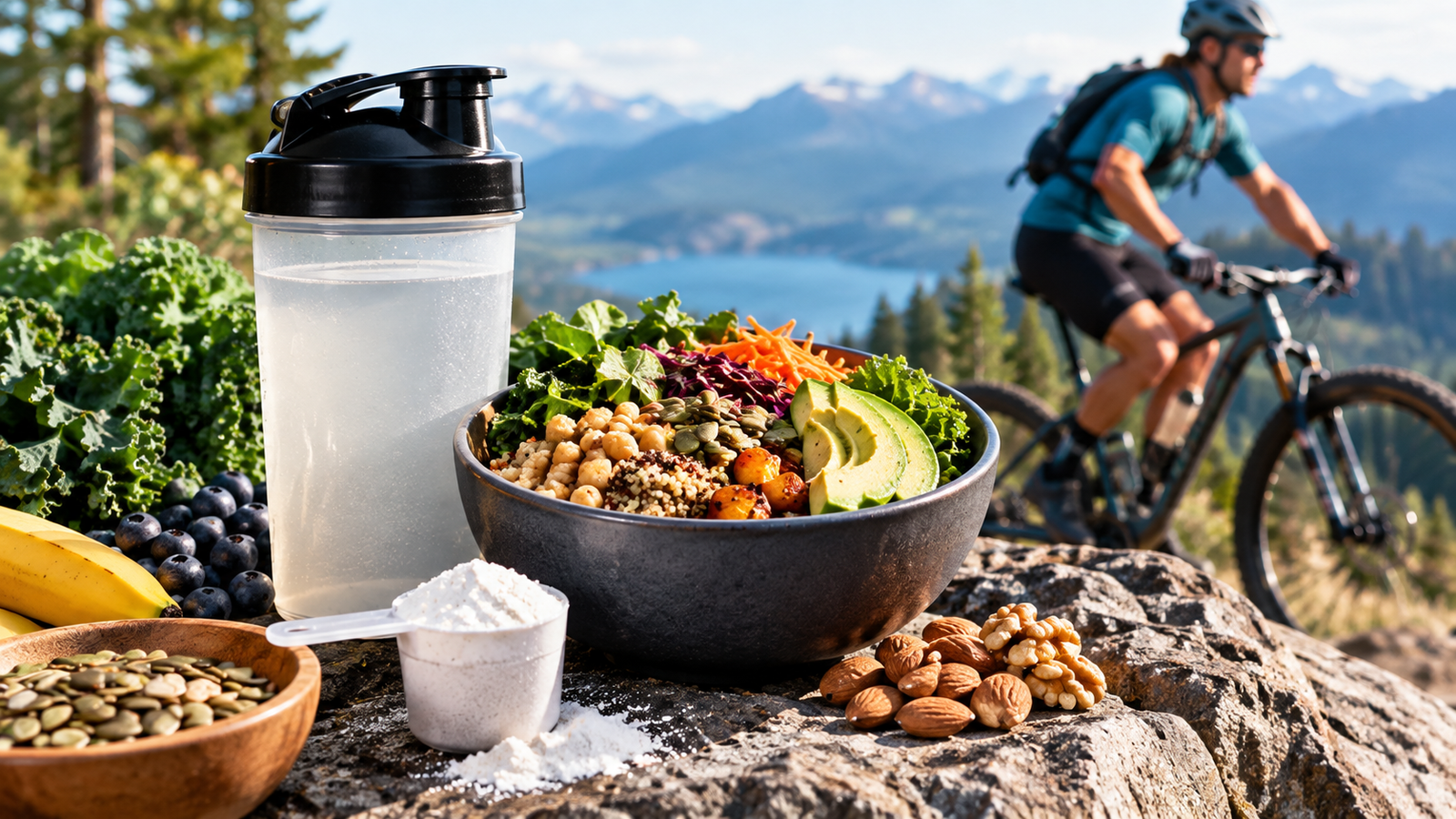
For athletes striving for explosive power, muscular hypertrophy, and cognitive sharp-mindedness, few supplements carry the overwhelming scientific backing of creatine. However, achieving complete creatine monohydrate saturation offers a unique physiological advantage for plant-based lifters and endurance runners.
Because dietary creatine is naturally found almost exclusively in animal muscle tissues (meat and seafood), individuals following a strict vegan or vegetarian diet maintain significantly lower baseline intramuscular and cerebral phosphocreatine (PCr) stores. Consequently, when plant-based athletes saturate their cellular stores through supplementation, they regularly experience greater relative (percentage) increases in muscular strength, sprint power, and cognitive performance compared to omnivores.
The Bioenergetics of Creatine & The Baseline Deficiency
Creatine is an organic acid synthesized endogenously in the liver and kidneys from the amino acids arginine, glycine, and methionine at a rate of roughly 1 gram per day. The remaining metabolic requirement is traditionally supplied via dietary intake.
                   THE ATP-PCr ENERGY RE-SYNTHESIS LOOP
│                                                                           │
│  [ High-Intensity Work ] ──► ATP Breaks Down ──► ADP + Inorganic P        │
│                                                       │                   │
│                                                       ▼                   │
│  [ Muscle Contraction Continues ] ◄── Re-synthesizes ATP ◄── [ PCr Store ]│
In skeletal muscle tissue, approximately 65-70% of creatine exists in the phosphorylated form as phosphocreatine (PCr). During high-intensity, short-duration exercise (such as heavy lifting or 100-meter sprints), PCr donates its phosphate group to adenosine diphosphate (ADP) to rapidly re-synthesize adenosine triphosphate (ATP) via the creatine kinase reaction.
Why Plant-Based Baseline Stores Are Lower
Omnivorous Baseline: Omnivores consume approximately 1-2 grams of dietary creatine daily from meat and fish, keeping muscle stores around 70-80% of maximum capacity (120-140 mmol/kg dry muscle mass).
Plant-Based Baseline: Vegetarians and vegans rely exclusively on endogenous synthesis, maintaining baseline stores that hover between 90-110 mmol/kg dry muscle mass.
When plant-based athletes supplement to achieve full saturation (160 mmol/kg dry muscle), they close a 35-45% baseline deficit, whereas omnivores only expand their stores by 15-20%.
3 Core Pillars of Performance Optimization
| Mechanism | Omnivore Response | Plant-Based Athlete Response |
| PCr Pool Expansion | +15-20% Increase | +30-45% Increase (Greater Relative Response) |
| Maximal Force Output | Moderate Strength Improvements | Higher Percentage Strength & Power Gains |
| Cerebral Bioenergetics | Minimal Cognitive Shift | Marked Improvements in Working Memory & Mental Fatigue |
—–
1. Muscular Power and Explosive Strength
Because plant-based muscle tissues experience a substantially higher percentage jump in available PCr, energy replenishment during high-intensity set repetitions is dramatically accelerated. This allows plant-powered lifters to maintain higher force production across multiple sets, driving greater mechanical tension and hypertrophic adaptations over time.
2. Cognitive Performance and Neurological Resilience
The brain is a metabolically demanding organ that utilizes PCr for rapid ATP buffering during complex cognitive tasks, sleep deprivation, or mental fatigue. Research demonstrates that because vegetarians have lower baseline cerebral creatine levels, creatine supplementation yields significant improvements in working memory, processing speed, and cognitive fatigue resistance compared to meat-eating control groups.
3. Cellular Hydration and Anabolic Signaling
Creatine acts as an osmolite, drawing intracellular water into muscle cells. This increased cell swelling acts as a direct anabolic signal—reducing protein breakdown, stimulating satellite cell activity, and upregulating IGF-1 gene expression within skeletal muscle tissue.
Evidence-Based Dosing & Loading Protocols
To achieve full intramuscular saturation, plant-based athletes can choose between two validated dosing methods:
                      CREATINE SATURATION PROTOCOLS
│                                                                        │
│  Method A: Fast Loading                                                │
│  • 20g / day (split into 4 x 5g doses) for 5-7 days                    │
│  • Followed by 3-5g / day maintenance phase                            │
│  • Full saturation achieved in ~7 days                                 │
│                                                                        │
│  Method B: Daily Saturation (Recommended)                              │
│  • 3-5g / day consistently (or 0.05g/kg body weight)                   │
│  • Full saturation achieved in ~21-28 days                             │
│  • Minimizes potential GI distress                                     │
Formulation: Choose 100% pure Creatine Monohydrate. It remains the most heavily researched, bioavailable, and cost-effective form on the market.
Co-Ingestion Tip: Consuming creatine alongside 30-50 grams of complex plant carbohydrates (or a plant protein-carb meal) elevates circulating insulin, accelerating muscle creatine transport via the sodium-dependent creatine transporter (CRT).
Integrating Bioenergetics with Hybrid Performance
Maximizing the advantages of creatine saturation requires pairing proper supplementation with recovery, plant-based nutrition, and progressive training:
Fueling Muscle Protein Synthesis: Pair your ergogenic loading strategy with essential amino acid targets as outlined in Importance of Protein to Achieving Your Goals.
Sustaining Strength & Endurance: Learn how to balance heavy lifting with aerobic development in Build Muscle Without Sacrificing Endurance Performance.
Protecting Sleep Architecture: Enhance brain recovery and hormonal secretion by reviewing Power of a Good Night’s Sleep: 10 Science-Backed Benefits.
Consistency & Habit Building: Keep your daily supplement and training habits locked in using our guide on An Important Question to Ask While Achieving Your Goals.
Ready to optimize your plant-based nutrition, supplement strategy, and strength training for peak performance? Explore how Online Fitness Coaching can help you achieve your goals today!
References
Avgerinos, K. I., Yiannakopoulou, N., Anastasiou, C. A., Giaginis, C., & Yannakoulia, M. (2018). Effects of creatine supplementation on cognitive function of healthy individuals: A systematic review of randomized controlled trials. Experimental Gerontology, 108, 166–173.
Burke, D. G., Chilibeck, P. D., Parise, G., Candow, D. G., Mahoney, D., & Tarnopolsky, M. (2003). Effect of creatine and weight training on muscle creatine and performance in vegetarians. Medicine & Science in Sports & Exercise, 35(11), 1946–1955.
Chilibeck, P. D., Kaviani, M., Candow, D. G., & Zello, G. A. (2017). Effect of creatine supplementation during resistance training on lean tissue mass and muscular strength in older adults: A meta-analysis. Journal of Sport and Health Science, 6(3), 376–385.
Kaviani, M., Shaw, K., & Chilibeck, P. D. (2020). Benefits of creatine supplementation for vegetarians comparing to omnivorous athletes: A systematic review. PLoS ONE, 15(11), Article e0241951.
Kreider, R. B., Kalman, D. S., Antonio, J., Ziegenfuss, T. N., Wildman, R., Collins, R., … & Lopez, H. L. (2017). International Society of Sports Nutrition position stand: Safety and efficacy of creatine supplementation in exercise, sport, and medicine. Journal of the International Society of Sports Nutrition, 14(1), Article 18.
Rae, C., Digney, A. L., McEwan, S. R., & Bates, T. C. (2003). Oral creatine monohydrate supplementation improves brain performance: A double-blind, placebo-controlled, cross-over trial. Proceedings of the Royal Society of London. Series B: Biological Sciences, 270(1529), 2147–2150.