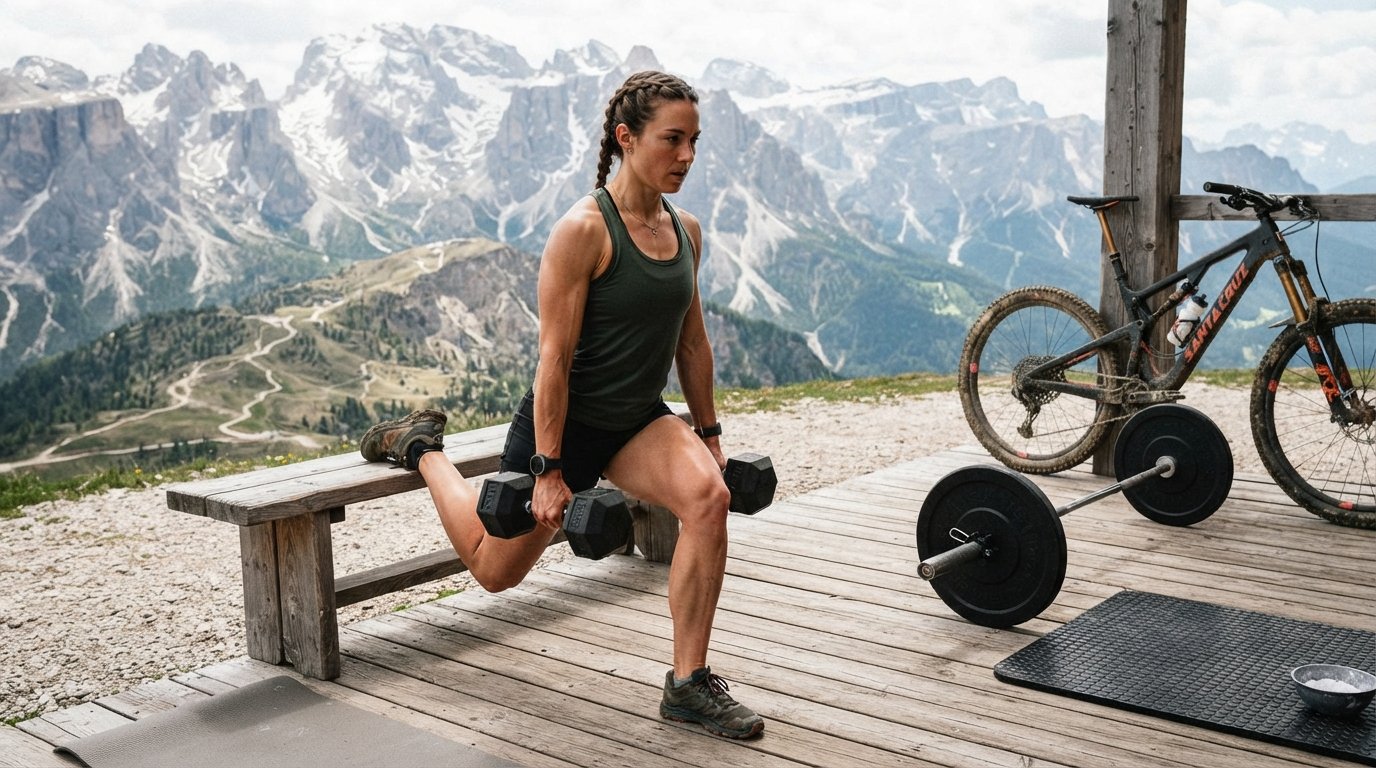
Off-road cycling demands intense power production while navigating rugged terrain, making the debate between bilateral vs. unilateral strength training essential for cross-country (XC) mountain bikers seeking to fix pedal stroke power leaks, resolve knee tracking issues, and eliminate asymmetrical muscle imbalances.
While heavy bilateral squats and deadlifts build foundational multi-joint force production, mountain biking is fundamentally a series of alternating single-leg power contractions performed over unstable trail surfaces. When athletes rely exclusively on bilateral movements, the nervous system often masks subtle side-to-side asymmetries, leading to pelvic rotation, knee valgus collapse, and lost mechanical efficiency during technical climbs. By understanding the physiological mechanics of the bilateral deficit and integrating targeted single-leg protocols—supported by plant-based anti-inflammatory recovery—XC racers can maximize power transfer to the pedals.
Neuromuscular Mechanics: The Bilateral Deficit & Pelvic Stability
                       PEDAL STROKE POWER TRANSFER MATRIX
│                                                                            │
│  Bilateral Deficit (BLD) ──► Σ (Single-Leg Force Output) > Bilateral Force │
│                                           │                                │
│                                           ▼                                │
│  Unilateral Loading    ──► Upregulates Gluteus Medius & Core Co-Contraction│
│                                           │                                │
│                                           ▼                                │
│  Enhanced Knee Tracking ──► Eliminates Valgus Collapse & Power Leaks       │
Selecting the appropriate movement pattern requires evaluating neuromuscular drive and joint kinetics under load:
The Bilateral Deficit Phenomenon: The bilateral deficit (BLD) describes the physiological phenomenon where the sum of maximal forces produced independently by each single leg is greater than the maximal force produced by both legs simultaneously. Training single-leg movements overrides interhemispheric neural inhibition, allowing for greater motor unit recruitment per working muscle group.
Frontal-Plane Core & Hip Stabilization: Riding out of the saddle across root-strewn climbs forces the hip abductors (gluteus medius) and contralateral quadratus lumborum to stabilize the pelvis. Unilateral exercises like Rear Foot Elevated Split Squats (RFESS) and step-ups create high frontal-plane shear forces, training core stabilization in ways traditional bilateral squats cannot replicate.
Knee Tracking and Force Vector Alignment: Improper knee tracking (patellofemoral alignment) under high pedal resistance bleeds power and causes overuse injuries. Single-leg resistance work reinforces linear tracking from the anterior superior iliac spine (ASIS) through the patella and second toe.
Head-to-Head: Bilateral vs. Unilateral Training Characteristics
| Exercise Parameter | Bilateral Movements (Barbell Back Squat / Trap Bar Deadlift) | Unilateral Movements (RFESS / Single-Leg Step-Ups) |
| Maximal Systemic Load | High (Maximizes absolute axial loading & spinal compression) | Moderate (High local muscular load with minimal axial stress) |
| Gluteus Medius Activation | Moderate to Low (Symmetrical base minimizes frontal plane demand) | Extremely High (Required to prevent pelvic drop/trendelenburg gait) |
| Neural Motor Unit Drive | Subject to interhemispheric bilateral deficit inhibition | Optimized (Higher maximal force expression per individual limb) |
| Pedal Stroke Transfer | High for general force foundation | Exceptional for alternating single-leg power application |
| Spinal Axial Stress | High (Requires significant lumbar extension bracing) | Low to Moderate (Ideal for managing back fatigue during high-volume blocks) |
—–
The Plant-Based Advantage: Accelerating Unilateral Recovery
Unilateral strength sessions place intense eccentric stress on single-leg muscle fibers, requiring targeted post-workout nutrition to reduce delayed onset muscle soreness (DOMS) and accelerate structural repair:
                 PLANT-BASED UNILATERAL RECOVERY PROTOCOL
│                                                                            │
│  Eccentric Fiber Stress ──► Trigger ROS & Inflammatory Cytokine Cascade    │
│                                           │                                │
│                                           ▼                                │
│  Rich Polyphenols & Tart Cherry ──► Attenuates Oxidative Damage & Soreness │
│                                           │                                │
│                                           ▼                                │
│  Plant Protein & Nitrates ──► Elevates Muscle Protein Synthesis & Hyperemia│
Polyphenol-Rich Anti-Inflammatory Nutrition: High-eccentric single-leg loading generates reactive oxygen species (ROS) and localized micro-tears. Consuming tart cherry extract, blueberries, and dark leafy greens supplies dietary anthocyanins and quercetin that blunt secondary inflammatory damage without inhibiting primary muscle adaptation.
Plant Protein Kinetics for Single-Leg Micro-Tears: Delivering 2.0-2.4g/kg of plant protein from pea, rice, and pumpkin seed isolates ensures a complete essential amino acid profile (rich in leucine) to repair unilateral muscle damage.
Dietary Nitrates for Hyperemia: Ingesting inorganic nitrates (beetroot powder, arugula) boosts nitric oxide production, expanding microvascular blood flow to fatigued single-leg tissue and clearing metabolic byproducts prior to endurance rides.
Actionable Mountain Bike Strength Integration Protocol
Prioritize Unilateral Variations Early in Off-Season: Dedicate the first 6–8 weeks of off-season training to single-leg movements (3–4 sets of 6–8 reps per leg) to correct left-to-right force imbalances before introducing heavy bilateral loads.
Execute Controlled Eccentric Tempos: Utilize a 3-second lowering phase on single-leg step-ups to build connective tissue resilience in the patellar tendon and hip capsule.
Incorporate Core Co-Contraction: Perform single-leg Romanian deadlifts (RDLs) paired with opposite-arm kettlebell presses to strengthen anti-rotational core stability for technical trail riding.
Integrating Strength Science with Training & Recovery
Combine unilateral strength protocols with endurance base building, warm-ups, and targeted plant nutrition:
Foundation Squat Variations: Compare classic multi-joint squats in 3 Most Popular Squat Variations.
Concurrently Building Endurance & Power: Protect single-leg power while maintaining VO2 max with Build Muscle Without Sacrificing Your Endurance Performance.
Essential Movement Mechanics: Review foundational movement patterns in Essential Bodyweight Exercises.
Pre-Workout Movement Preparation: Prepare hips and knees for heavy single-leg work using Components of a Proper Warm-Up.
Post-Workout Anabolic Nutrition: Optimize post-lifting recovery timing via What to Eat After Exercising: Recovery Science.
Ready to eliminate power leaks, fix muscle imbalances, and build explosive off-road strength with evidence-based coaching? Explore how Online Fitness Coaching can help you achieve your goals today!
References
Appleby, B. B., Cormack, S. J., & Newton, R. U. (2019). Specificity and transfer of lower-body strength gains to sprint acceleration, change of direction and jump performance. Journal of Sports Sciences, 37(24), 2759–2768.
Behm, D. G., Drinkwater, E. J., Willardson, J. M., & Cowley, P. M. (2010). Canadian Society for Exercise Physiology position stand: The use of instability devices in conditioning programs. Applied Physiology, Nutrition, and Metabolism, 35(1), 109–112.
Makaruk, H., Trinruang, E., & Winchester, J. B. (2011). Explaining the bilateral deficit: The role of interhemispheric inhibition and motor unit recruitment patterns. Journal of Strength and Conditioning Research, 25(10), 2875–2881.
McCurdy, K. W., Langford, G. A., Doscher, M. W., Wiley, L. P., & Mallard, K. G. (2005). The effects of short-term unilateral and bilateral lower-body resistance training on measures of strength and power. Journal of Strength and Conditioning Research, 19(1), 9–15.
Ramírez-Campillo, R., Burgos, C. H., Henríquez-Olguín, C., Andrade, D. C., Martínez, C., Álvarez, C., & Izquierdo, M. (2018). Effect of unilateral volume-matched strength training on lower-body power and balance in endurance athletes. Journal of Sports Sciences, 36(16), 1875–1882.
Trombold, J. R., Barnes, J. N., Critchley, L., & Coyle, E. F. (2010). Ellagitannin consumption accelerates recovery of muscle strength after eccentric exercise. Journal of Sports Sciences, 28(2), 193–201.