
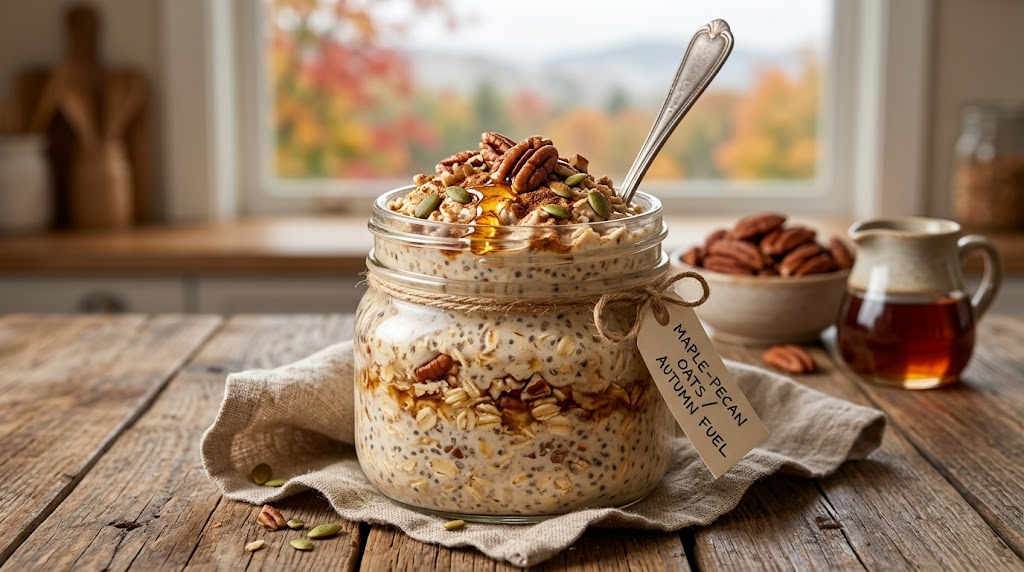
As autumn temperatures cool down morning workout routines, endurance athletes and lifters need a fueling solution that combines warm seasonal flavors with high-octane performance nutrition. Preparing maple pecan plant protein overnight oats offers a zero-cook, prep-ahead breakfast designed to deliver sustained metabolic energy and complete muscle recovery without gastrointestinal drag.
This seasonal recipe bridges exercise physiology with culinary precision. By leveraging β-glucan soluble fiber from rolled oats, this meal slows gastric emptying to ensure steady glucose kinetics. Fortified with a complementary pea-and-rice protein isolate blend and healthy fats from raw pecans, it hits the essential leucine threshold required to drive muscle protein synthesis while keeping your digestive system calm before early training sessions.
Nutritional Biochemistry: Beta-Glucans, Protein Complementarity & Lipid Kinetics
                         PRE-WORKOUT METABOLIC FUELING MATRIX
│                                                                                       │
│  Rolled Oats (Beta-Glucan) ──► Forms Viscous Gel ──► Steady Blood Glucose Delivery    │
│                                           │                                           │
│                                           ▼                                           │
│  Pea + Rice Isolate Blend  ──► Complete PDCAAS   ──► Hits ≥3.0g Leucine Threshold     │
│                                           │                                           │
│  Crushed Pecans (Monounsaturated) ──► Sustained Energy ──► Suppresses Cortisol Spikes │
Formulating an ideal morning endurance fuel requires balancing gastrointestinal transit speed, blood glucose dynamics, and amino acid availability:
β-Glucan Viscosity and Glycemic Control: Rolled oats contain rich concentrations of β-glucan, a soluble dietary fiber that forms a viscous matrix in the stomach. This slows carbohydrate enzymatic breakdown, lowering the glycemic index (GI) and providing a steady, long-lasting release of glucose into circulation during training.
Pea & Rice Isolate Complementarity: Pea protein is naturally high in lysine but lower in methionine, whereas brown rice protein is methionine-rich and lower in lysine. Blending them at a 70:30 ratio yields a complete amino acid profile with a Protein Digestibility-Corrected Amino Acid Score (PDCAAS) equivalent to whey, delivering over 3.0g of bioavailable leucine per serving.
Pecan Monounsaturated Fats: Crushed pecans contribute high-quality monounsaturated fatty acids (MUFAs) and gamma-tocopherols. These slow gastric digestion just enough to stabilize satiety while serving as an additional oxidative substrate during submaximal Zone 2 endurance blocks.
Head-to-Head: Standard Refined Cereal vs. Maple-Pecan Protein Overnight Oats
| Nutritional Metric | Standard Refined Breakfast Cereal + Almond Milk | Maple-Pecan Plant Protein Overnight Oats |
| Glycemic Index (GI) | High (GI > 75) | Low to Moderate (GI ~ 45-50) |
| Protein Content & Profile | Low (3-5\text{g}$ incomplete protein) | High (30-35g complete pea-rice blend) |
| Leucine per Serving | < 0.4g (Sub-threshold) | >/= 3.0g (Triggers mTORC1 synthesis) |
| Soluble Fiber ($\beta\text{-Glucan}$) | Minimal to none | High (3-4g per serving) |
| Digestive Comfort Pre-Workout | High risk of reactive hypoglycemia & crash | Sustained energy delivery without GI distress |
The Recipe: Maple-Pecan Plant Protein Overnight Oats
Prep Time: 5 minutes
Chilling Time: 4–6 hours (or overnight)
Yield: 1 Large Performance Serving
Ingredients
Base Complex Carbohydrate: 1 cup (90g) rolled thick-cut old-fashioned oats
Protein Isolate Matrix: 1 scoop (30g) unflavored or vanilla pea-rice protein isolate blend
Soluble Fiber & Liquid Base: 1.25 cups (300mL) unsweetened soy milk or pea milk (for additional natural protein)
Healthy Fat & Bioactive Topping: 2 tbsp (20g) raw pecans, roughly chopped
Micronutrient Booster: 1 tbsp (10g) chia seeds or ground flaxseeds
Natural Sweetener & Flavor: 1 tbsp (15mL) pure grade-A maple syrup, 1/2 tsp ground cinnamon, and a pinch of sea salt
                          PREPARATION INSTRUCTIONS
│                                                                             │
│  1. Combine Dry Ingredients  ──► Oats, Protein Powder, Chia, Cinnamon, Salt │
│  2. Whisk in Liquid & Maple  ──► Soy Milk + Pure Maple Syrup in Glass Jar   │
│  3. Seal and Refrigerate     ──► Chill 4+ Hours; Top with Crushed Pecans    │
Step-by-Step Instructions
Combine Dry Base: In a 16 oz wide-mouth glass mason jar, combine the rolled oats, plant protein isolate blend, chia seeds, ground cinnamon, and sea salt. Stir thoroughly with a fork to evenly distribute the protein powder and prevent clumping.
Incorporate Liquids: Pour in the soy or pea milk and pure maple syrup. Stir vigorously until all dry ingredients are fully submerged and integrated into a smooth liquid base.
Overnight Hydration: Seal the jar with a tight lid and place it in the refrigerator for at least 4 hours (ideally overnight) to allow the oats and chia seeds to absorb the fluid and fully gel the β-glucan fibers.
Garnish and Serve: In the morning, open the jar, give it a quick stir, and top with raw crushed pecans and an optional extra drizzle of pure maple syrup. Consume cold or warm gently in the microwave for 45 seconds.
Macronutrient & Micronutrient Profile
Calories: ~ 580 kcal
Protein: 34g (Supplying ~ 3.1g bioavailable L-leucine)
Carbohydrates: 68g (12g dietary fiber, 10g natural sugars)
Fats: 18g (2.5g saturated, 9g monounsaturated, 6.5g polyunsaturated Omega-3/Omega-6)
Key Micronutrients: High in Magnesium (140mg), Zinc (4.2mg), Iron (5.5mg), and Potassium (520mg)
Integrating Performance Nutrition with Science & Training
Pairing your morning fueling strategy with structured training blocks and holistic health frameworks ensures maximum adaptation:
Fall Base Building Fuel: Fuel long Zone 2 base rides using Fall Base Building & Fat Oxidation: Transitioning from High-Intensity Racing to Long Zone 2 Blocks.
Seasonal Carbohydrate Selection: Learn more about whole-food starches in Seasonal Root Vegetables and Ancient Grains: Optimizing Complex Carbs for Autumn Training.
Off-Season Muscle Accretion: Support heavy strength training using Autumn Bulking vs. Clean Recomposition: Avoiding Excessive Fat Gain During Off-Season Gains.
Winter Micronutrient Strategy: Keep your immune barrier peaked with Vitamin D3 Supplementation in Autumn and Winter: Supporting Immunity and Muscle Function.
Warm Evening Recovery Meal: Balance your prep-ahead breakfasts with our savory High-Protein Autumn Squash and Lentil Recovery Stew.
Ready to optimize your morning fueling, fine-tune your macronutrient timing, and achieve peak performance with evidence-based coaching? Explore how Online Fitness Coaching can help you achieve your goals today!
References
Burke, L. M., Hawley, J. A., Wong, S. H., & Jeukendrup, A. E. (2011). Carbohydrates for training and competition. Journal of Sports Sciences, 29(Suppl 1), S17–S27.
Gorissen, S. H. M., Crombag, J. J. R., Senden, J. M. G., Waterval, W. A. H., Bierau, J., Verdijk, L. B., & van Loon, L. J. C. (2018). Protein content and amino acid composition of commercially available plant-based protein isolates. Nutrients, 10(8), Article 1117.
Hou, Q., Li, Y., Li, L., Cheng, G., Sun, X., Li, S., & Tian, H. (2015). The metabolic effects of oat intake in patients with type 2 diabetes: A systematic review and meta-analysis. Nutrients, 7(12), 10369–10387.
Morton, R. W., Murphy, K. T., McKellar, S. R., Schoenfeld, B. J., Henselmans, M., Helms, E., Aragon, A. A., Devries, M. C., Banfield, L., Krieger, J. W., & Phillips, S. M. (2018). A systematic review, meta-analysis and meta-regression of the effect of protein supplementation on resistance training-induced gains in muscle mass and strength in healthy adults. British Journal of Sports Medicine, 52(6), 376–384.