
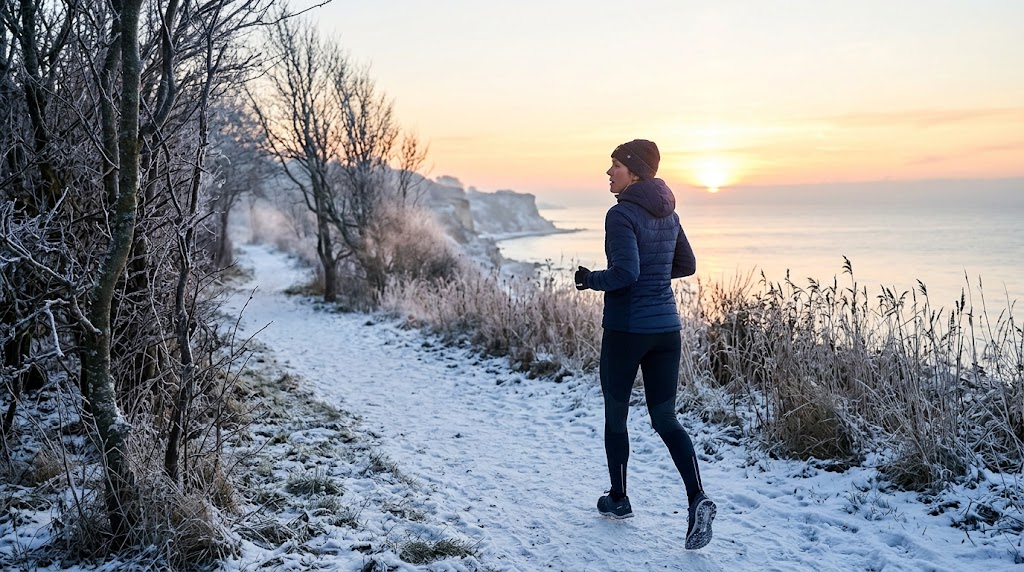
As autumn yields to winter, the dramatic reduction in daily sunlight creates a distinct physiological strain on endurance athletes and strength lifters. Navigating circadian alignment in shorter days is essential to prevent seasonal sluggishness, maintain core body temperature rhythms, protect parasympathetic recovery, and avoid performance drop-offs.
The body’s primary master clock—the suprachiasmatic nucleus (SCN) located within the hypothalamus—relies on precise environmental cues (zeitgebers) to calibrate endocrine output, autonomic nervous system (ANS) balance, and cellular repair processes. By leveraging targeted morning light protocols through intrinsically photosensitive retinal ganglion cells (ipRGCs) alongside structured evening wind-down strategies, plant-powered athletes can entrain robust circadian rhythms even during the shortest days of the year.
Neurobiology: Retinal Melanopsin, SCN Entrainment & Temperature Rhythms
                     CIRCADIAN ENTRAINMENT NEUROBIOLOGY
│                                                                          │
│  Morning Lux / Photons ──► Activates ipRGCs (Melanopsin Transduction)    │
│                                           │                              │
│                                           ▼                              │
│  Retinohypothalamic Tract ──► Entrains Suprachiasmatic Nucleus (SCN)     │
│                                           │                              │
│                                           ▼                              │
│  Cortisol Awakening Pulse ──► Triggers Daytime Core Body Temp Elevation  │
│                                           │                              │
│                                           ▼                              │
│  Nighttime Melatonin Release ──► Cools Core Body Temp & Drives SWS Repair│
Maintaining peak athletic readiness during seasonal light shifts requires managing three primary physiological pathways:
Retinal Melanopsin Signal Transduction: Intrinsically photosensitive retinal ganglion cells (ipRGCs) express the photopigment melanopsin, which is uniquely sensitive to blue-spectrum light (~ 460-480 nm). Morning light hitting the retina triggers an immediate signal along the retinohypothalamic tract directly to the SCN, suppressing melatonin synthesis and triggering the Cortisol Awakening Response (CAR).
Core Body Temperature (CBT) Rhythms: Athletic power output, nerve conduction velocity, and joint mobility peak alongside the natural circadian crest in core body temperature, typically occurring late afternoon (4:00 PM-7:00 PM). Shorter days flatten this temperature amplitude, leading to lethargy unless active zeitgebers (morning light and exercise) preserve peak temperature kinetics.
Autonomic Nervous System (ANS) Modulation: Irregular winter light exposure blunts vagal nerve stimulation, leading to nocturnal parasympathetic insufficiency, elevated resting heart rate (RHR), and reduced heart rate variability (HRV) during critical recovery windows.
Head-to-Head: Summer Light Entrainment vs. Winter Circadian Disruptions
| Physiological Parameter | Summer Natural Environment | Unmanaged Winter Environment | Optimized Winter Protocol |
| Morning Light Lux Intensity | Direct sunlight (10,000-100,000 lux) | Dim indoor lighting (200-500 lux) | Light box or outdoor exposure (10,000 lux) |
| Cortisol Awakening Response | Rapid, robust peak within 30 mins | Sluggish, delayed rise; morning brain fog | Sharpened via early photon density |
| Nighttime Melatonin Onset | Precise phase alignment | Delayed phase shift via night screen exposure | Accelerated via 480 nm blue light block |
| Core Body Temp Amplitude | High variation (1.0-1.5-degrees C range) | Blunted variation (feeling cold all day) | Restored via warm shower & active exercise |
| Deep Slow-Wave Sleep (SWS) | Optimal (20-25% of total sleep) | Fragmented (<15% SWS duration) | Maximized via evening cooling protocols |
—–
The Plant-Based Circadian Advantage: Chrono-Nutrition Protocols
Matching nutrient timing with circadian biology—termed chrono-nutrition—amplifies SCN signaling through peripheral tissue clocks in the liver and gastrointestinal tract:
                    CHRONO-NUTRITION ALIGNMENT MATRIX
│                                                                        │
│  1. Morning Tyrosine Sourcing ──► Soy, Seeds, & Grains for Dopamine    │
│  2. Midday Carbs / Energy Flux──► Fuels Core Body Temp Crest           │
│  3. Evening Tryptophan/Glycine──► Supports Serotonin-to-Melatonin Path │
Morning Tyrone and Catecholamine Synthesis: Consuming intact plant proteins rich in L-tyrosine (such as soy protein isolate, pumpkin seeds, and oats) at breakfast provides raw precursors for dopamine and norepinephrine synthesis, supporting morning alertness.
Evening Tryptophan and Complex Carbohydrate Matrix: Incorporating complex carbohydrates alongside L-tryptophan-rich foods (chia seeds, walnuts, legumes) during dinner stimulates insulin secretion. This lowers competing large neutral amino acids (LNAA), allowing tryptophan to cross the blood-brain barrier and synthesize serotonin and melatonin for night-time repair.
Magnesium Bisglycinate & Glycine Synergy: Supplementing with bioavailable magnesium bisglycinate in the evening promotes peripheral vasodilation, aiding the natural drop in core body temperature necessary to initiate slow-wave sleep.
Actionable Winter Circadian Optimization Protocol
Secure Early Photon Exposure: Within 30 minutes of waking, step outside for 10-15 minutes of direct natural light without sunglasses. If waking before sunrise, utilize a 10,000 lux bright-light therapy lamp placed 16-24 inches from your eyes for 20 minutes.
Implement an Artificial Dusk Protocol: Beginning 2 hours before bed, dim overhead lighting, activate blue-light blocking filters on devices, or wear amber-tinted blue-blocking glasses to preserve endogenous melatonin release.
Cool the Thermal Environment: Set bedroom temperatures to 62-66 degrees F (16-19 degrees C). Taking a warm shower 90 minutes prior to bed draws blood to the skin’s surface, accelerating core body heat loss upon stepping out and speeding sleep onset.
Integrating Circadian Biology with Training & Recovery
Pairing circadian alignment with wearable telemetry and periodized nutrition ensures peak recovery through the winter months:
Wearable Sleep Telemetry: Monitor how light management impacts deep sleep and recovery in Smartwatch Sleep Tracking in Winter: Analyzing Deep Sleep, HRV, and Overtraining Alerts.
Winter Micronutrient Support: Safeguard your seasonal health using Vitamin D3 Supplementation in Autumn and Winter: Supporting Immunity and Muscle Function.
Autumn Immune Resilience: Protect your mucosal barrier during dark training blocks via Autumn Immune Resilience: Whole-Food Protocols to Prevent Training Disruptions.
Chrono-Nutrient Morning Fueling: Start early training sessions with our Maple-Pecan Plant Protein Overnight Oats for Crisp Autumn Mornings.
Tracking Autonomic Stress: Measure nervous system adaptation to seasonal shifts in Heart Rate Variability: Useful Metric or Overhyped Tech?.
Ready to optimize your circadian rhythms, master seasonal sleep architecture, and elevate your winter performance with evidence-based coaching? Explore how Online Fitness Coaching can help you achieve your goals today!
References
Blume, C., Garbazza, C., & Spitschan, M. (2019). Effects of light on human circadian rhythms, sleep and mood. Somnologie, 23(3), 147–156.
Czeisler, C. A., & Gooley, J. J. (2007). Sleep and circadian rhythms in humans. Cold Spring Harbor Symposia on Quantitative Biology, 72, 579–597.
Halson, S. L. (2014). Sleep in elite athletes and nutritional interventions to enhance sleep. Sports Medicine, 44(Suppl 1), S13–S23.