
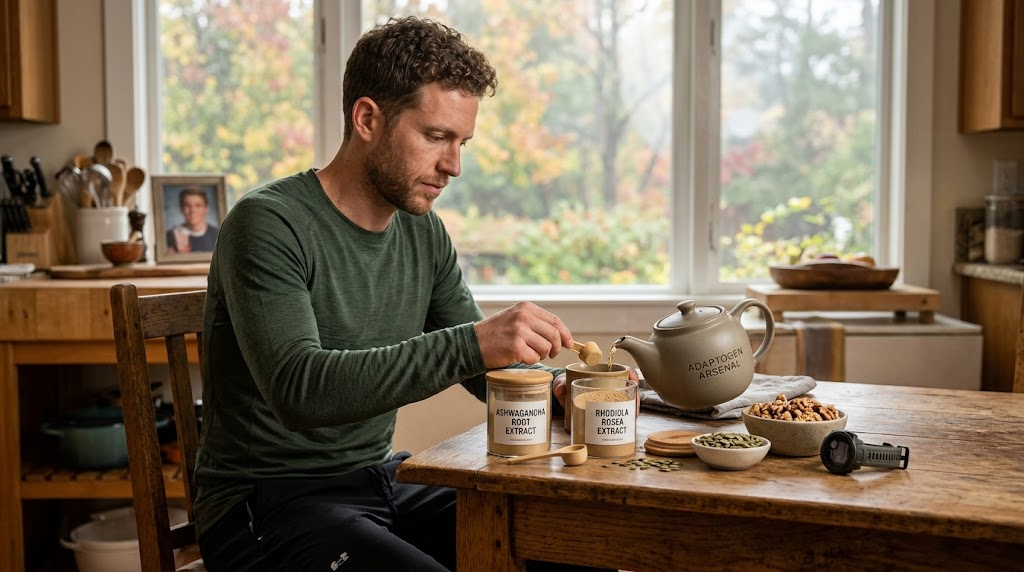
As daylight hours shorten and autumn temperatures drop, athletes often face a combination of increased central nervous system (CNS) lethargy, elevated perceptual exertion, and seasonal mood shifts. Deploying ashwagandha and rhodiola to combat autumn fatigue provides an evidence-based botanical strategy to stabilize physical output, dampen training-induced stress, and sustain seasonal motivation.
Rather than relying on central nervous system stimulants like high-dose caffeine—which can exacerbate underlying adrenal strain—standardized plant adaptogens target the hypothalamic-pituitary-adrenal (HPA) axis. By downregulating serum cortisol surges, buffering heat-shock proteins, and modulating monoamine neurotransmitters, these herbal bioactives accelerate physiological recovery during heavy off-season training blocks.
Neuroendocrine Biochemistry: HPA Axis Modulation & Cortisol Attenuation
                    ADAPTOGENIC HPA AXIS BUFFER MATRIX
│                                                                            │
│  Autumn Cold / Heavy Workload ──► Triggers HPA Axis & Cortisol Surge       │
│                                           │                                │
│                                           ▼                                │
│  Ashwagandha (Withanolides)   ──► Suppresses Excess Cortisol & CRH         │
│                                           │                                │
│                                           ▼                                │
│  Rhodiola (Salidrosides)      ──► Activates Neuropeptide Y & Serotonin     │
│                                           │                                │
│                                           ▼                                │
│  Systemic Adaptogenic Output  ──► Blunts Rating of Perceived Exertion (RPE)│
The ergogenic efficiency of plant adaptogens relies on their ability to regulate cellular homeostasis under physiological and environmental stressors:
Ashwagandha (Withania somnifera) & Serum Cortisol Attenuation: Standardized root extracts rich in withanolides inhibit excessive corticotropin-releasing hormone (CRH) signaling from the hypothalamus. Clinical trials show that high-concentration ashwagandha supplementation reduces resting serum cortisol by 23-30%, dampening muscle catabolism and protecting nocturnal heart rate variability (HRV).
Rhodiola Rosea (Rhodiola rosea) & Salidroside Kinetics: Rhodiola’s active bioactives—rosavins and salidrosides—stimulate the release and uptake of serotonin, dopamine, and norepinephrine in the CNS. Furthermore, salidrosides induce molecular stress-response proteins (such as Hsp70), preventing central fatigue during long Zone 2 endurance blocks and intense lifting sessions.
Reductions in Perceived Exertion (RPE): Acute administration of Rhodiola rosea has been demonstrated to significantly lower the Rating of Perceived Exertion (RPE) during endurance testing, allowing athletes to maintain higher power output despite seasonal fatigue.
Head-to-Head: Ashwagandha vs. Rhodiola Rosea Profile
| Physiological Parameter | Ashwagandha (Withania somnifera) | Rhodiola Rosea (Rhodiola rosea) |
| Primary Active Bioactives | Withanolides (e.g., Withaferin A) | Rosavins (3%) & Salidrosides (1%) |
| Primary Physiological Target | Adrenal cortex & GABAergic receptors | CNS monoamines & Heat-shock proteins |
| Best Timing of Administration | Evening / Post-workout (Calming) | Morning / Pre-workout (Energizing) |
| Impact on Sleep & HRV | Enhances deep sleep & vagal tone | Minimizes mental fatigue & exhaustion |
| Ergogenic Focus | Muscle strength, VO2max, & recovery | Explosive capacity, stamina, & focus |
—–
The Plant-Based Adaptogen Advantage: Synergy & Dosing Protocols
To maximize bioavailability and avoid botanical desensitization, implement an evidence-based supplementation structure:
                    DAILY ADAPTOGEN DOSING TIMELINE
│                                                                        │
│  Morning (Pre-Workout) ──► 200–400mg Rhodiola Rosea (Standardized 3/1) │
│                                           │                            │
│  Evening (Post-Meal)   ──► 300–600mg Ashwagandha (Full-Spectrum KSM-66)│
│                                           │                            │
│  Cycling Structure     ──► 5 Days ON / 2 Days OFF (8 Weeks On, 2 Off)  │
Morning Rhodiola Protocol for Training Energy: Take 200-400mg of Rhodiola rosea root extract (standardized to >/= 3% rosavins and >/= 1% salidrosides) 30-45 minutes prior to morning training or demanding work blocks.
Evening Ashwagandha Protocol for Recovery: Take 300-600mg of a full-spectrum root extract (such as KSM-66 or Sensoril) alongside dinner or an evening snack to downregulate evening cortisol and accelerate sleep onset.
Strategic Cycling to Preserve Sensitivity: Cycle adaptogens using a 5-days-on, 2-days-off weekly schedule for 8 to 12 weeks, followed by a 2-week washout phase to maintain receptor sensitivity.
Actionable Seasonal Stress Management Protocol
Track HRV and Resting Heart Rate: Use wearable telemetry to assess baseline parasympathetic status. High resting heart rate combined with low HRV indicates a need to increase adaptogenic recovery support.
Pair Adaptogens with Whole-Food Fueling: Avoid taking adaptogens on an empty stomach; pair them with complex carbohydrates or healthy plant fats to optimize gastrointestinal absorption.
Combine with Sunlight & Sleep Hygiene: Adaptogens amplify, but do not replace, fundamental recovery habits like morning light exposure and consistent sleep timing.
Integrating Botanical Science with Training & Recovery
Pairing adaptogens with structured nutrition, sleep tracking, and periodized training ensures complete off-season resilience:
Circadian Alignment Strategy: Combine adaptogens with light management in Circadian Alignment in Shorter Days: Optimizing Morning Light and Evening Wind-Down.
Wearable Telemetry Tracking: Monitor how adaptogens lower nocturnal stress via Smartwatch Sleep Tracking in Winter: Analyzing Deep Sleep, HRV, and Overtraining Alerts.
Winter Micronutrient Support: Pair your adaptogens with Vitamin D3 Supplementation in Autumn and Winter: Supporting Immunity and Muscle Function.
Autumn Immune Resilience: Protect your immune barrier during heavy training blocks using Autumn Immune Resilience: Whole-Food Protocols to Prevent Training Disruptions.
Chrono-Nutrient Morning Fuel: Start training days with our nutrient-rich Maple-Pecan Plant Protein Overnight Oats for Crisp Autumn Mornings.
Ready to build your adaptogen arsenal, master your recovery metrics, and elevate your autumn performance with evidence-based coaching? Explore how Online Fitness Coaching can help you achieve your goals today!
References
Bonilla, D. A., Moreno, Y., Gho, C., Petro, J. L., Odriozola-Martínez, A., & Kreider, R. B. (2021). Effects of Ashwagandha (Withania somnifera) on physical performance: Systematic review and meta-analysis. Journal of Functional Morphology and Kinesiology, 6(1), Article 20.
Chandrasekhar, K., Kapoor, J., & Anishetty, S. (2012). A prospective, randomized double-blind, placebo-controlled study of safety and efficacy of a high-concentration full-spectrum extract of ashwagandha root in reducing stress and anxiety in adults. Indian Journal of Psychological Medicine, 34(3), 255–262.
Ishaque, S., Shamseer, L., Bukutu, C., & Vohra, S. (2012). Rhodiola rosea for physical and mental fatigue: A systematic review. BMC Complementary and Alternative Medicine, 12, Article 70.
Noreen, E. E., Buckley, J. G., Lewis, S. L., Brandauer, J., & Stuempfle, K. J. (2013). The effects of an acute dose of Rhodiola rosea on endurance exercise performance. Journal of Strength and Conditioning Research, 27(3), 839–847.
Panossian, A., & Wikman, G. (2010). Effects of adaptogens on the central nervous system and the molecular mechanisms associated with their stress-protective activity. Pharmaceuticals, 3(1), 188–224.