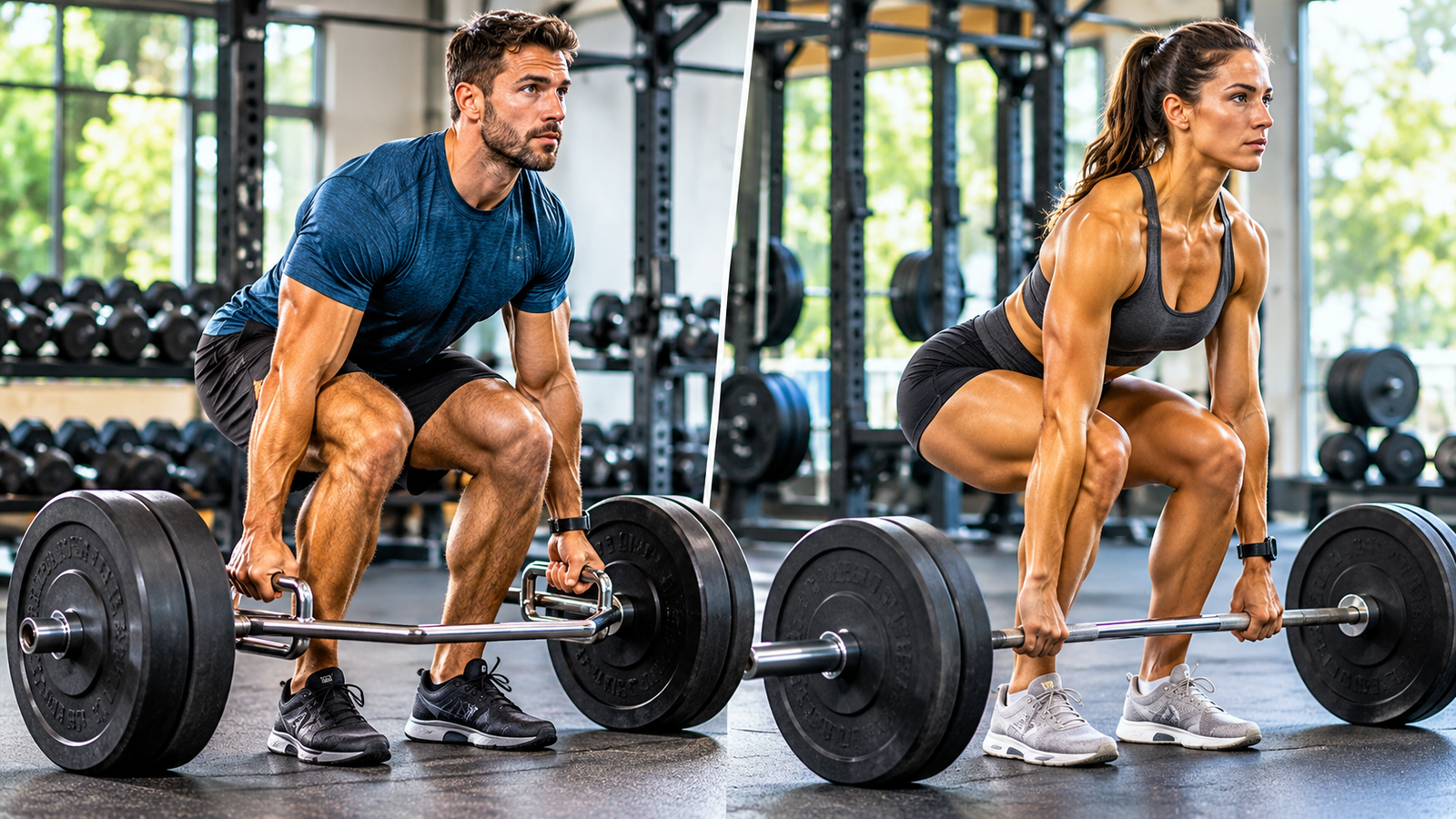
Trap bar vs. straight-bar deadlifts is a comparison worth understanding whether you’re trying to build muscle, improve athletic performance, get stronger after 40, or simply develop a more capable body without placing unnecessary demands on your lower back.
Both exercises are excellent compound movements. Both develop the muscles responsible for lifting, carrying, accelerating, and stabilizing the body. But they don’t distribute mechanical demands in exactly the same way.
The trap bar generally allows a more upright lifting position and often produces greater peak force and power in laboratory comparisons. The conventional straight-bar deadlift places the load in front of the body and typically requires a more pronounced hip hinge.
Does that make the trap bar safer? Is the straight bar better for building the posterior chain? And which one should you actually use?
The answer depends on your goals, anatomy, training experience, technique, and ability to recover.
Let’s look at what the biomechanics and research actually tell us.
1. Why Deadlift Selection Matters
The deadlift is one of the most effective exercises for developing whole-body strength.
It requires coordinated force production from the hips, knees, and ankles while the trunk muscles stabilize the spine and transfer force between the upper and lower body.
Depending on the variation, deadlifts can emphasize:
- Glutes: Hip extension and powerful lower-body movement.
- Hamstrings: Hip extension and control of the posterior chain.
- Quadriceps: Knee extension, particularly during more knee-dominant variations.
- Spinal erectors: Trunk stabilization and resistance to unwanted spinal movement.
- Core musculature: Bracing and maintaining trunk stiffness under load.
- Grip and forearms: Holding and controlling substantial external resistance.
These adaptations have value beyond the weight room.
For recreational lifters, stronger hips and legs support everyday activities such as lifting objects, climbing stairs, and carrying groceries.
For athletes, strength development can improve force production and provide a foundation for more explosive movements.
For endurance athletes, appropriately programmed resistance training can improve performance-related qualities without requiring excessive training volume.
Research examining maximal-strength training in distance runners found improvements in running economy following an eight-week intervention. This illustrates how developing strength can complement endurance performance, although results depend on the athlete and the overall program.
The goal isn’t to lift the heaviest possible weight at every opportunity.
It’s to develop useful strength that transfers to the activities you care about.
2. Understanding the Two Deadlift Variations
The most important difference between the two exercises is the position of the load relative to the lifter.
Conventional Straight-Bar Deadlift
The conventional deadlift uses a straight bar positioned in front of the athlete.
The lifter bends at the hips and knees, grips the bar, braces the trunk, and extends the hips and knees to bring the weight to a standing position.
This movement typically involves:
- Greater forward trunk inclination.
- A pronounced hip-hinge pattern.
- Substantial hip-extensor involvement.
- Significant spinal-erector stabilization demands.
- A relatively greater emphasis on posterior-chain mechanics.
The bar should remain close to the body throughout the lift.
Allowing it to drift forward increases the horizontal distance between the load and the relevant joint axes, increasing the external moment that the muscles must counteract.
Trap Bar Deadlift
The trap bar, also called a hex bar, allows the lifter to stand inside the frame.
Instead of holding the weight in front of the body, the hands are positioned alongside the hips.
This changes the relationship between the lifter and the load.
The movement generally allows:
- A more upright trunk position.
- Greater knee flexion.
- Greater quadriceps contribution.
- Strong gluteal and hip-extensor involvement.
- A more symmetrical load position around the body.
The trap-bar deadlift often feels like a hybrid between a squat and a conventional deadlift.
However, the exact movement pattern depends on the athlete’s body proportions, stance, handle height, and technique.
High-handle trap-bar deadlifts generally reduce the range of motion and may be more accessible to some beginners. Low handles increase the required range of motion and can make the exercise more demanding.
3. Lower-Back Loading: Is the Trap Bar Safer?
This is probably the most important question for people deciding between the two exercises.
The lower back experiences mechanical loading during both variations. This is normal.
The goal of strength training isn’t to eliminate spinal loading. It’s to develop the capacity to tolerate appropriate loading while managing technique, progression, and recovery.
Two important mechanical concepts help explain the differences.
Compression and shear
Compressive loading acts along the axis of spinal structures, while shear loading acts parallel to the relevant spinal surface, creating a tendency for adjacent structures to slide relative to one another.
Both occur during normal movement and lifting.
Neither measurement alone establishes whether an exercise is safe or harmful.
The importance of the moment arm
The horizontal distance between an external load’s line of force and a joint’s rotational axis influences the external moment that must be resisted.
The relationship can be simplified as:
External moment = Force × Perpendicular moment arm
When the load moves farther from the body, the moment arm generally increases.
This can increase the demand on the muscles responsible for stabilizing the trunk and controlling the movement.
Because the trap bar positions the lifter inside the frame, it can change the relationship between the load and the hips and trunk. The resulting lifting position often requires less forward trunk inclination than a conventional deadlift.
What the research shows
A 2011 biomechanical comparison found that the hexagonal-bar deadlift produced lower peak lumbar net moments than the straight-bar deadlift under several tested loading conditions.
However, the differences were not statistically significant at every load.
A 2022 narrative review of low-back biomechanics during repetitive deadlifting also found that lumbar loading depends on several factors, including load magnitude, bar type, handle height, and individual characteristics.
Importantly, the review identified limitations in the available research, including the lack of direct evidence establishing injury outcomes from repetitive deadlift training.
What does this mean in practical terms?
The trap bar may offer a more favorable mechanical position for some lifters, particularly those who find conventional deadlifting uncomfortable or difficult to perform consistently.
But lower modeled lumbar moments do not prove that the trap bar prevents back injuries.
Technique, training history, load management, and individual tolerance remain important with either variation.
Lower-back comparison
| Consideration | Trap Bar | Straight Bar |
|---|---|---|
| Typical trunk position | More upright | More forward inclination |
| Load position | Around the lifter | In front of the lifter |
| Knee contribution | Often greater | Often lower |
| Hip-hinge emphasis | Moderate to high | Generally higher |
| Lumbar moment | Often lower in tested conditions | Often higher in tested conditions |
| Technical learning curve | Often more accessible | Often more demanding |
| Injury prevention | Not established as superior | Not inherently unsafe |
—–
Bottom line: The trap bar can be a useful choice when managing lumbar loading is a priority. But neither variation guarantees lower-back protection.
4. Strength and Power: Which Deadlift Produces More?
Both exercises develop strength, but their mechanical differences can influence force and power production.
Power is the rate at which mechanical work is performed. In strength training, it reflects the combination of force and movement velocity.
A lifter doesn’t always need to move the heaviest possible load to develop power. The ability to produce substantial force quickly is also important.
What the research shows
A 2016 study comparing straight and hexagonal barbells examined muscle activation and power characteristics during deadlifting.
The researchers found greater peak force, peak power, and peak velocity with the hexagonal bar under the tested conditions.
They also observed differences in muscle activation patterns:
- Greater vastus lateralis activation with the hexagonal bar.
- Greater biceps femoris activation during the concentric phase with the straight bar.
- Greater erector spinae activation during the eccentric phase with the straight bar.
These findings support the idea that the two variations distribute muscular demands differently.
However, the study examined acute performance in a relatively small group of trained male lifters. It does not establish that long-term trap-bar training produces superior athletic performance for everyone.
Why power matters outside the gym
Power production contributes to everyday and athletic movements.
Examples include:
- Accelerating from a standing position.
- Climbing stairs quickly.
- Jumping and landing.
- Sprinting.
- Accelerating a bicycle out of a corner.
- Producing force during running strides.
For recreational athletes, developing power can help preserve physical capability as they age.
For endurance athletes, strength and power training can complement the repeated submaximal contractions required by their sport.
The trap bar is particularly attractive when the goal is to train force production through a relatively upright, coordinated hip-and-knee extension pattern.
The straight bar remains an excellent option for developing conventional hip-hinge strength.
5. Which Exercise Builds the Posterior Chain Better?
The posterior chain includes the muscles along the back of the body, particularly the glutes, hamstrings, and spinal erectors.
Both deadlift variations train these muscles.
The difference is not that one works the posterior chain and the other doesn’t. The difference is how much emphasis is placed on particular muscle groups and movement patterns.
Trap-bar deadlift
The trap bar generally allows more knee flexion and a more upright trunk position.
This can increase the relative contribution of the quadriceps while still providing substantial hip-extensor loading.
It is particularly useful for:
- General lower-body strength.
- Gluteal development.
- Force production.
- Power training.
- Lifters who prefer a more upright pulling position.
Conventional straight-bar deadlift
The conventional deadlift generally requires a more pronounced hip hinge.
It is particularly useful for:
- Hip-extensor strength.
- Posterior-chain coordination.
- Gluteal and hamstring development.
- Spinal-erector strength and stabilization.
- Developing proficiency in conventional deadlifting.
Don’t overlook complementary exercises
Neither deadlift needs to do everything.
If your goal is to develop the hamstrings under greater stretch, Romanian deadlifts may be an excellent addition.
If you want more single-leg strength, split squats and step-ups can address qualities that bilateral deadlifts do not emphasize as strongly.
A well-rounded program can combine a primary deadlift variation with complementary movements rather than relying on one exercise to develop every aspect of lower-body strength.
6. Which Deadlift Should You Choose?
Here is where the decision becomes practical.
Beginners
My recommendation: Start with the trap bar when available.
The trap bar often provides a more accessible introduction to loaded hip-and-knee extension.
Its more upright position and the ability to use high handles can make it easier for some beginners to learn the movement and gradually increase resistance.
A beginner should still learn proper bracing, controlled movement, and appropriate loading.
The straight bar is also a perfectly reasonable starting option when the individual can perform it comfortably and receives appropriate instruction.
Recreational lifters
My recommendation: Choose the variation that best matches your goals and feels consistently comfortable.
If your primary objective is general strength, muscle development, and physical capability, either variation can work.
Choose the trap bar if you prefer its movement pattern or want to emphasize a more upright pull.
Choose the straight bar if you enjoy conventional deadlifting and want to develop a more pronounced hip hinge.
You do not need to switch exercises simply because one is more popular or allows a heavier load.
Experienced strength trainees
My recommendation: Use both strategically if they serve different purposes.
Experienced lifters may benefit from alternating variations across training blocks.
For example:
- Trap bar during a power-development block.
- Straight bar during a hip-hinge strength block.
- Romanian deadlifts for additional hamstring emphasis.
There is no requirement to perform both variations in the same session.
Endurance athletes
My recommendation: Make the trap bar your default heavy pulling variation, particularly when managing fatigue and preserving endurance-session quality are priorities.
Endurance athletes need strength, but they also need to recover from cycling, running, swimming, and other sport-specific training.
The trap bar offers an effective way to develop substantial lower-body force while often allowing a more upright lifting position.
The straight bar remains useful for athletes who tolerate it well and want to develop conventional hip-hinge strength.
The important consideration is not simply which exercise is best in isolation. It is which exercise provides the desired stimulus without compromising the rest of the training program.
➡️ Strength Training for Endurance Athletes: What Actually Transfers
7. Programming Deadlifts for Strength Without Excessive Fatigue
More lifting does not automatically produce better results.
The goal is to provide enough training stimulus to improve strength while allowing sufficient recovery between sessions.
General programming guidelines
| Training goal | Sets | Reps | General emphasis |
|---|---|---|---|
| Maximal strength | 3–4 | 3–5 | Heavy, controlled lifting |
| General strength | 3–4 | 5–6 | Progressive overload |
| Power development | 3–5 | 2–3 | Fast, intentional repetitions |
| Strength maintenance | 2–3 | 3–5 | Preserve strength with less volume |
—–
These are starting guidelines, not universal prescriptions. Adjust the workload based on experience, technique, recovery, and training history.
Beginner example
- Trap-bar deadlift: 2–3 × 5–6
- Bodyweight split squat: 2 × 8 per leg
- Glute bridge: 2 × 10–12
- Plank: 2–3 sets
Focus on learning the movement before increasing the load.
General strength example
- Trap-bar or straight-bar deadlift: 3 × 4–6
- Romanian deadlift: 2 × 6–8
- Split squat: 2–3 × 6–8 per leg
- Core stabilization: 2–3 sets
Endurance athlete example
During a strength-development phase:
- Trap-bar deadlift: 3 × 4–5
- Romanian deadlift: 2 × 6–8
- Single-leg strength exercise: 2 × 6 per leg
- Core stabilization: 2 sets
During a demanding competition period:
- Trap-bar deadlift: 2 × 3–5
- Single-leg strength exercise: 2 × 5–6 per leg
- Core stabilization: 2 sets
For most athletes, stopping approximately 1–3 repetitions short of failure helps manage fatigue while maintaining a meaningful training stimulus.
Managing strength and endurance training
Research on concurrent resistance and endurance training explains how training volume, intensity, frequency, and scheduling can influence adaptation.
Practical guidelines:
- Avoid heavy deadlifting immediately before important interval sessions.
- Separate demanding lower-body lifting and key endurance workouts when possible.
- Reduce lifting volume during particularly demanding training weeks.
- Maintain strength with fewer sets during competition periods.
- Prioritize recovery rather than forcing additional volume.
Strength training should improve your physical capabilities, not consistently undermine the quality of your other workouts.
8. The Plant-Based Nutrition Connection: Iron and Oxygen Transport
Deadlifting develops strength and power. But if you’re also an endurance athlete, nutritional adequacy remains important for supporting the systems that produce and deliver energy.
One nutrient worth monitoring is iron.
Iron contributes to several essential physiological functions:
- Hemoglobin: The protein in red blood cells responsible for transporting oxygen.
- Myoglobin: The oxygen-binding protein found in skeletal muscle.
- Mitochondrial enzymes: Proteins involved in cellular energy production.
Iron is important for both endurance performance and normal muscle function.
Plant-based iron sources
Plant foods provide non-heme iron.
Although non-heme iron is generally less readily absorbed than heme iron, absorption varies depending on iron status and the composition of the meal.
A 2019 review of iron considerations for athletes highlights the importance of iron availability for oxygen transport and energy metabolism, particularly in endurance athletes.
Useful plant-based sources include:
| Food | Nutritional contribution |
|---|---|
| Lentils | Iron, protein, and fiber |
| Black beans | Iron, protein, and carbohydrates |
| Tofu and tempeh | Iron and plant protein |
| Pumpkin seeds | Iron and magnesium |
| Oats | Iron and complex carbohydrates |
| Quinoa | Iron and carbohydrates |
| Fortified cereals | Potentially concentrated iron source |
—–
Improve absorption with vitamin C
Vitamin C helps increase non-heme iron absorption.
Simple combinations include:
- Lentils with tomatoes.
- Black beans with bell peppers.
- Tofu with broccoli.
- Oatmeal with strawberries.
- Spinach with citrus.
Phytates, which naturally occur in legumes, whole grains, nuts, and seeds, can reduce non-heme iron absorption. Soaking, sprouting, and fermenting certain foods can reduce phytate content.
A simple iron absorption pathway
PLANT IRON SOURCES
Lentils | Beans | Tofu | Seeds | Whole Grains
                 |
                 v
           NON-HEME IRON
                 |
       +---------+---------+
       |                   |
       v                   v
   VITAMIN C             PHYTATES
   Enhances              Can inhibit
   absorption            absorption
       |                   |
       +---------+---------+
                 |
                 v
        INTESTINAL ABSORPTION
                 |
                 v
             IRON STATUS
                 |
        +--------+--------+
        |                 |
        v                 v
    HEMOGLOBIN         MYOGLOBIN
  Oxygen transport   Muscle oxygen storage
        |                 |
        +--------+--------+
                 |
                 v
       SUPPORTS NORMAL
       AEROBIC METABOLISM
One important clarification: consuming iron-rich foods does not rapidly increase oxygen-carrying capacity or immediately improve performance. The objective is to maintain adequate iron status over time and correct deficiencies when they occur.
Iron supplementation should not be automatic. If fatigue, declining performance, or other symptoms raise concern, discuss appropriate testing with a healthcare professional. Ferritin, hemoglobin, transferrin saturation, and other measures may be useful depending on the clinical context.
➡️ For a deeper discussion, see Plant-Based Diets and Iron Status in Athletes.
9. The Final Decision: Which Deadlift Is Best?
There is no universal winner.
Both exercises can develop substantial strength, train the posterior chain, and support athletic performance.
The trap bar often provides a more upright pulling position, greater knee contribution, and higher peak power in some laboratory comparisons.
The conventional straight bar offers a more pronounced hip hinge and remains an excellent option for developing hip-dominant strength.
Quick decision guide
| Your primary goal | Best starting choice |
|---|---|
| Learning to deadlift | Trap bar, often with high handles |
| General strength and fitness | Either variation |
| Building lower-body power | Trap bar |
| Developing conventional hip-hinge strength | Straight bar |
| Managing forward trunk inclination | Trap bar may be preferable |
| Training the posterior chain | Either, with complementary exercises |
| Endurance performance | Trap bar is often a practical default |
| Experienced conventional lifter | Continue straight bar if well tolerated |
—–
My recommendation
For most recreational lifters and endurance athletes, I favor the trap-bar deadlift as the default heavy pulling movement.
It offers an effective combination of lower-body strength development, power potential, and a lifting position that many people find easier to manage.
However, I would not discourage someone from using the conventional deadlift if they have good technique, tolerate it well, and enjoy the movement.
The best exercise is the one that matches your goals, allows consistent progression, and fits into a sustainable training program.
Final Takeaway: Build Strength That Serves Your Life
Deadlifts are not reserved for powerlifters or competitive athletes.
They are valuable tools for developing the strength needed to move, lift, carry, accelerate, and remain physically capable throughout life.
The trap bar may be the better starting point for many people, particularly those seeking a more upright pulling position or a practical way to develop lower-body power.
The straight bar remains an excellent choice for those who want to develop conventional hip-hinge strength.
Don’t choose an exercise based on the biggest weight you can lift or the latest training trend.
Choose it based on biomechanics, technique, individual tolerance, and the adaptations you actually want.
Then support your training with adequate recovery and a well-planned diet that provides sufficient protein, iron, and other essential nutrients.
Build strength. Move well. Recover intelligently.
That’s Plant-Powered Performance.
References
Camara, K. D., Coburn, J. W., Dunnick, D. D., Brown, L. E., Galpin, A. J., & Costa, P. B. (2016). An examination of muscle activation and power characteristics while performing the deadlift exercise with straight and hexagonal barbells. Journal of Strength and Conditioning Research, 30(5), 1183–1188.
Fyfe, J. J., Bishop, D. J., & Stepto, N. K. (2014). Interference between concurrent resistance and endurance exercise: Molecular bases and the role of individual training variables. Sports Medicine, 44(6), 743–762.
Ramirez, V. J., Bazrgari, B., Gao, F., & Samaan, M. (2022). Low back biomechanics during repetitive deadlifts: A narrative review. IISE Transactions on Occupational Ergonomics and Human Factors, 10(1), 34–46.
Sim, M., Burns, S. F., & Mano, T. (2019). Iron considerations for the athlete: A narrative review. European Journal of Applied Physiology, 119(7), 1463–1478.
Støren, Ø., Helgerud, J., Støa, E. M., & Hoff, J. (2008). Maximal strength training improves running economy in distance runners. Medicine & Science in Sports & Exercise, 40(6), 1087–1092.
Swinton, P. A., Stewart, A., Agouris, I., Keogh, J. W. L., & Lloyd, R. (2011). A biomechanical analysis of straight and hexagonal barbell deadlifts using submaximal loads. Journal of Strength and Conditioning Research, 25(7), 2000–2009.