
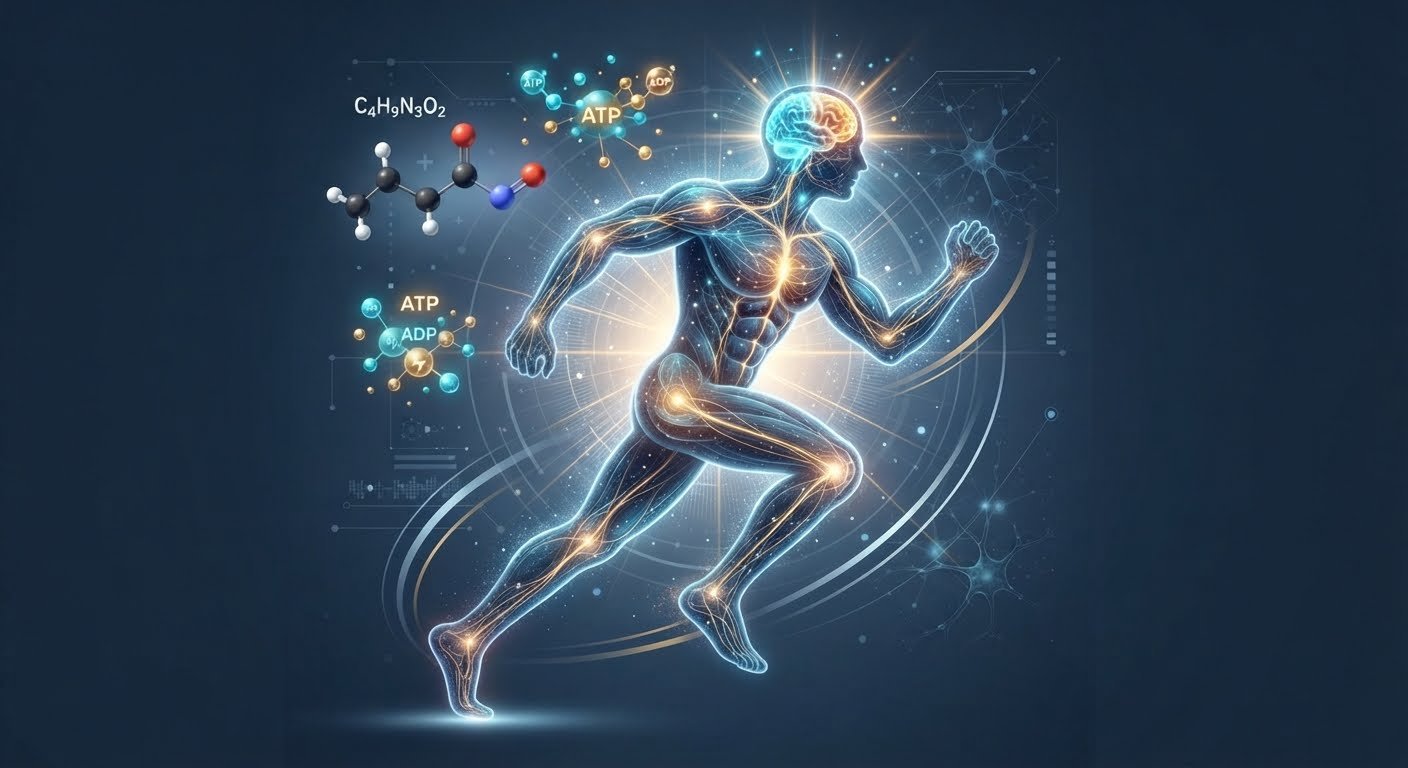
For decades, sports nutrition pigeonholed creatine monohydrate as a hyper-specific compound reserved exclusively for bodybuilding hypertrophy and short-duration power output. However, contemporary physiological science reveals benefits of creatine monohydrate beyond muscle. Recognizing why creatine isn’t just for bodybuilders—and how it can boost your mental sharpness, endurance capacity, and recovery—unlocks profound advantages for both neurological vitality and athletic longevity.
Research shows that creatine supplementation significantly elevates intracellular phosphocreatine pools not only in skeletal muscle but also within neural tissue, providing crucial metabolic buffering during high-demand states. By exploring phosphocreatine energy buffering in cerebral cortex tissue, ATP resynthesis kinetics during high-intensity cognitive and physical stress, and baseline creatine saturation differences in plant-based athletes, we can optimize both mental and physical performance.
Neurological & Metabolic Architecture: Brain Energy Buffering
            CEREBRAL PHOSPHOCREATINE & ATP BUFFERING CASCADE
│                                                                        │
│  Dietary Creatine Ingestion & Cellular Uptake (SLC6A8 Transporters)    │
│                               │                                        │
│                               ▼                                        │
│  Enzymatic Phosphorylation via Creatine Kinase (CK)                    │
│                               │                                        │
│                               ▼                                        │
│  Rapid ATP Resynthesis During High Cognitive or Physical Stress        │
│                               │                                        │
│                               ▼                                        │
│  Reduced Mental Fatigue, Preserved Working Memory & Enhanced Endurance │
The bio-energetic mechanisms governing cerebral and muscular creatine kinetics operate through precise enzymatic pathways:
The Creatine Kinase Reaction in Neural Tissue: The brain is an extraordinarily high-energy organ, consuming roughly 20% of the body’s resting oxygen despite accounting for only 2% of total mass. Research demonstrates that the brain utilizes the creatine kinase/phosphocreatine system to rapidly buffer fluctuations in adenosine triphosphate (ATPATP), maintaining cellular energy homeostasis during intense mental processing.
Cognitive Enhancement Under Stress: When subjected to sleep deprivation, hypoxia, or heavy cognitive loads, cerebral ATPATP reserves can become strained. A controlled investigation by McMorris et al. (2006) established that daily creatine supplementation improves performance in tasks requiring speed, mental agility, and memory by sustaining optimal cellular energy status.
Endurance Performance and Lactate Kinetics: Beyond the central nervous system, supplemental creatine maintains cellular energy flux across slow- and fast-twitch muscle fibers. Clinical reviews confirm that enhanced phosphocreatine availability delays the reliance on glycolytic pathways, buffering hydrogen ion accumulation and extending time to exhaustion.
Head-to-Head: Omnivorous vs. Plant-Based Creatine Saturation
The Plant-Powered Twist: Baseline Saturation and Neurological Benefits
             PLANT-BASED CREATINE SATURATION & UPTAKE DYNAMICS
│                                                                         │
│  Absence of Dietary Creatine in Vegan/Vegetarian Diets                  │
│                               │                                         │
│                               ▼                                         │
│  Lower Basal Intramuscular and Cerebral Creatine Pools                  │
│                               │                                         │
│                               ▼                                         │
│  Heightened Responsiveness to Daily Creatine Monohydrate Supplementation│
│                               │                                         │
│                               ▼                                         │
│  Maximal Cellular Energy Buffering and Superior Ergogenic Outcomes      │
Adopting a whole-food, plant-based diet offers immense cardiovascular and longevity benefits, but it inherently lacks dietary creatine, as plant foods contain virtually none:
Amplified Responsiveness in Plant-Based Athletes: Because omnivores ingest exogenous creatine through animal tissues, their baseline muscular and cerebral stores are partially filled. Research revealed that vegetarians and vegans exhibit significantly lower initial phosphocreatine reserves, rendering them markedly more responsive to creatine supplementation in both physical output and cognitive tests.
Cellular Longevity and Neuroprotection: Beyond athletic output, emerging gerontological studies highlight creatine’s role in supporting mitochondrial health and neuroprotection. As explored in our comprehensive review on Plant-Powered Longevity Healthspan Guide, maintaining robust cellular energy reserves is vital for long-term health span.
Synergy with Carbohydrate Influx: Pairing creatine ingestion with carbohydrate-rich whole foods enhances cellular uptake via insulin-mediated sodium-creatine cotransporter () activation. For ideal post-training fueling strategies, review our protocol in Eating After Exercising.
Actionable Creatine Supplementation Protocol
Establish a Consistent Daily Dose: Skip high-dose loading phases if they cause digestive discomfort. A simple, steady daily intake of 3 to 5 grams of pure creatine monohydrate fully saturates muscle and brain tissue.
Time Your Intake for Maximum Retention: Consume your daily creatine alongside a post-workout meal containing complex carbohydrates and plant proteins, supporting absorption pathways outlined in Where Do Vegans Get Their Protein?.
Track Cognitive and Physical Metrics: Combine creatine supplementation with rigorous training tracking and recovery monitoring, referencing insights from Heart Rate Variability: Useful or Overhyped?.
Integrating Creatine Protocols with Training & Recovery
Combine your creatine supplementation strategy with targeted performance resources across our site library:
Endurance Fueling Optimization: Enhance your aerobic capacity by reviewing Supplements for Vegan Endurance Athletes.
Recovery and Acidosis Management: Explore synergistic buffering agents in Beta-Alanine and Carnosine Loading.
Mitochondrial Health and Zone 2 Training: Support cellular energy production by reading Zone 2 Cardio for Longevity.
Comprehensive Supplement Guidelines: Browse our broader evidence-based evaluations in Top 5 Essential Supplements for Vegan Athletes.
References
Brosnan, J. T., & Brosnan, M. E. (2007). The role of dietary creatine. The Journal of Nutrition, 137(6), 1678S–1682S.
Burke, D. G., Chilibeck, P. D., Parise, G., Candow, D. G., Mahoney, D., & Tarnopolsky, M. (2003). Effect of creatine and weight training on muscle creatine and performance in vegetarians. Medicine & Science in Sports & Exercise, 35(11), 1946–1955.
Kreider, R. B., Kalman, D. S., Antonio, J., Ziegenfuss, T. N., Wildman, R., Collins, R., Candow, D. G., Kleiner, S. M., Almada, A. L., & Lopez, H. L. (2017). International Society of Sports Nutrition position stand: Safety and efficacy of creatine supplementation in exercise, sport, and medicine. Journal of the International Society of Sports Nutrition, 14(1), Article 18.
McMorris, T., Harris, R. C., Swain, J., Daley, J., Smith, M. K., Palmer, G., & Watson, M. (2006). Effect of creatine supplementation and sleep deprivation, with progressive exercise, on cognitive and psychomotor performance, mood, and plasma cortisol. Psychopharmacology, 185(1), 93–103.
Rae, C., Digney, A. L., McEwan, S. R., & Bates, T. C. (2003). Oral creatine monohydrate supplementation improves brain performance: A double-blind, placebo-controlled, cross-over trial. Proceedings of the Royal Society of London. Series B: Biological Sciences, 270(1529), 2147–2150.
Wallimann, T., Tokarska-Schlattner, M., & Schlattner, U. (2011). The creatine kinase system and pleiotropic effects of creatine. Amino Acids, 40(5), 1271–1296.