
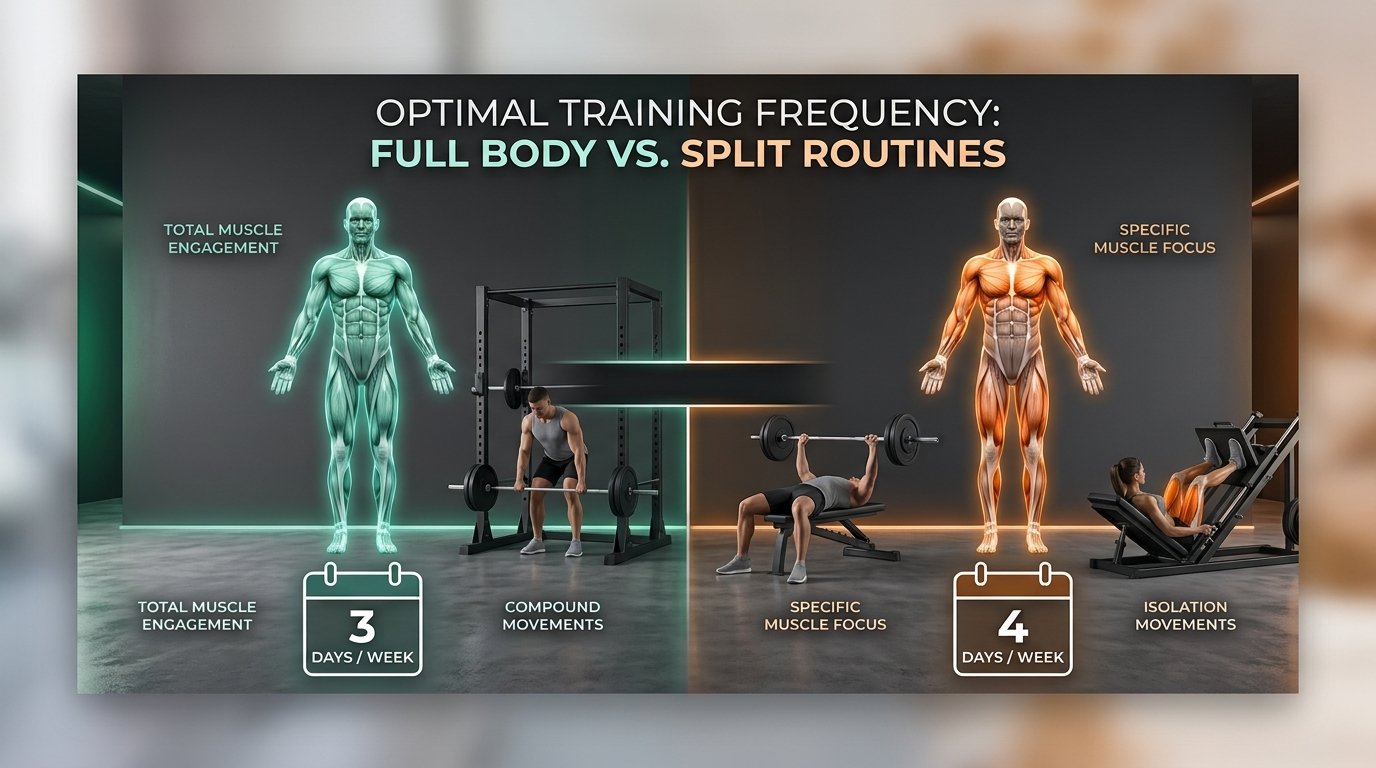
For busy non-professional athletes and serious lifters alike, the debate surrounding optimal training frequency remains one of the most persistent hurdles in program design. Should you hammer a muscle group once a week using grueling body-part splits, or distribute your total volume across frequent, shorter full-body sessions? Traditional bodybuilding dogma historically favored the high-volume bro-split, whereas modern exercise science demonstrates that muscle protein synthesis (MPS) remains elevated for only 24-48 hours post-exercise, suggesting a distinct advantage for higher frequencies.
When viewed through the lens of athletic recovery, this debate takes on an additional dimension. By incorporating polyphenol-rich, antioxidant-dense whole plant foods, plant-based athletes can mitigate exercise-induced muscle damage (EIMD) and accelerate systemic clearance of inflammatory byproducts. This enhanced recovery velocity allows for superior volume distribution and frequent muscle stimulation without running into chronic overtraining.
The Physiology of Muscle Protein Synthesis & Frequency
                    THE MPS WINDOW & FREQUENCY PARADIGM
│                                                                         │
│  Resistance Exercise Bout ──► Spikes MPS for 24–48 Hours                │
│                                           │                             │
│                                           ▼                             │
│  Low Frequency (1x/week)   ──► Long Inactive Period with Zero MPS Spike │
│  High Frequency (3x/week)  ──► Multiple Anabolic Spikes Across 7 Days   │
Muscle hypertrophy is driven by the cumulative frequency of protein synthesis spikes over a 7-day period:
The 48-Hour Anabolic Window: Following a resistance training session, MPS peaks and returns to baseline within 24-48 hours in trained individuals. Training a muscle only once per week leaves it in an unstimulated, non-growing state for the majority of the week.
Equating Weekly Volume Load: Landmark meta-analyses show that when total weekly volume (sets x reps x weight) is equated, training a muscle group 2 times per week yields superior hypertrophic outcomes compared to once-weekly isolation splits.
Minimizing Central Nervous System (CNS) Fatigue: Spreading sets across multiple sessions prevents excessive localized fatigue accumulation in a single workout, allowing for higher movement quality and mechanical tension execution.
Head-to-Head Frequency Paradigm Matrix
| Training Strategy | Weekly Frequency per Muscle | Primary Advantage | Primary Limitation | Ideal Athlete Profile |
| Full-Body Routines | 3-4 times / week | Maximizes MPS spikes; forgiving if a workout is missed | High systemic fatigue if volume per session is unmanaged | Time-restricted lifters & hybrid endurance athletes |
| Upper / Lower Splits | 2 times / week | Balances volume load per session with adequate recovery | Requires 4 consistent training days per week | Intermediate to advanced body composition athletes |
| Traditional Bro-Splits | 1 time / week | Allows extreme localized overload per muscle group | Sub-optimal 7-day MPS frequency; high muscle damage risk | Advanced bodybuilders prioritizing deep local fatigue |
—–
The Plant-Based Recovery Advantage: Mitigating EIMD
               PLANT-BASED RECOVERY & FREQUENCY SYNERGY
│                                                                        │
│  High-Frequency Training ──► Generates Recurring Localized Micro-Tears │
│                                           │                            │
│                                           ▼                            │
│  Plant Polyphenols (Berries/Tart Cherry) ──► Suppresses NF-κB & IL-6   │
│                                           │                            │
│                                           ▼                            │
│  Accelerated Clear-Out   ──► Clears Soreness Faster for Next Session   │
A common concern with high-frequency training (3-4 times/week full body) is managing delayed onset muscle soreness (DOMS) and exercise-induced muscle damage (EIMD). This is where a whole-food, plant-based diet provides a distinct biochemical advantage:
Suppressing Pro-Inflammatory Cytokines: Phytochemicals, anthocyanins from dark berries, and curcumin downregulate nuclear factor kappa B (NF-κB) and interleukin-6 (IL-6), blunting excessive systemic inflammation without blunting necessary local mechanical adaptation.
Accelerating Force Recovery: Plant bioactives enhance microvascular perfusion and nitric oxide availability, speeding up the clearance of metabolic waste products and allowing high-frequency lifters to bounce back faster between heavy sessions.
Actionable Training Frequency Blueprint
Adopt a 3-Day Full-Body or 4-Day Upper/Lower Split: Prioritize multi-joint compound lifts (squats, deadlifts, presses, rows) distributed across 3-4 weekly sessions to maximize anabolism (Schoenfeld et al., 2016).
Manage Per-Session Volume: Keep working sets per muscle group between 3-5 sets per session, stopping 1-3 reps shy of failure (RIR) to prevent crippling neuromuscular fatigue.
Fuel with Anti-Support Nutrients: Support frequent recovery by pairing your training schedule with recipes rich in antioxidants, such as our High-Protein Berry-Spinach Anabolic Recovery Smoothie.
Integrating Training Frequency with Science & Performance
Optimizing your weekly split requires coordinating your lifting schedule with proper nutrition, protein distribution, and recovery telemetry:
Mastering Progressive Overload: Ensure your frequent lifting sessions drive structural growth by reading How to Build Vegan Muscle: The Complete Science-Backed Guide.
Daily Protein Synthesis Targets: Review your exact essential amino acid requirements in How Much Protein Do Plant-Based Athletes Really Need?
Tracking Autonomic Recovery & Readiness: Monitor how frequent training impacts your nervous system in Heart Rate Variability: Useful Metric or Overhyped Tech?
Supporting Recovery with Plant Bioactives: Enhance tissue repair and reduce soreness using insights from Spermidine & Autophagy Activation: How Plant Compounds Stimulate Cellular Cleanup.
Ready to fine-tune your training frequency, split routines, and athletic performance with evidence-based coaching? Explore how Online Fitness Coaching can help you achieve your goals today!
References
Barnard, N. D., Goldman, D. M., Loomis, J., Kahleova, H., Levin, S. M., Neabore, S., & Tran, T. C. (2019). Plant-based diets for cardiovascular safety and performance in endurance sports. Nutrients, 11(1), Article 130.
Barstow, T. J. (2019). Understanding near-infrared spectroscopy and its application to skeletal muscle. Journal of Applied Physiology, 126(5), 1360–1369.
Phillips, S. M. (2014). A brief review of critical processes in exercise-induced muscular hypertrophy. Sports Medicine, 44(Suppl 1), 71–77.
Schoenfeld, B. J., Ogborn, D., & Krieger, J. W. (2016). Effects of resistance training frequency on measures of muscle hypertrophy: A systematic review and meta-analysis. Sports Medicine, 46(11), 1689–1697.