
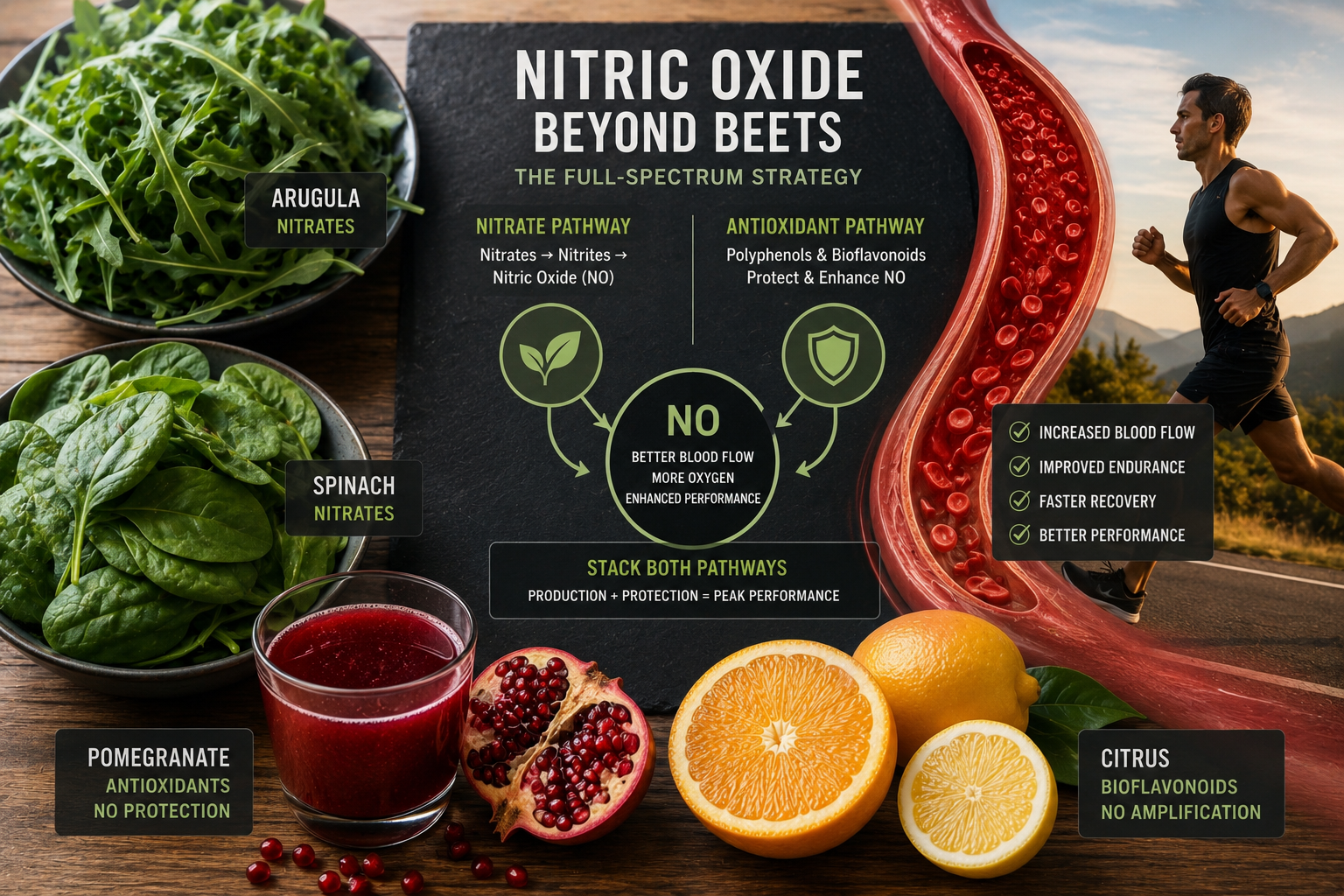
In the world of sports nutrition, “beets” have become synonymous with blood flow. While beet juice is a powerful tool, relying solely on one source is like training only your biceps—it ignores the functional complexity of the system. To achieve true vascular dominance, you need a Nitric Oxide beyond beets strategy that leverages the synergy between high-nitrate greens and antioxidant-rich bioflavonoids.
By stacking diverse plant pathways, you don’t just increase Nitric Oxide (NO) production; you protect it from degradation. This full-spectrum approach ensures that your vascular system remains dilated and efficient during the most demanding high-intensity bouts.
The Nitrate-Nitrite-NO Pathway
Most athletes understand that dietary nitrates are converted into nitrite by oral bacteria and then into Nitric Oxide in the acidic environment of the stomach and during exercise. While beets are famous for this, arugula actually contains a higher concentration of nitrates per gram.
However, the “Full-Spectrum Strategy” isn’t just about loading nitrates; it’s about preventing “superoxide” from neutralizing your NO. This is where stacking comes into play. According to a 2014 study, the timing and combination of macronutrients and specific micronutrients are critical for optimizing the metabolic environment for performance.
Stacking for Vascular Performance
To maximize the “pump” and endurance, you must combine two distinct pathways:
The Nitrate Donors: Arugula, spinach, and celery provide the raw inorganic nitrate.
The Antioxidant Protectors: Pomegranate and citrus bioflavonoids (like hesperidin) reduce oxidative stress.
Research indicates that polyphenols in pomegranates can prolong the half-life of Nitric Oxide by protecting it from oxidative destruction. Furthermore, other research shows citrus bioflavonoids improve endothelial function, ensuring that the “pipes” of your vascular system are flexible and responsive.
➡️ The Lactate Shuttle: Recycling Energy with Anthocyanins
Strategy: The Full-Spectrum Protocol
To implement a Nitric Oxide beyond beets protocol that actually moves the needle, follow this stacking guide:
The Pre-Workout Base: Consume a salad of arugula and spinach 2–3 hours before training.
The Catalyst: Add pomegranate arils or a citrus-based bioflavonoid supplement to your pre-workout stack.
Avoid the Wash: Do not use antibacterial mouthwash after your nitrate-rich meal; you need those oral bacteria to initiate the conversion of nitrate to nitrite!
➡️ The Thermic Effect of Plant Protein: Why Your Metabolism Prefers Peas Over Pasta
References
da Silva, A. A., do Carmo, J. M., Li, X., Wang, Z., Mouton, A. J., & Hall, J. E. (2020). Role of hyperinsulinemia and insulin resistance in hypertension: Metabolic syndrome revisited. Canadian Journal of Cardiology, 36(5), 706–717.
Ormsbee, M. J., Bach, C. W., & Baur, D. A. (2014). Pre-exercise nutrition: The role of macronutrients, modified starches and supplements on metabolism and endurance performance. Nutrients, 6(5), 1782–1808.
Willems, M. E. T. (2020). Anthocyanin-rich blackcurrant supplementation as a nutraceutical ergogenic aid for exercise performance and recovery: A narrative review. Nutrients, 12(11), 3498.
Willems, M. E. T., & Blacker, S. D. (2022). Anthocyanin-rich supplementation: Emerging evidence of strong potential for sport and exercise nutrition. Frontiers in Nutrition, 9, 864323.