
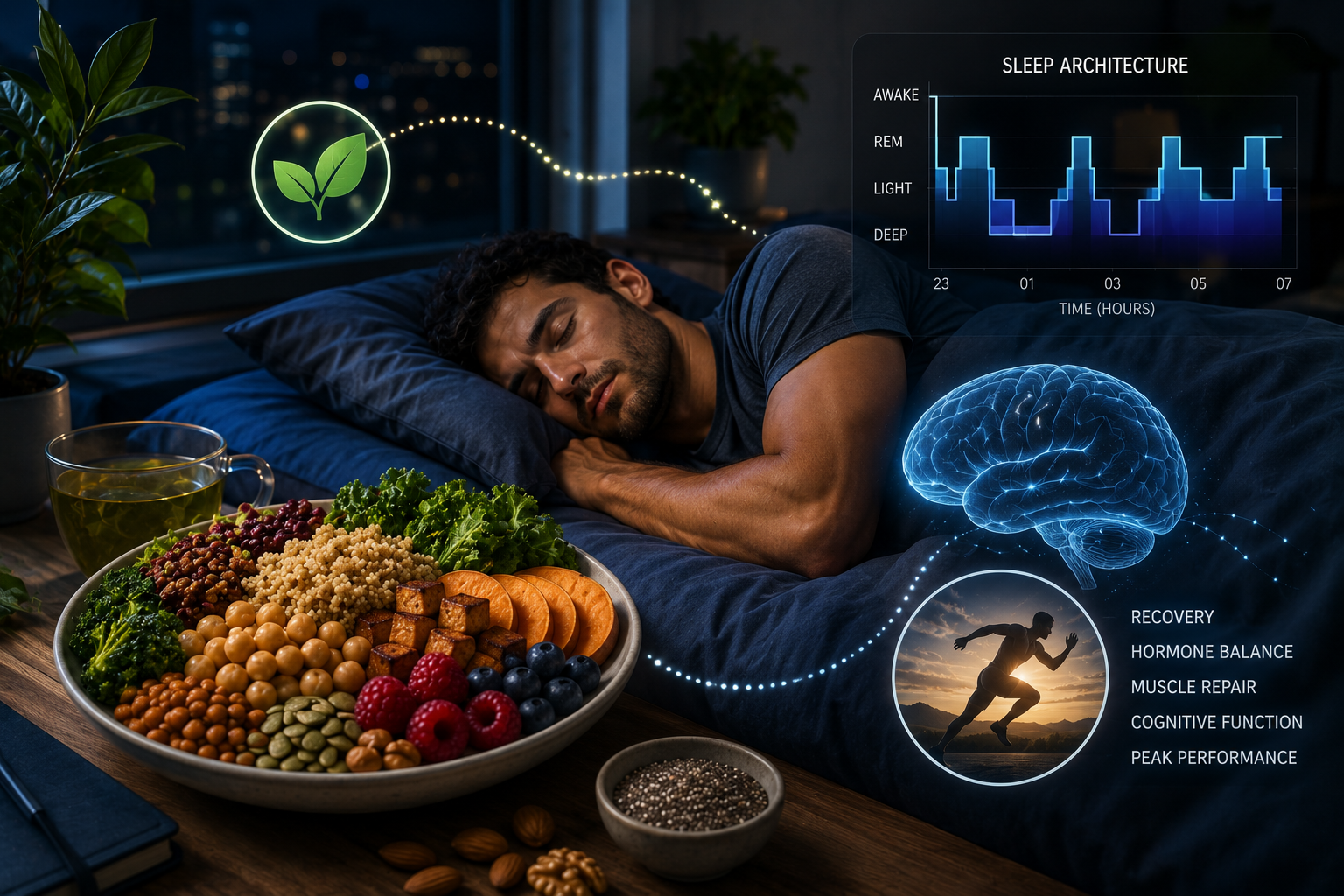
When athletes map out their recovery strategies, the focus almost always defaults to standard modalities: foam rolling, cold plunges, or targeted supplementation. Yet, the most critical recovery window in existence happens completely in the dark. Sleep is the ultimate human growth hormone injection, the baseline cleanser of metabolic waste, and the primary driver of neural restoration.
While total time spent in bed matters, true athletic progression relies on your internal sleep architecture—the complex, structural phases of light, deep (slow-wave), and rapid eye movement (REM) sleep.
Emerging research demonstrates that matching a clean, plant-based lifestyle with tactical nutrient timing shifts these sleep stages into high gear. By utilizing specific whole foods, you can optimize your internal circadian clock, balance your neural pathways, and accelerate your overall physical repair.
Understanding Your Internal Sleep Architecture
Your nightly rest is not a uniform block of unconsciousness. Instead, it operates on a series of predictable, 90-minute ultradian cycles divided into distinct physiological stages:
Sleep Cycle ──> N1 & N2: Light Sleep ──> N3: Deep Slow-Wave Sleep ──> REM Sleep
                                            (GH Release & Muscle Repair)    (Neural Integration)
1. Deep Sleep (N3 Slow-Wave Sleep)
This is the holy grail for physical recovery. During deep sleep, your blood pressure drops, breathing slows, and blood flow shifts heavily toward skeletal muscle tissue. This stage triggers the release of human growth hormone (HGH), driving cellular repair, tissue remodeling, and muscle protein synthesis.
2. REM Cycles
While deep sleep repairs your body, REM sleep repairs your mind. It is during REM cycles that your brain processes athletic motor skills, integrates movement patterns learned during training, and balances neurotransmitter stores.
If your nutrition is dysregulated, these cycles fracture. Diets high in animal protein—especially those heavy in saturated fats—tax the digestive system at night, keeping heart rate variability low, increasing micro-arousals, and shortening overall sleep efficiency.
Conversely, a recent 2026 study showed individuals leaning into clean, structured whole-plant nutrition patterns routinely show significant improvements in uninterrupted sleep duration and overall restorative sleep markers.
The Plant-Based Cellular Mechanism: Fiber and Deep Rest
Why does a plant-forward approach inherently support a superior night of rest? The physiological connection is built directly into the plant cell wall.
Large-scale data tracking real-time dietary entries alongside multi-stage wearable sleep recordings confirms that higher daily fiber density directly expands your percentage of restorative sleep stages. Clinical feeding trials corroborate this, showing that high dietary fiber intake is directly correlated with an increased proportion of time spent in deep, slow-wave sleep, alongside fewer mid-night awakenings. Because dietary fiber is found exclusively in plant foods, a menu centered on whole grains, legumes, and dense starches creates the biological baseline for long, deep sleep cycles.
Furthermore, high-protein and high-saturated-fat animal products require immense digestive workload, forcing your gastrointestinal tract to work overtime when it should be resting. This digestive burden elevates core temperature and disrupts the natural nocturnal dip required for sound sleep.
➡️ The Cortisol-Performance Connection: How Adaptogens Support Plant-Powered Resilience
Food as a Circadian Signal: Melatonin and Tryptophan Precursors
To systematically engineer your sleep patterns, you must consume the building blocks of the body’s primary sleep-inducing signaling molecules: Serotonin and Melatonin.
This conversion process relies on the essential amino acid tryptophan. However, simply consuming tryptophan isn’t enough; it must cross the blood-brain barrier.
Dietary Tryptophan ──> (Insulin Shift via Complex Carbs) ──> Brain Cross ──> Serotonin ──> Melatonin
When you pair plant-derived tryptophan with clean, complex carbohydrates, the resulting gentle insulin shift clears competing amino acids out of the bloodstream. This allows tryptophan to cross into the brain unhindered, boosting the natural synthesis of sleep-inducing hormones.
The Ultimate Nighttime Sleep Promoters
Tart Cherries: A rare, direct food source of exogenous melatonin. Systematic reviews demonstrate that consuming tart cherries significantly increases circulating melatonin levels, which directly enhances sleep efficiency and extends sleep duration via polysomnography markers.
Kiwifruit: Loaded with natural serotonin, nerve-calming potassium, and high-potency antioxidants, consuming kiwis in the evening directly decreases sleep latency.
Pumpkin Seeds and Walnuts: These matrices are loaded with plant-based tryptophan, melatonin, and magnesium—the mineral that activates GABA receptors to calm the central nervous system before bed.
➡️ The Thermic Effect of Plant Protein: Why Your Metabolism Prefers Peas Over Pasta
Protocol: Structuring Your Evening Recovery Stack
To leverage these sleep architecture pathways for recovery, use this practical nighttime fueling routine:
The Evening Transition (3 Hours Before Bed): Build your final large meal around high-fiber, slow-digesting carbohydrates like whole lentils, black beans, or brown rice. This stabilizes blood sugar and delivers a massive hit of plant-based magnesium and tryptophan to initiate relaxation.
The Circadian Micro-Snack (90 Minutes Before Bed): If you require a light snack to prevent middle-of-the-night hunger, blend a small serving of tart cherry juice with a tablespoon of chia seeds or chopped walnuts. The healthy omega-3 fatty acids and natural melatonin signal the brain that recovery mode has officially begun.
The Sunset Window Rule: Keep your carbohydrate timing strict. Avoid simple, highly refined sugars late at night, as they cause rapid glucose spikes that fragment your REM cycles and spike cortisol levels.
➡️ Circadian Rhythm and Glycogen: The Strategic Timing of Plant-Based Carbs
Plant-Powered Performance Takeaway: Muscle tissue does not grow when you are lifting weights; it grows when you are asleep. By transitioning your evening nutrition to emphasize high-fiber plant structures, clean tryptophan precursors, and natural melatonin donors, you optimize your internal sleep architecture. The result is a deeper state of slow-wave sleep, sharper neurological recovery, and a body primed for peak performance every single day.
References
Barforoush, F., Soltani, S., Clark, C. C. T., & Jalali, M. (2025). The effect of tart cherry on sleep quality and sleep disorders: A systematic review. Journal of Medicinal Food, 28(9), 882–891.
Ma, X., Zhao, Y., Zhao, W., Zhou, J., Ai, S., & Sun, T. (2026). Association between the planetary health diet and sleep health in older adults: findings from a national community-based study. Frontiers in Nutrition, 13, Article 1758298
Shkolnik, M., Sapir, G., Shilo, S., Talmor-Barkan, Y., Segal, E., & Rossman, H. (2026). Day-to-day dietary variation shapes overnight sleep physiology: a target-trial emulation in 4.8 thousand person-nights. medRxiv. Advance online publication.
St-Onge, M.-P., Roberts, A., Shechter, A., & Choudhury, A. R. (2016). Fiber and saturated fat are associated with sleep arousals and slow wave sleep. Journal of Clinical Sleep Medicine, 12(1), 19–24.