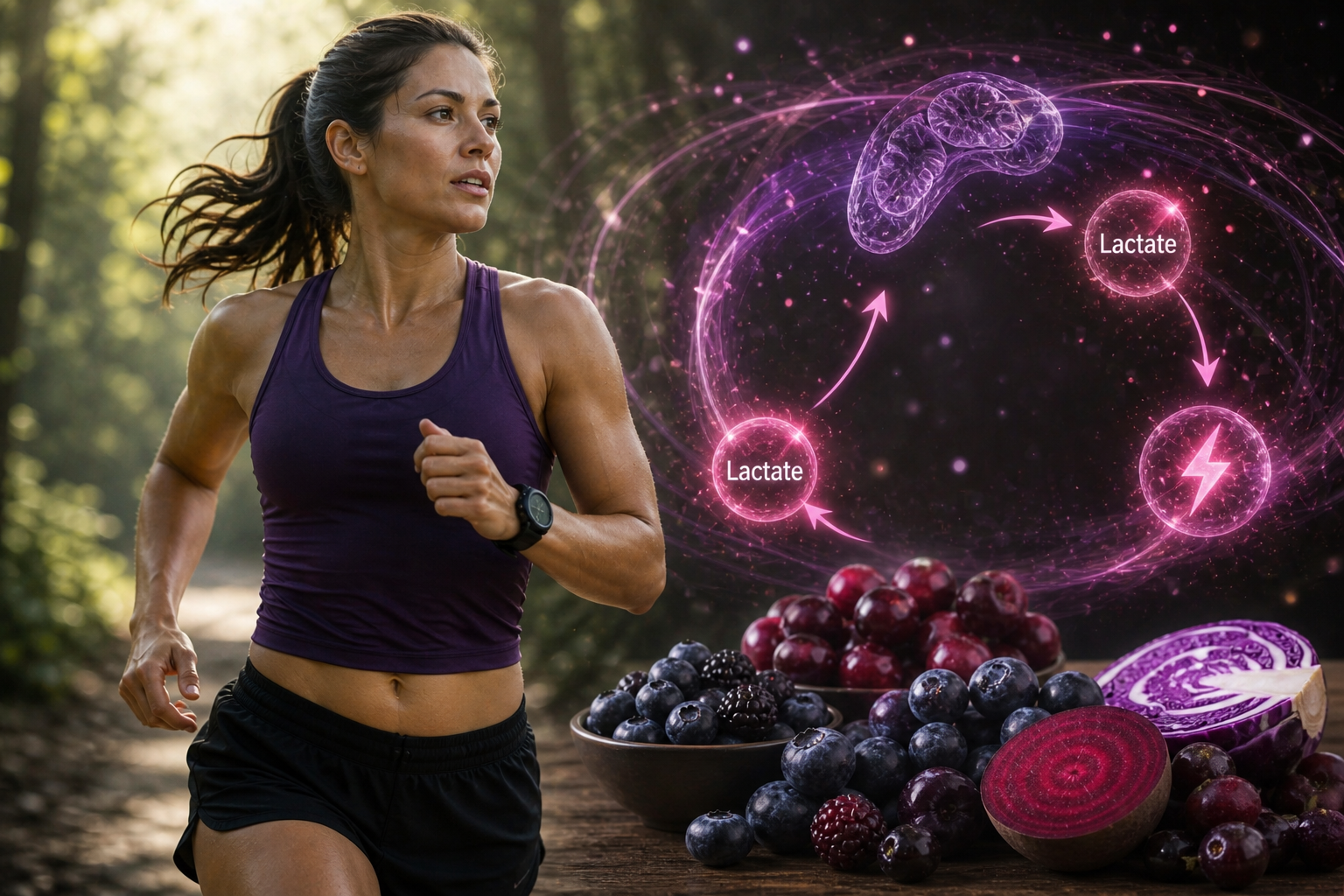
In the world of high-intensity training, “lactic acid” has long been the scapegoat for muscle failure. But modern sports science tells a different story: lactate is not a waste product, but a vital energy source. This biological recycling system, known as the Lactate Shuttle, is the key to maintaining power during high-intensity bouts.
For the plant-powered athlete, there is a strategic advantage hiding in dark-colored fruits like tart cherries. Anthocyanin-rich fruits can help your body master this shuttle, transforming a “burning” metabolite into clean, efficient fuel.
The Lactate Shuttle: Lactate as Fuel, Not Foe
The Lactate Shuttle hypothesis, pioneered by Dr. George Brooks, describes how lactate moves within and between cells to be used as an oxidative fuel. Instead of being a “metabolic dead-end,” lactate produced in fast-twitch fibers is shuttled to the heart, brain, and slow-twitch muscle fibers, where it is converted back into energy.
This process is critical during high-intensity exercise when glucose demands are high. Lactate provides a rapid means of distributing energy throughout the body, helping to even out energy distribution during exhaustive efforts.
How Anthocyanins Power the Recycling Process
Anthocyanins—the potent pigments found in tart cherries, blueberries, and blackcurrants—act as more than just antioxidants. They are emerging as ergogenic aids that specifically target metabolic pathways and blood flow.
Vascular Efficiency: Anthocyanins promote vasodilation and increased blood flow, which are essential for the systemic clearance and delivery of lactate to oxidative tissues.
Mitochondrial Support: These compounds support mitochondrial function and density, the very “factories” where lactate is oxidized for ATP production.
Reduced Glycolytic Stress: By enhancing the body’s ability to clear and recycle lactate, anthocyanin-rich fruits like tart cherries help maintain high-intensity performance without the premature fatigue often associated with “the burn”.
➡️ Beta-Alanine and Carnosine: The Plant-Based Performance Edge
Strategy: Implementing the Tart Cherry “Shuttle”
To maximize the Lactate Shuttle effect, consistency is key. Research suggests that 7 to 10 days of anthocyanin-rich supplementation can improve markers of recovery and potentially enhance anaerobic output.
For athletes looking to push their VO2 max, the combination of specific plant nutrients and the body’s natural energy-recycling systems creates a powerful synergy for longevity and performance.
➡️ The Plant-Based VO2 Max Blueprint: Fueling Longevity
References
Brooks, G. A. (2018). The science and translation of lactate shuttle theory. Cell Metabolism, 27(4), 757–785.
Fast Talk Labs. (2026, February 5). Lactate shuttle science: How Dr. George Brooks changed metabolism & performance [Video]. YouTube.
Leija, R. G., & Brooks, G. A. (2024). Enteric and systemic postprandial lactate shuttle phases and dietary carbohydrate carbon flow in humans. Nature Metabolism, 6(4), 670–677.
New Interval Training. (n.d.). The science: Science, new interval training, lactate shuttle, MCTs, George Brooks.
Willems, M. E. T. (2020). Anthocyanin-rich blackcurrant supplementation as a nutraceutical ergogenic aid for exercise performance and recovery: A narrative review. Nutrients, 12(11), 3498.
Willems, M. E. T., & Blacker, S. D. (2022). Anthocyanin-rich supplementation: Emerging evidence of strong potential for sport and exercise nutrition. Frontiers in Nutrition, 9, 864323.
Wikipedia contributors. (n.d.). Lactate shuttle hypothesis. Wikipedia, The Free Encyclopedia.
Recommended Video:
Lactate Shuttle Science with Dr. George Brooks This video is highly relevant as it features a deep-dive discussion into the revolutionary work of Dr. George Brooks, explaining exactly how the lactate shuttle rewrote the textbook on energy metabolism and high-intensity performance.