
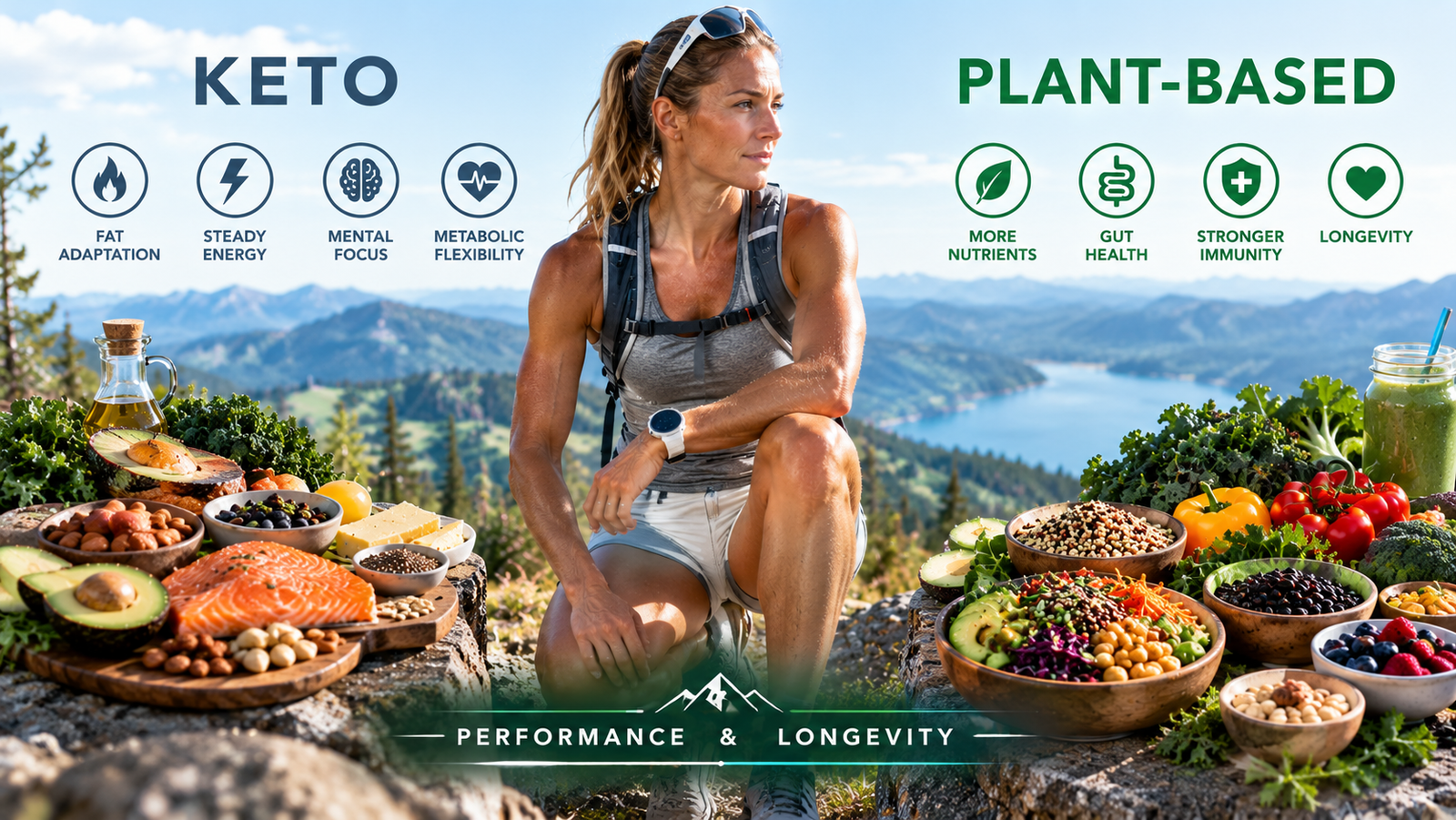
When choosing an eating strategy to optimize body composition, athletic performance, and long-term health, two contrasting dietary philosophies dominate the conversation: the high-fat, ultra-low-carbohydrate ketogenic (keto) diet and the nutrient-dense whole-food, plant-based (vegan) diet.
While the keto diet gained mainstream popularity for its rapid initial weight loss and appetite suppression, a deeper examination of nutritional biochemistry reveals critical limitations—particularly regarding glycolytic athletic performance, cardiovascular risk, and long-term metabolic health. Comparing a keto vs plant-based diet across physiological markers demonstrates why whole plant foods remain the superior choice for high-performing athletes and longevity seekers.
Physiological Overview: Ketosis vs. Carbohydrate Oxidation
                     METABOLIC PATHWAY COMPARISON
│                                                                         │
│  KETO DIET (70-75% Fat)          ──► Hepatic Ketogenesis (AcAc / βHB)   │
│                                   • Higher Oxygen Cost per ATP          │
│                                   • Impaired Glycolytic Capacity        │
│                                                                         │
│  PLANT-BASED (High Complex Carb) ──► Muscle Glycogen / Glucose Oxidation│
│                                   • Rapid ATP Resynthesis               │
│                                   • High Nitric Oxide & Endothelial     │
The Ketogenic State: Restricting carbohydrates to under 50 grams per day depletes liver and muscle glycogen stores. The liver oxidizes fatty acids into ketone bodies—primarily acetoacetate and β-hydroxybutyrate (βHB)—to serve as alternative fuel.
The Whole-Food Plant-Based State: Fueling with unrefined complex carbohydrates (legumes, grains, tubers, fruits) maintains filled glycogen stores while supplying dietary fiber, polyphenols, and inorganic nitrates that enhance nitric oxide bioavailability.
Head-to-Head Physiological Audit
| Health & Performance Pillar | Ketogenic Diet | Whole-Food Plant-Based Diet | Clear Advantage |
| High-Intensity Athletic Power | Impaired (Suppresses pyruvate dehydrogenase) | Superior (Maximal muscle glycogen availability) | Plant-Based |
| Cardiovascular & Arterial Health | Elevated LDL-C, ApoB, & endothelial stiffness | Lowers ApoB, improves flow-mediated dilation | Plant-Based |
| Gut Microbiome & Fiber Diversity | Severely depleted (Lacks fermentable fiber) | High SCFA production (Butyrate, Propionate) | Plant-Based |
| Insulin Sensitivity | Induces physiologic/pathologic insulin resistance | Improves peripheral & hepatic insulin sensitivity | Plant-Based |
| Initial Fat Loss & Appetite | High (Rapid water/glycogen loss & satiety) | High (High volume, low caloric density, GLP-1) | Tie / Context |
—–
Potential Benefits and Serious Drawbacks of the Keto Diet
Short-Term Benefits of Keto
Rapid Initial Weight Loss: Carbohydrate restriction drains muscle glycogen (which holds 3-4 grams of water per gram of glycogen), producing rapid initial water weight reduction.
Appetite Suppression: Elevated circulating βHB and high fat consumption suppress ghrelin (the hunger hormone), reducing spontaneous caloric intake.
Seizure Management: Clinically, ketogenic diets remain an effective therapy for refractory, drug-resistant pediatric epilepsy.
Critical Drawbacks & Risks of Keto
Impaired High-Intensity Performance: Ketosis downregulates pyruvate dehydrogenase, limiting the body’s ability to utilize glycogen during high-intensity, glycolytic training (sprints, heavy lifting, HIIT).
Atherogenic Lipid Profiles: High intakes of saturated fats (from butter, coconut oil, and animal fats) elevate apolipoprotein B (ApoB) and low-density lipoprotein cholesterol (LDL-C), accelerating arterial plaque accumulation.
Physiologic Insulin Resistance: Chronic carbohydrate deprivation induces “physiological insulin resistance” to preserve scarce glucose for the brain, blunting muscular glucose uptake.
Microbiome Starvation: Eliminating whole grains, legumes, and fruits starves beneficial gut bacteria, reducing short-chain fatty acid (SCFA) synthesis and impairing gut barrier integrity.
Why Whole-Food Plant-Based Is the Clear Winner for Athletes
In a landmark metabolic ward study conducted by the National Institutes of Health (NIH), researchers compared an ultra-low-carbohydrate keto diet directly against a low-fat, high-carbohydrate plant-based diet in a controlled environment:
                       NIH METABOLIC WARD FINDINGS
│                                                                         │
│  PLANT-BASED DIET ──► Lower Caloric Intake (-550-700 kcal/day)          │
│                   ──► Higher Total Fat Loss                             │
│                   ──► Favorable Postprandial Glucose & Insulin Response │
Greater Body Fat Loss: Despite consuming more carbohydrates, subjects on the whole-food plant-based diet lost significantly more actual body fat than those on the keto diet, who primarily lost lean body mass and body water.
Uncompromised Energy Output: Plant-based carbohydrates fully replenish liver and muscle glycogen, fueling rapid adenosine triphosphate (ATP) resynthesis during intense exertion without increasing oxygen cost.
Enhanced Vascular Endothelial Function: Rich in antioxidants, polyphenols, and dietary nitrates, plant-based diets promote flow-mediated dilation (FMD) and systemic circulation, accelerating post-workout recovery.
Long-Term Healthspan & Longevity: High fiber intake (40-60 g/day) supports gut microbiome diversity, lowers systemic inflammation, and significantly reduces the risk of cardiovascular disease, type 2 diabetes, and premature mortality.
Integrating Plant-Based Performance with Training
Transitioning to an evidence-based whole-food plant-based protocol allows you to optimize recovery, body composition, and athletic power:
Evaluating Whole Foods vs. Analogues: Learn how intact plant foods optimize metabolic health in Processed Vegan Meats vs Whole Foods: Performance & Health Audit.
Optimizing Anabolic Protein Targets: Ensure your plant-based diet satisfies amino acid needs for lean mass retention in How Much Protein Do Plant-Based Athletes Really Need to Build Muscle?.
Saturating Muscle Energy Stores: Combine complex carbs with proven ergogenic aids detailed in Creatine Monohydrate Saturation for Plant-Based Athletes.
Supporting Endogenous Clearing Pathways: Discover how plant antioxidants assist metabolic recovery in Dietary Detoxification: Supporting Endogenous Pathways Through Plant-Based Nutrition.
Ready to optimize your nutrition, body composition, and athletic performance with evidence-based plant-based coaching? Explore how Online Fitness Coaching can help you achieve your goals today!
References
Barnard, N. D., Goldman, D. M., Loomis, J., Kahleova, H., Levin, S. M., Neabore, S., & Tran, T. C. (2019). Plant-based diets for cardiovascular safety and performance in endurance sports. Nutrients, 11(1), Article 130.
Burke, L. M., Ross, M. L., Garvican-Lewis, L. A., Welvaert, M., Heikura, I. A., Forbes, S. G., Mirtschin, J. G., Cato, L. E., Strobel, N., Sharma, A. P., & Hawley, J. A. (2017). Low carbohydrate, high fat diet impairs exercise economy and negates the performance benefit from intensified training in elite race walkers. The Journal of Physiology, 595(9), 2785–2807.
Hall, K. D., Guo, J., Courville, A. B., Boring, J., Brychta, R., Chen, K. Y., Darcey, V., Forde, C. G., Gharib, A. M., Gallagher, I., Howard, R., Joseph, P. V., Milley, L., Ouwerkerk, R., Reis, C., Schick, A., Stagliano, M., Torres, S., Walter, M., … & Zhou, M. (2021). Effect of a plant-based, low-fat diet versus an animal-based, ketogenic diet on ad libitum energy intake. Nature Medicine, 27(2), 344–353.