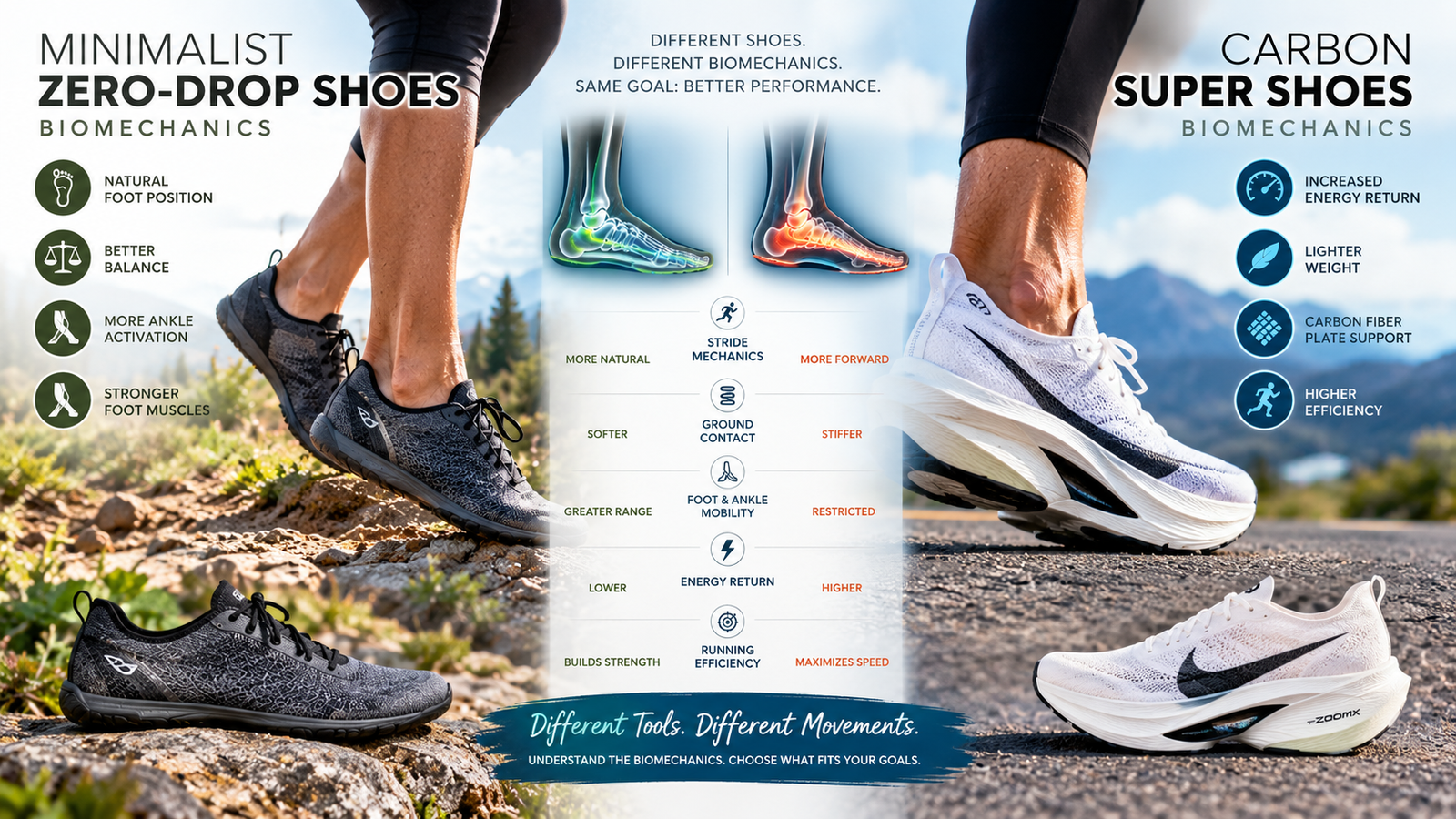
Footwear choices in modern athletics have diverged into two radically distinct technological paradigms: the minimalist movement—defined by minimalist zero-drop shoes with wide toe boxes and zero stack elevation—and the maximalist revolution, dominated by carbon-fiber-plated super shoes with ultra-compliant, high-rebound foams.
While endurance runners flock to thick-stacked super shoes to improve running economy, strength athletes and functional lifters increasingly lean toward zero-drop, ultra-thin footwear to optimize force transmission and foot muscle recruitment.
Evaluating minimalist zero-drop shoes alongside carbon-plated maximalist footwear through a biomechanical lens allows athletes to strategically deploy both technologies to maximize force production, enhance joint stiffness, and preserve tissue health.
The Biomechanical Continuum: Structural Control vs. Mechanical Energy Return
                   FOOTWEAR BIOMECHANICAL SPECTRUM
│                                                                        │
│  MINIMALIST / ZERO-DROP           MAXIMALIST / CARBON SUPER SHOES      │
│  • Stack Height: 3 - 10 mm        • Stack Height: 30 - 40 mm           │
│  • Heel-to-Toe Drop: 0 mm         • Heel-to-Toe Drop: 8 - 10 mm        │
│  • Active Muscle Recruitment      • Passive Energy Storage & Return    │
│  • High Proprioception & GRF      • Reduced Ankle Work / High Stiffness│
Human foot architecture consists of 26 bones, 33 joints, and over 100 muscles, tendons, and ligaments forming a dynamic arch system. How footwear interacts with ground reaction forces (GRF) alters neuromuscular firing and metabolic demand:
Minimalist Zero-Drop Mechanism: Places the calcaneus (heel) and forefoot on the exact same horizontal plane without arch support or motion control. This design forces the intrinsic foot musculature (abductor hallucis, flexor digitorum brevis) and ankle complex to stabilize the foot tripod actively.
Carbon-Plated Super Shoe Mechanism: Combines a stiff full-length carbon-fiber plate embedded within high-resilience polyether block amide (PEBA) foam. The curved carbon plate stiffens the first metatarsophalangeal (MTP) joint, creating a teeter-totter lever effect that reduces mechanical energy loss at the toes while the foam returns stored mechanical strain energy.
Head-to-Head Biomechanical Audit
| Mechanical & Kinetic Pillar | Minimalist Zero-Drop Shoes | Carbon-Plated Super Shoes | Optimal Application |
| Ground Reaction Force (GRF) Transfer | Direct, immediate force transmission with zero energy absorption loss | Dampened initial impulse; delayed force transfer curve | Minimalist (Lifting / Sprinting) |
| Intrinsic Foot Muscle Activation | High (Promotes intrinsic foot muscle hypertrophy and arch tone) | Low (Passive stabilization via high foam borders and rigid plate) | Minimalist (Gait Mechanics) |
| Running Economy & Metabolic Cost | Higher energetic cost at submaximal running speeds | 4-6% reduction in oxygen consumption (VO2) | Super Shoes (Race Day) |
| Proprioception & Sensory Feedback | Maximum tactile cutaneous receptor feedback from the sole | Suppressed sensory feedback due to thick PEBA foam stack | Minimalist (Neuromuscular Control) |
| Achilles Tendon & Calf Workload | High eccentric loading on gastrocnemius, soleus, and Achilles | Reduced ankle joint work; load shifted toward hips and knees | Strategic Rotation |
—–
Minimalist Zero-Drop Shoes: Biomechanics in Strength & Lifting
                  FORCE DYNAMICS IN STRENGTH TRAINING
│                                                                        │
│  Zero-Drop + Thin Sole  ──► Solid Base of Support (Tripod Foot)        │
│                                      │                                 │
│                                      ▼                                 │
│  Zero Compression       ──► Unfiltered Force Transfer into Ground      │
│                                      │                                 │
│                                      ▼                                 │
│  Wide Toe Box           ──► Metatarsal Splay & Proprioceptive Balance  │
During heavy multi-joint compound lifts—such as barbell squats, deadlifts, and overhead presses—force production depends on maintaining a rigid, stable interface with the floor.
Eliminating Compressible Energy Loss: Squatting or deadlifting in cushioned running shoes causes energy leakage as the foam compresses under load. Minimalist zero-drop shoes feature dense, thin rubber soles (3-8 mm) that eliminate squish, ensuring 100% of generated force transfers directly into the floor.
Proprioceptive Foot Tripod Alignment: A wide toe box allows the hallux (big toe) and metatarsals to splay naturally. This maximizes surface contact and activates the “foot tripod” (calcaneus, 1st metatarsal head, and 5th metatarsal head), improving balance and gluteal muscle recruitment.
Ankle Mobility & Posterior Chain Engagement: Zero-drop shoes require the ankle joint to move through its true, unassisted range of motion. Unlike elevated weightlifting shoes that artificially increase knee flexion, zero-drop shoes keep the center of mass over the midfoot, engaging the glutes, hamstrings, and erectors during hip-hinge movements.
Carbon-Plated Super Shoes: Biomechanics in Endurance & Running Economy
For endurance athletes and runners competing over long distances, carbon-plated super shoes alter gait kinematics to conserve metabolic energy:
                    SUPER SHOE ENERGY RETURN SYSTEM
│                                                                        │
│  Foot Strike  ──► PEBA Foam Compresses & Stores Mechanical Energy      │
│                                      │                                 │
│                                      ▼                                 │
│  Mid-Stance   ──► Stiff Carbon Plate Leverages Metatarsal Joint        │
│                                      │                                 │
│  Toe-Off      ◄── High Elastic Rebound Reduces Ankle Negative Work     │
Metatarsophalangeal (MTP) Joint Stiffening: The rigid carbon-fiber plate acts as a lever arm, restricting flexing at the MTP joints. This reduces the energy lost through toe bending and improves the mechanical leverage of the plantar flexors.
Resilient Energy Storage: Modern PEBA foams offer energy returns exceeding 80-89%, compared to older EVA foams (60-65%). This resilient cushioning returns mechanical strain energy directly to the runner during toe-off.
Reduction in Ankle Joint Mechanical Work: By absorbing impact and reducing the negative work performed by the calf-Achilles complex, super shoes delay muscular fatigue during marathon-distance events, allowing athletes to maintain their speed with a lower heart rate and reduced oxygen consumption.
Strategic Playbook: How to Rotate Footwear for Longevity & Performance
                    HYBRID ATHLETE FOOTWEAR PROTOCOL
│                                                                          │
│  Strength & Gym Work   ──► Minimalist Zero-Drop Shoes (100% Usage)       │
│  Daily & Zone 2 Runs   ──► Minimalist / Moderate Cushion (Build Strength)│
│  Key Speed & Race Day  ──► Carbon-Plated Super Shoes (Performance Edge)  │
Rather than viewing minimalist and maximalist shoes as opposing methodologies, hybrid athletes achieve optimal results by using each tool strategically:
Use Minimalist Zero-Drop Shoes for Strength Training & Warm-Ups: Wear barefoot or zero-drop shoes during all weight room sessions, plyometrics, and mobility work. This builds intrinsic foot strength, strengthens the plantar fascia, and solidifies your foundation.
Rotate Minimalist/Standard Shoes for Base Endurance Building: Complete 70-80% of daily aerobic Zone 2 runs in low-drop or minimalist footwear to maintain Achilles tendon stiffness and lower leg durability.
Deploy Carbon-Plated Super Shoes for Race Day & Key Workouts: Save carbon-plated super shoes for specific race-pace tempo sessions, time trials, and competition days to capture the 4% running economy bonus without over-stressing the hips or hamstring origin.
Integrating Footwear Tech with Training & Recovery
Optimizing your biomechanics with the right footwear works hand-in-hand with smart training metrics, targeted nutrition, and structural recovery:
Evaluating Wearable Biomechanics Data: Discover how to track ground contact time, stride rate, and strain metrics in How to Train Smarter with Fitness Wearables.
Monitoring Neuromuscular Fatigue: Learn how fluid status and mechanical stress impact athletic readiness in Heart Rate Variability: Useful Metric or Overhyped Tech?.
Precision Hydration Telemetry: Prevent muscle cramping during intense footwork sessions by applying insights from Wearable Sweat Sensors: The Science of Precision Hydration.
Connective Tissue Support for Athletes: Support tendon collagen synthesis and joint elasticity with evidence-based nutrition in Tendon and Connective Tissue Health on a Plant-Based Diet.
Ready to fine-tune your athletic biomechanics, footwear rotation, and personalized training plans? Explore how Online Fitness Coaching can help you achieve your goals today!
References
Burns, G. T., & Tam, N. (2019). Is it the shoes? A simple proposal for regulating marathon running shoes. British Journal of Sports Medicine, 53(8), 461–462.
Franklin, S., Grey, M. J., Heneghan, N., Liew, B., & Buurke, J. H. (2015). Barefoot vs common footwear: A systematic review of the kinematic, kinetic, and muscle activation differences during walking and running. Journal of Sport and Health Science, 4(3), 230–239.
Hunter, I., McLeod, A., Valentine, D., Low, T., Ward, J., & Hager, R. (2019). Running economy, mechanics, and marathon racing shoes. Journal of Sports Sciences, 37(20), 2367–2373.