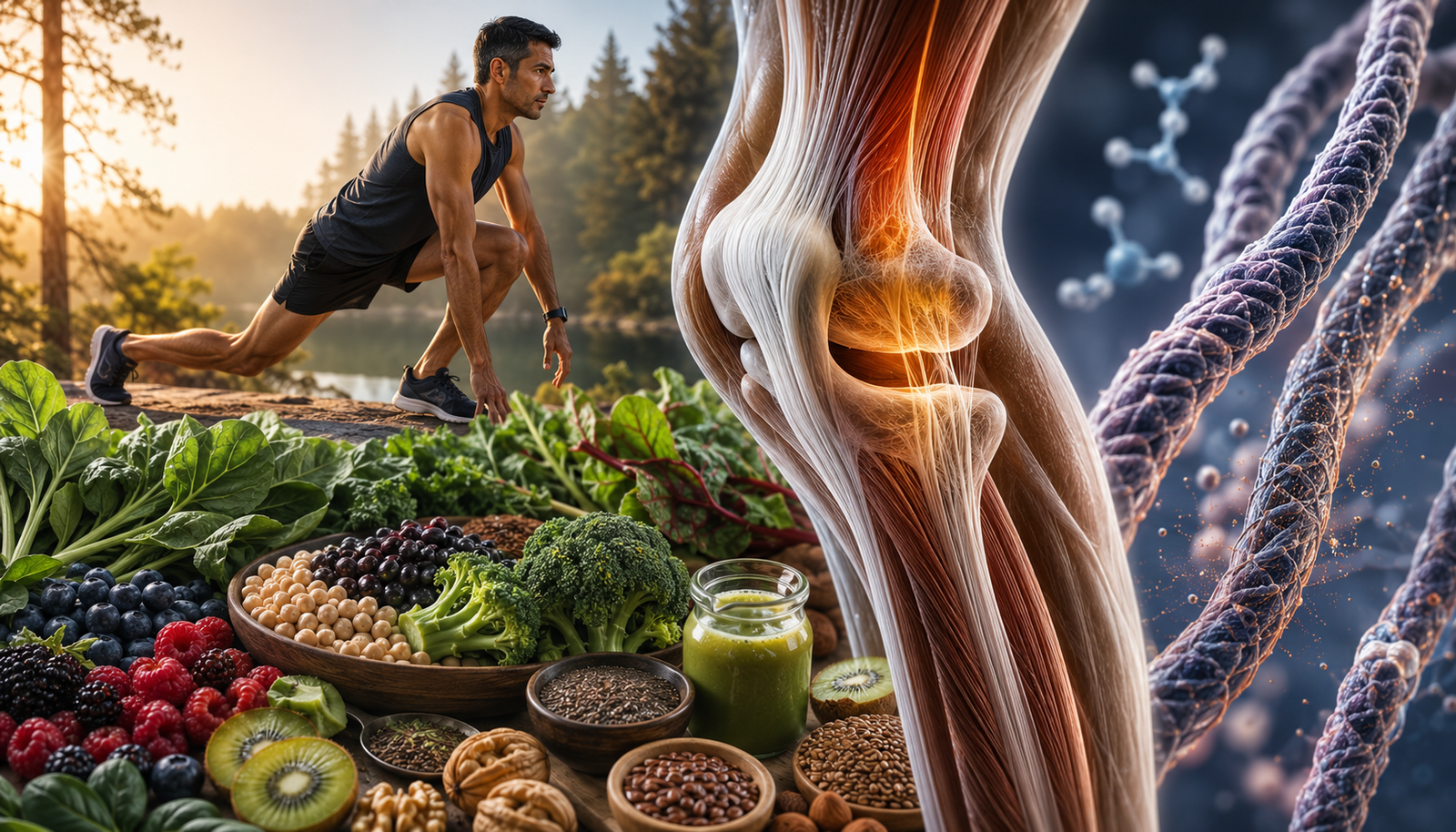
When endurance athletes and strength practitioners transition to plant-rich nutrition, a frequent concern centers on ligament resilience, joint integrity, and collagen turnover. Because commercial collagen supplements are derived exclusively from bovine, porcine, or marine extracellular matrix, many athletes wonder if animal tissue ingestion is mandatory to prevent overuse tendinopathies. However, human physiological research demonstrates that tendon & connective tissue health on plant-based diets can be fully optimized by supplying the foundational rate-limiting substrates—specifically key amino acids, trace minerals, and enzymatic cofactors—required for endogenous collagen synthesis.
1. Deconstructing Collagen: Endogenous Synthesis vs. Direct Intake
Collagen is the structural triple-helix protein that constitutes approximately 80% of the dry weight of human tendons and ligaments. A common physiological misconception is that humans must consume animal collagen to manufacture internal collagen tissue.
In reality, ingested collagen proteins are broken down by gastric pepsin and pancreatic proteases into individual amino acids, dipeptides, and tripeptides prior to intestinal absorption. The body does not transport intact collagen fibrils directly to musculoskeletal connective tissue; rather, fibroblasts take up circulating free amino acids to assemble new procollagen chains from scratch.
                       [ INGESTED PROTEIN / AMINO ACIDS ]
                                       │
                                       ▼
                       [ GASTRIC & INTESTINAL DIGESTION ]
                                       │
                                       ▼
                       [ FREE AMINO ACID POOL IN BLOOD ]
                      (Glycine, Proline, Lysine, Hydroxylysine)
                                       │
                                       ▼
                        [ TENDON FIBROBLAST UPTAKE ]
                                       │
        ┌──────────────────────────────┼──────────────────────────────┐
        ▼                              ▼                              ▼
 [ VITAMIN C COFACTOR ]      [ COPPER DEPENDENT LOX ]     [ SILICA STRUCTURE ]
 Prolyl / Lysyl             Enzymatic Cross-linking      Glycosaminoglycan
 Hydroxylase Action         for Tensile Strength         Matrix Stabilization
        │                              │                              │
        └──────────────────────────────┼──────────────────────────────┘
                                       │
                                       ▼
                     [ MATURE ENDOGENOUS COLLAGEN FIBRIL ]
The Rate-Limiting Amino Acid Triad
Human Type I collagen consists predominantly of a repeating sequence: Glycine – X – Y, where X and Y are frequently proline and hydroxyproline.
Glycine (~33% of collagen): The smallest amino acid, essential for tight spatial folding of the collagen triple helix. Rich plant sources include pumpkin seeds, sesame seeds, spirulina, soy protein isolate, and spinach.
Proline (~12–15% of collagen): Synthesized endogenously from glutamic acid and ornithine, but dietary intake accelerates turnover during heavy training blocks. Plentiful in legumes, peanuts, wheat germ, and buckwheat.
Lysine: An essential amino acid that serves as the base for intermolecular cross-linking. Plant foods like lentils, tempeh, black beans, and quinoa provide high concentrations.
2. The Micronutrient Quartet: Vitamin C, Copper, Silica, and Zinc
Supplying amino acids alone is insufficient for functional collagen maturation. Specific vitamins and minerals act as obligatory coenzymes without which procollagen chains cannot form strong, cross-linked fibrils capable of handling mechanical strain.
  [ Proline / Lysine Residues ] ──► [ Vitamin C + Fe2+ ] ──► [ Hydroxyproline / Hydroxylysine ] ──► [ Triple Helix Assembly ]
                                                                                                           │
  [ Mature Triple Helix ] ◄────── [ Copper-Dependent LOX ] ◄───────────── [ Extracellular Secretion ] ◄────┘
1. Vitamin C (Ascorbic Acid)
Vitamin C serves as the essential electron donor for prolyl 4-hydroxylase and lysyl hydroxylase—the intracellular enzymes responsible for converting proline and lysine into hydroxyproline and hydroxylysine. Without adequate intracellular ascorbic acid, un-hydroxylated collagen chains fail to form stable triple-helix structures and are degraded internally.
Target: Consuming 100–500 mg of Vitamin C alongside proline- and glycine-rich plant meals or 30–60 minutes prior to tendon-loading sessions maximizes collagen fractional synthetic rate.
2. Copper
Copper acts as an irreplaceable cofactor for lysyl oxidase (LOX), an extracellular enzyme that catalyzes the covalent cross-linking of collagen and elastin molecules. This cross-linking process grants tendons their high tensile strength and stiffness needed to transfer muscle force to bone.
Plant Sources: Cashews, sunflower seeds, dark chocolate, chickpeas, lentil sprouts, and shiitake mushrooms.
3. Silica (Orthosilicic Acid)
Silica facilitates the synthesis of glycosaminoglycans (GAGs) within the tendon extracellular matrix (ECM). GAGs attract water, providing compressive resistance and hydration to connective tissue sheaves.
Plant Sources: Horsetail extract, oats, brown rice, green beans, and silica-rich mineral water.
4. Zinc
Zinc is a critical cofactor for matrix metalloproteinases (MMPs), enzymes that govern the remodeling and turnover of damaged connective tissue following intense physical exertion.
Plant Sources: Pumpkin seeds, hemp seeds, tofu, lentils, and nutritional yeast.
3. Practical Plant-Based Protocol for Connective Tissue Synthesis
To maximize tendon stiffness and strain tolerance, combine mechanical loading (isometric or eccentric resistance exercises) with precise nutritional timing.
                       [ PRE-TRAINING TENDON PROTOCOL ]
                                (30-60 Min Prior)
                                       │
                                       ▼
                     [ 15-20g Plant Protein / Precursors ]
                         + [ 200-500mg Vitamin C ]
                                       │
                                       ▼
                       [ TARGETED ISOMETRIC LOADING ]
                        (e.g., Heavy Wall Sits, Heel Raises)
                                       │
                                       ▼
                    [ PEAK PRECURSOR DYNAMICS & NUTRIENT ]
                        DELIVERY TO AVASCULAR TENDON
Pre-Workout Tendon Precursor Smoothie Formula:
Glycine / Proline Base: 20g Pea/Rice Isolate Blend or 5–10g pure Glycine powder
Vitamin C Source: 1 cup strawberries/kiwi or 250mg L-ascorbic acid
Copper & Zinc Source: 2 tbsp pumpkin seed butter or hemp seeds
Silica Booster: 100mL silica-rich oat/grain extract or mineral water
Pair this nutritional input with 5–10 minutes of targeted isometric exercises (e.g., heavy leg extensions or calf holds) 30 to 60 minutes after consumption to drive blood flow and nutrient diffusion into the targeted tendon matrix.
➡️ Plant-Based Diet for Over 50: The Ultimate Guide to Longevity & Muscle
For endurance athletes managing total stress during high-volume training blocks, explore how systemic immune stability interacts with joint health in Plant-Based Diets and Immune Resilience Under Heavy Training Load.
Nutrient Synergy Matrix for Collagen Synthesis
| Nutrient | Primary Biochemical Function | Top Whole Plant Sources | Recommended Daily Target |
| Glycine | Direct structural constituent of collagen triple helix | Pumpkin seeds, spirulina, soy isolate, sesame seeds | 3-5 g/day (active athletes) |
| Proline | Imparts structural rigidity to procollagen strands | Legumes, peanuts, buckwheat, sunflower seeds | 2-4 g/day |
| Vitamin C | Hydroxylation cofactor for prolyl/lysyl hydroxylase | Guava, bell peppers, citrus fruits, broccoli, strawberries | 200-500 mg/day |
| Copper | Activates lysyl oxidase for covalent cross-linking | Cashews, dark cocoa, chickpeas, sesame seeds | 1.5-3.0 mg/day |
| Silica | Stabilizes extracellular matrix & GAG synthesis | Oats, green beans, horsetail tea, brown rice | 20-50 mg/day |
—–
Strategic Action Steps for Long-Term Joint Resilience
Time Your Precursors: Ingest a Vitamin C and amino acid-rich snack 30–60 minutes before heavy isometric or eccentric training sessions to maximize connective tissue uptake.
Prioritize Micronutrient Density: Ensure daily inclusion of copper- and zinc-rich seeds, legumes, and dark leafy greens to support enzymatic cross-linking.
Protect Sleep Architecture: Tendon repair and growth hormone secretion peak during slow-wave sleep. Implement environmental sleep controls using our 10 Science-Backed Tips to Improve Sleep Quality & Recovery.
Cultivate the Right Mindset: View recovery as an active, structural adaptation process. Learn how internal framing dictates consistency in What Is Your Story? Rewriting Internal Narratives for Fitness Success.
References
Baar, K. (2019). Stress relaxation and targeted nutrition to treat tendinopathy. British Journal of Sports Medicine, 53(4), 240–241.
Jugdaohsingh, R. (2007). Silicon and bone health. The Journal of Nutrition, Health & Aging, 11(2), 99–110.
Li, P., & Wu, G. (2018). Roles of dietary glycine, proline, and hydroxyproline in collagen synthesis and animal growth. Amino Acids, 50(1), 29–38.
Lis, D. M., & Baar, K. (2019). Effects of different vitamin C-enriched collagen derivatives on collagen synthesis. International Journal of Sport Nutrition and Exercise Metabolism, 29(5), 526–531.
Rucker, R. B., Kosonen, T., Clegg, M. S., Mitchell, A. E., Rucker, B. R., Uriu-Adams, J. Y., & Keen, C. L. (1998). Copper, lysyl oxidase, and extracellular matrix protein cross-linking. The American Journal of Clinical Nutrition, 67(5), 996S–1002S.
Shaw, G., Lee-Barthel, A., Ross, M. L., Wang, B., & Baar, K. (2017). Vitamin C-enriched gelatin supplementation before intermittent activity augments collagen synthesis. The American Journal of Clinical Nutrition, 105(1), 136–143.