No Need to Count Calories
The absolute quality of the food on your plate is far more important than arbitrary numbers. Calories don’t matter if the food quality sucks. Clinical data, such as the landmark DIETFITS Randomized Clinical Trial published in JAMA, demonstrates that prioritizing high-quality, whole foods leads to successful long-term weight management and metabolic improvements without the psychological stress of meticulous calorie tracking. Focus on nutrient density rather than math.
Don’t Make Your Nutrition Complicated
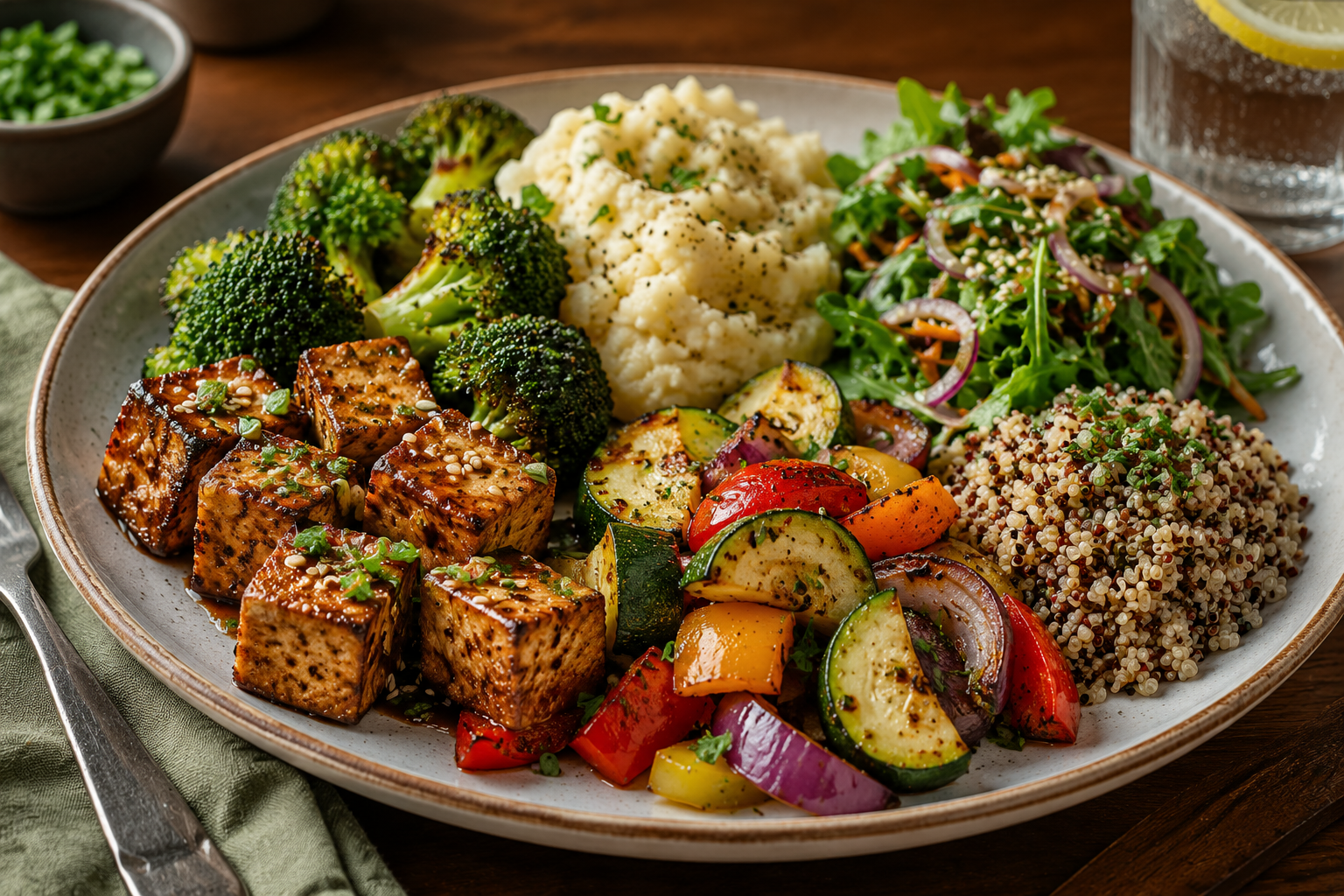
Stop overthinking your meals. Your plate should contain a colorful variety of vegetables and a palm-sized portion of lean protein. If you are an active man or have demanding training goals, you can easily scale that up to two palm-sized portions. Keeping protein consistent preserves lean tissue and naturally manages your appetite.
You Crave Sweets?
When a sugar craving hits, try snacking on some fresh or dried fruit after your meal to leverage natural fibers and micronutrients. Still craving sweets after that? Then go ahead and eat it mindfully. Restricting yourself completely only leads to eventual bingeing; allowing a bit of flexibility is what makes smart eating permanent.
What About After Your Workout?
True muscle building and recovery happen after your workout is over. Your foundational nutrition makes up about 75% of the entire muscle-building and fat-loss equation. A precise balance of carbohydrates and protein should be your primary focus post-workout. Carbohydrates act as the primary fuel source to replenish depleted muscle glycogen stores, while clean protein supplies the essential amino acids required for rebuilding damaged muscle fibers.
Have Cravings? Can’t Get Your Nutrition Plan Under Control?
If you feel entirely disconnected from your hunger cues, try a simple resetting experiment: eat only whole fruits, vegetables, whole grains, and clean meats for one single week. Completely eliminate added sugars, dairy, or ultra-processed foods, then evaluate how you feel. A highly cited study in Cell Metabolism proved that ultra-processed diets rapidly drive overeating and unwanted weight gain compared to unprocessed whole foods, even when total calories and macronutrients are perfectly matched. Removing these hyper-palatable triggers for seven days rewires your taste buds and natural satiety pathways.
What Is an Example of a Balanced Breakfast?
A perfect morning baseline doesn’t require culinary mastery. Try this combination:
Scrambled eggs tossed with your favorite seasonal vegetables
Toasted sprouted grain bread topped with real grass-fed butter
A piece of fresh fruit
This combination delivers a clean balance of highly bioavailable protein and complex carbohydrates to rebuild and refuel tired muscles from your overnight fast.
Is Plain Water Too Boring for You?
Did you know your body is made of 50% to 65% water, and it is absolutely vital for almost every single cellular function? The Harvard T.H. Chan School of Public Health emphasizes that proper hydration directly impacts everything from joint lubrication to cognitive clarity.
A practical baseline to shoot for is drinking half your body weight in ounces of water daily. For example, if you weigh 180 lbs, aim to drink 90 oz of water each day. If plain water doesn’t appeal to you:
Add fresh lemons, limes, and oranges to your water bottle.
Drink unsweetened seltzer if you prefer a bubbly texture.
Brew unsweetened green tea to get your fluids along with a potent dose of cellular antioxidants.
Don’t Have Enough Time to Eat Right?
The secret to avoiding fast food isn’t willpower; it’s basic preparation. Prep your vegetables every 3 to 4 days. This means cutting, washing, and cooking them ahead of time so they are ready to grab and eat the moment you get hungry.
A Quick Veggie Prep Method:
Par-boil green beans, broccoli, and cauliflower in very salty water for 2 to 4 minutes.
Quickly shock them in a prepared ice bath to stop the cooking process instantly before they get mushy.
This leaves them perfectly crisp, tasty, and ready to munch! Keep these cut fresh vegetables front and center in your fridge for a quick, guilt-free snack. Pair them with a little hummus for a healthy fat and protein boost to keep you fully satisfied between meals.
Take Control of Your Environment
If you keep a specific food inside your house, you will eventually eat it! You might as well have the good stuff waiting for you when cravings hit.
EAT LESS C.R.A.P.
C - Carbonated Sugary Drinks
R - Refined Sugars
A - Artificial Sweeteners & Colors
P - Processed Foods

EAT MORE F.O.O.D.
F - Fruits & Veggies
O - Organic, Clean Proteins
O - Omega-3 Fatty Acids
D - Drink Clean Water
Stop making it complicated! Give your body exactly what it needs. It really is that simple.
If you need a bit more physical structure and accountability to implement these habits, consider working directly with Dr. Mike’s Fitness Coaching. Our specialized program gives you access to a custom Nutrition Database and Meal Planner synced explicitly to your personal metabolic goals. The digital system allows you to:
Create a customized daily or weekly meal plan.
Let the automated system instantly build a meal plan around your favorite foods.
Easily exchange single ingredients or entire meals with a single click.
Access a massive library of macro-friendly recipes.
Compile an automated weekly shopping list for all the items required by your plan.
References
Adolphus, K., Lawton, C. L., & Dye, L. (2013). The effects of breakfast on behavior and academic performance in children and adolescents. Frontiers in Human Neuroscience, 7, Article 425.
Gardner, C. D., Trepanowski, J. F., Del Gobbo, L. C., Hauser, M. E., Rigdon, J., Ioannidis, J. P. A., Desai, M., & King, A. C. (2018). Effect of low-fat vs low-carbohydrate diet on 12-month weight loss in overweight adults and the association with genotype pattern or insulin secretion: The DIETFITS randomized clinical trial. JAMA, 319(7), 667–679.
Hall, K. D., Ayuketah, A., Brychta, R., Fletcher, H., Göstutürk, P., Zhou, M., Smith, S. L., Leeman-Castillo, I. E., Guo, J., Thony, C., Knuth, N. D., Walter, M., Walter, P. J., Cai, M. S., Maric, A., Miller, I. C., Huang, C. K., Nguyen, S. B., Coughlin, J. W., … Zhou, Z. (2019). Ultra-processed diets cause excess calorie intake and weight gain: An inpatient randomized controlled trial of ad libitum food intake. Cell Metabolism, 30(1), 67–77.
Harvard T.H. Chan School of Public Health. (n.d.). Water. The Nutrition Source.