
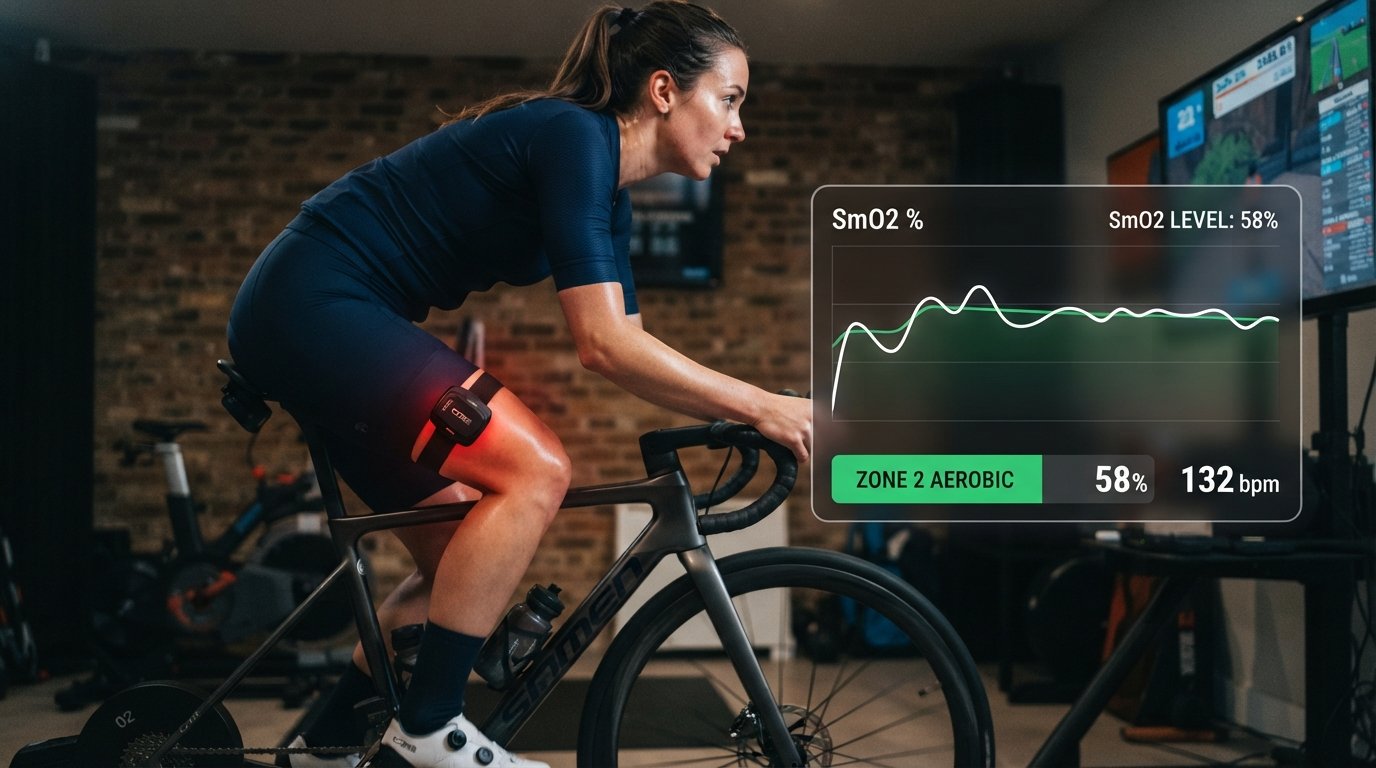
For endurance runners, cyclists, and hybrid athletes committed to precise physiological progression, traditional metrics like heart rate and power output tell only part of the story. While power measures mechanical output and heart rate reflects central cardiovascular response, neither metric reveals the actual metabolic stress occurring inside the working skeletal muscle tissue.
The advent of near-infrared spectroscopy sensors (or NIRS sensors)—portable wearable devices such as the Moxy Monitor or Humon Hex—has revolutionized endurance training. By projecting near-infrared light through the skin to measure localized muscle tissue oxygen saturation (SmO2) and regional blood volume, athletes can identify precise metabolic thresholds, quantify local oxidative capacity, and optimize Zone 2 aerobic training without invasive laboratory testing.
The Physiology of Localized Tissue Oxygenation (SmO2)
                     CENTRAL vs. LOCALIZED TELEMETRY
│                                                                         │
│  Central Metrics (Heart Rate / ECG) ──► Systemic Cardiovascular Lag     │
│  Local Metrics (NIRS / SmO2)        ──► Instantaneous Muscle O2 Balance │
│                                                                         │
│  The Local Equation:                                                    │
│  SmO2 = (Oxygenated Hemoglobin) / (Total Hemoglobin [Oxy + Deoxy])      │
When muscle fibers contract during exercise, they consume oxygen to produce adenosine triphosphate (ATP) via oxidative phosphorylation. NIRS technology evaluates this microvascular exchange in real time:
Penetrating Near-Infrared Light: Emitted wavelengths (650-1,00 nm) pass safely through skin and adipose tissue, reflecting off hemoglobin and myoglobin within the active capillary bed.
Calculating SmO2 Percentage: The sensor measures the dynamic ratio of oxygenated hemoglobin to total hemoglobin, displaying a live percentage (0-100%) representing how saturated the working muscle is at any given second.
Overcoming Cardiac Lag: Heart rate data suffers from physiological lag—it takes time for cardiovascular adjustments to register after changing pace. NIRS sensors capture instantaneous local oxygen uptake changes the moment muscle fiber recruitment shifts.
Head-to-Head Telemetry Comparison
| Telemetry Modality | Measured Variable | Primary Advantage | Limitation | Optimal Application |
| Heart Rate Monitors (ECG/PPG) | Systemic heart beats per minute | Ubiquitous, easy to interpret | Subject to cardiac drift, stress, and thermal lag | Overall training load tracking |
| Cycling Power Meters / GPS | Mechanical external work (Watts/ Speed) | Direct measure of physical output | Ignores internal physiological cost and fatigue state | Pacing time trials |
| Near-Infrared Spectroscopy (NIRS) | Local tissue oxygen saturation (SmO2) | Instantaneous, hyper-localized cellular metabolic feedback | Placement sensitive; requires data interpretation | Zone 2 threshold tuning & interval efficiency |
—–
Pinpointing Zone 2 and Aerobic Thresholds Without Blood Tests
Traditionally, finding exact aerobic thresholds required invasive laboratory blood lactate pinpricks. NIRS sensors provide an elegant non-invasive alternative by monitoring the balance between oxygen delivery and oxygen consumption:
                    NIRS DESATURATION CURVE DYNAMICS
│                                                                 │
│  Steady-State Zone 2     ──► Stable SmO2 Plateau (50-70%)       │
│  Threshold Cross-Over    ──► Continuous Inevitable SmO2 Decline │
│  High-Intensity Sprint   ──► Complete Local Deoxygenation (<20%)│
The Steady-State Zone 2 Plateau: During steady-state aerobic exercise, oxygen delivery matches mitochondrial consumption. On a NIRS data chart, SmO2 drops initially during the warm-up, then stabilizes into a flat plateau. This flat line confirms you are operating strictly within your sustainable Zone 2 aerobic window.
The Deoxygenation Threshold (DeOxT): When work rate increases past the first ventilatory threshold (VT1), muscle oxygen consumption outpaces capillary delivery. The SmO2 curve begins an unyielding downward slope. Identifying this precise inflection point allows endurance athletes to establish their exact training ceiling.
Evaluating Recovery Velocity: During active rest intervals, the speed at which SmO2 rebounds back toward baseline reflects mitochondrial oxidative capacity and microvascular reoxygenation efficiency.
Actionable NIRS Training & Fueling Protocol for Athletes
Once you equip a NIRS sensor on your primary working muscle group (e.g., vastus lateralis for cycling/running, or gastrocnemius for running), integrate these protocols:
                     NIRS OPTIMIZATION WORKFLOW
│                                                                         │
│  1. Baseline Calibration ──► Record resting SmO2 (70-85%)               │
│  2. Zone 2 Stabilization ──► Adjust pace/watts until SmO2 flattens      │
│  3. Nitrate Synergy      ──► Pair with plant nitrates to boost delivery │
Locking In Zone 2 Pace: Perform a progressive step test while watching your live SmO2 data field. The exact power output or pace where your SmO2 ceases to plateau and begins continuous decline marks your true aerobic threshold ceiling.
Synergizing with Plant-Based Nitrates: Dietary inorganic nitrates (found abundantly in beetroot and leafy greens) boost nitric oxide (NO) bioavailability, improving endothelial vasodilation and enhancing microvascular oxygen delivery to working muscle tissue. NIRS sensors allow athletes to measure the tangible impact of nitrate supplementation on tissue oxygenation recovery rates.
Optimizing Interval Rest Periods: Monitor your muscle reoxygenation slope between hard interval reps. Once SmO2 plateaus back near baseline, your cellular energy stores are primed for the next high-output effort.
Integrating NIRS Tech with Training & Recovery
Pairing advanced wearable biosensors with structured aerobic foundations and smart nutrition accelerates overall athletic performance:
Building Your Aerobic Engine: Master the foundational principles of aerobic base building by reading Low-Intensity Zone 2 Cardio for Plant-Based Athletes: A Beginner’s Guide.
Tracking Wearable Telemetry & Strain: Learn how to combine local muscle oxygen data with central recovery scores in How to Train Smarter with Fitness Wearables.
Precision Intra-Workout Hydration: Prevent neuromuscular fatigue during long NIRS-tracked endurance sessions using insights from Wearable Sweat Sensors: The Science of Precision Hydration.
Plant-Based Protein & Muscle Recovery: Protect your muscle tissue between endurance blocks with guidelines from How to Build Vegan Muscle: The Complete Science-Backed Guide.
Ready to integrate cutting-edge biosensor telemetry, precision Zone 2 training, and evidence-based plant-based nutrition into your routine? Explore how Online Fitness Coaching can help you achieve your goals today!
References
Barnard, N. D., Goldman, D. M., Loomis, J., Kahleova, H., Levin, S. M., Neabore, S., & Tran, T. C. (2019). Plant-based diets for cardiovascular safety and performance in endurance sports. Nutrients, 11(1), Article 130.
Barstow, T. J. (2019). Understanding near-infrared spectroscopy and its application to skeletal muscle. Journal of Applied Physiology, 126(5), 1360–1369.
Perrey, S., & Ferrari, M. (2018). Muscle oximetry in sports science. Sports Medicine, 48(Suppl 1), 597–616.
San-Millán, I., & Brooks, G. A. (2018). Assessment of metabolic flexibility and plasticity in vivo: A novel method to uncover metabolic bioenergetics in endurance athletes and patients with type 2 diabetes or cancer. Sports Medicine, 48(2), 367–379.