
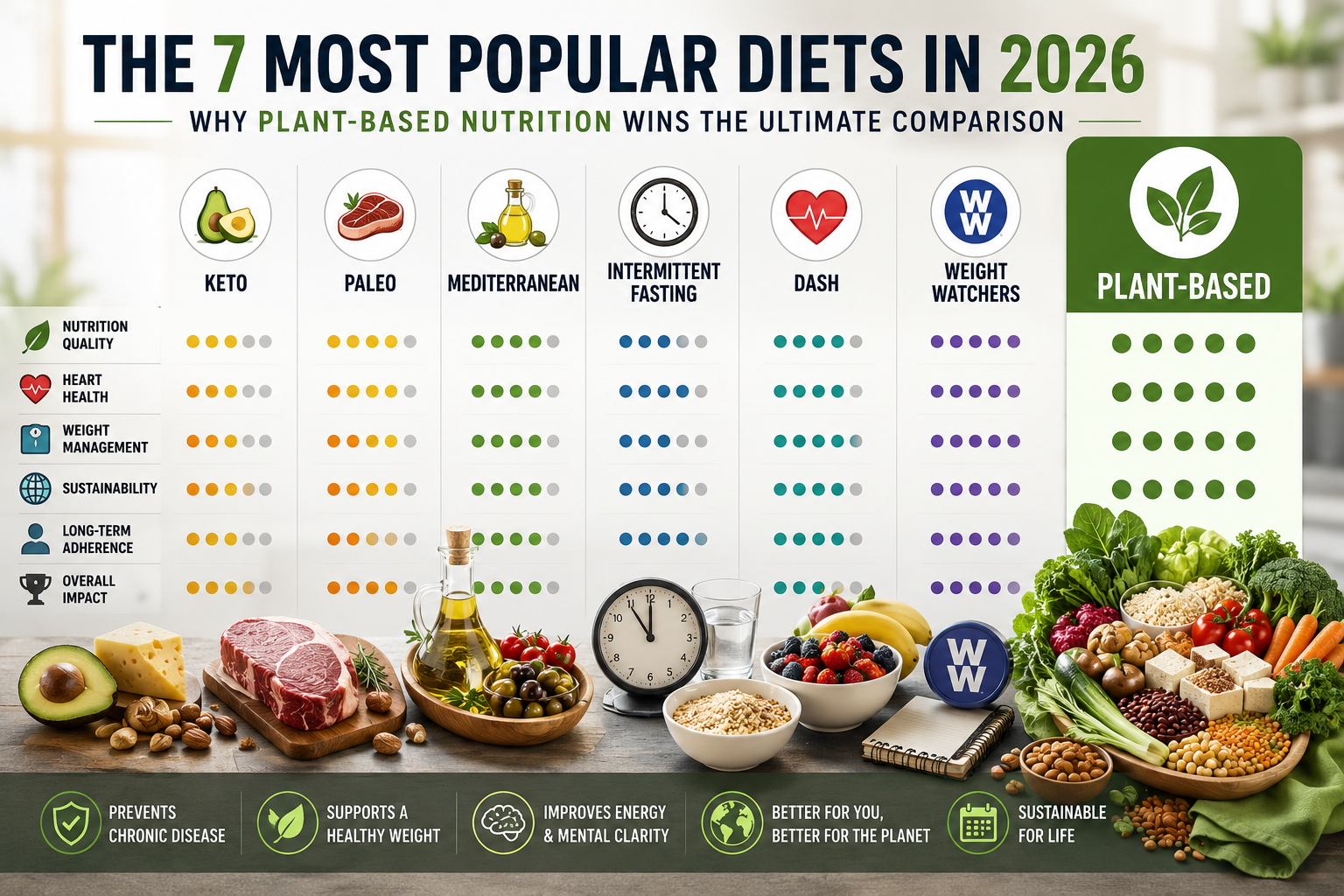
When trying to reach your health and fitness goals, the sheer volume of nutritional advice can feel overwhelming. In this updated 2026 guide, I will evaluate the 7 most popular diets followed today. However, we must establish a foundational truth right from the start: popularity does not automatically equate to long-term clinical effectiveness or sustainable cellular health. While nutritional trends shift rapidly, the underlying physiology of human metabolism remains constant.
Navigating these trends requires a strategic, evidence-based approach. A professional nutrition coach can build you a personalized nutrition plan, provide expert accountability, and decode the complex cellular science behind your food choices. Remember, it is always best to consult with a qualified healthcare professional before implementing any major dietary restriction.
When we evaluate the data in 2026, one clear outcome emerges: while several dietary patterns offer short-term advantages, a whole-food, plant-based framework consistently triumphs over the rest by optimizing the gut microbiome, preserving metabolic flexibility, and fundamentally reducing long-term disease risk.
The 7 Most Popular Diets Evaluated
1. Intermittent Fasting (IF)
Intermittent fasting is an eating pattern structured around alternating periods of fasting and voluntary calorie restriction. Common variations include the 16/8 method (a 16-hour fast with an 8-hour eating window), the 5:2 protocol (consuming 500–600 calories on two non-consecutive days), and alternate-day fasting.
The Claims: Accelerates fat loss via prolonged insulin suppression, enhances cellular cleanup through autophagy, and boosts growth hormone markers.
The Shortcomings: Fasting is an administrative tool for calorie management, not a metabolic miracle. It does not dictate nutrient quality. Furthermore, overly aggressive fasting windows can trigger elevated cortisol production, disrupt endocrine health, and frequently lead to binging patterns.
2. The Paleo Diet
The Paleolithic diet attempts to mimic the ancestral eating habits of early humans. It emphasizes lean meats, fish, wild fruits, vegetables, nuts, and seeds, while strictly eliminating grains, dairy, legumes, and ultra-processed items.
The Claims: Spurs weight loss through high satiety, enhances lean muscle repair via elevated protein intake, and lowers systemic inflammation by removing refined sugars.
The Shortcomings: By banning legumes and whole grains, the Paleo diet severely starving your gut microbiome of vital prebiotic fibers. Clinical data shows that long-term restriction of these complex carbohydrates can negatively alter microflora composition and increase long-term cardiovascular risk factors.
3. The Ketogenic (Keto) Diet
The ketogenic diet is a severe low-carbohydrate, high-fat protocol designed to force the body out of glucose metabolism and into a state of nutritional ketosis, where hepatic ketone bodies replace glucose as the primary fuel source.
The Claims: Rapid short-term weight loss, enhanced appetite suppression via ghrelin modulation, and stabilized daily blood glucose lines.
The Shortcomings: The traditional animal-heavy keto diet is highly problematic over time. According to a 2018 multicenter trial in Spain, the massive influx of saturated fats routinely elevates low-density lipoprotein cholesterol (LDL-C) and induces arterial endothelial dysfunction. Furthermore, it blunts high-intensity athletic performance by down-regulating the metabolic enzymes needed for rapid glycolysis.
4. The Whole30 Diet
Whole30 is a strict, 30-day nutritional reset that completely eliminates added sugars, alcohol, grains, legumes, soy, and dairy. It acts essentially as an acute elimination protocol.
The Claims: Identifies systemically disruptive foods, reduces systemic inflammation, improves sleep quality, and jumpstarts short-term fat loss.
The Shortcomings: Whole30 is inherently unsustainable. It operates as a psychological band-aid rather than a long-term lifestyle design. Eliminating highly health-protective food groups like black beans, lentils, and oats for non-allergic individuals lacks strict scientific justification.
5. The Mediterranean Diet
Modeling the traditional dietary habits of Greece, Italy, and Spain, this framework emphasizes unrefined whole foods, prioritizing fruits, vegetables, legumes, whole grains, nuts, and extra virgin olive oil, alongside moderate fish consumption.
The Claims: Outstanding cardiovascular outcomes, robust anti-inflammatory protection, and superb long-term adherence rates.
The Shortcomings: While highly effective, many modern adaptations of this diet over-emphasize animal proteins and dairy relative to their traditional roots, slightly diminishing the maximum potential fiber delivery and antioxidant density.
6. The Whole-Food, Plant-Based (Vegan) Diet
A whole-food, plant-based (WFPB) diet completely excludes animal-derived products, including meat, dairy, eggs, and seafood. Instead, it centers entirely on a diverse spectrum of fruits, vegetables, legumes, whole grains, nuts, and seeds.
The Claims: Maximizes endothelial health, systematically lowers LDL-C, vastly optimizes the gut microbiome via fiber variety, and provides rich cellular hydration.
The Shortcomings: Because modern industrial agricultural soils are depleted, a plant-based diet requires conscious supplementation of vitamin B12, along with careful tracking of vitamin D3 and long-chain omega-3 fatty acids (EPA/DHA) sourced from algae.
7. Low-Carb Diets
Varying from moderate carbohydrate restriction to variations like Atkins or South Beach, these plans limit total carbohydrate intake while elevating daily protein and fat ratios.
The Claims: Effective short-term weight management and improved insulin sensitivity in individuals with metabolic syndrome.
The Shortcomings: Similar to the keto protocol, if a low-carb diet is built around animal carcasses and dairy fats, it accelerates systemic inflammation, damages renal metrics over time, and robs the body of life-extending phytonutrients found exclusively in plants.
Head-to-Head Comparison: Why the Plant-Based Approach Wins
When we stack these 7 most popular diets against each other using strict, long-term physiological markers, a whole-food, plant-based diet emerges as the clear winner for three primary reasons:
| Health Marker | Plant-Based (WFPB) | Keto / Paleo / Low-Carb | Intermittent Fasting / Whole30 |
| Microbiome Health | Excellent (Extreme fiber diversity) | Poor (Prebiotic deprivation) | Neutral (Fasting focus only) |
| Cardiovascular Risk | Lowest (Reduces LDL-C & plaque) | Elevated (High saturated fat loading) | Variable (Dependent on food choices) |
| Long-Term Adherence | High (Abundant food volume) | Very Low (Severe chronic restriction) | Low (Rigid time structures) |
1. The Mastery of the Food Matrix
Diets like Keto, Paleo, and basic Low-Carb treat human nutrition as a simple game of math, isolating macronutrient totals at the expense of metabolic health. A plant-based diet leverages the power of the natural Food Matrix. The intricate fiber structures of whole plants slow down nutrient absorption, allowing for steady energy delivery without causing the systemic inflammation linked to animal protein digestion.
2. Unrivaled Cardiovascular Protection
Cardiovascular disease remains a leading global health concern. High-fat, low-carb protocols routinely trigger an increase in apolipoprotein B (ApoB) and LDL-C, which can speed up arterial plaque formation. According to a historical clinical trial, and still relevant today, A whole-food, plant-based diet is the only nutritional approach clinically proven to halt and occasionally reverse advanced coronary artery disease by improving endothelial nitric oxide production.
3. Sustainable Metabolic Flexibility
True athletic performance and longevity require metabolic flexibility—the body’s ability to seamlessly burn both fats and carbohydrates based on demand. While a ketogenic diet ruins your ability to use carbohydrates for explosive movement, a WFPB diet maintains high insulin sensitivity while concurrently enhancing fat oxidation through its dense antioxidant network.
The Bottom Line
While short-term fat loss can be achieved via the structural restrictions of Intermittent Fasting, Paleo, or Keto, long-term vitality requires a deeper biochemical perspective. As the Eat – Lancet Commission demonstrates, a whole-food, plant-based diet provides the exact micronutrient density, fiber volume, and cardiovascular defense mechanisms necessary to sustain optimal health over a lifetime.
References
Estruch, R., Ros, E., Salas-Salvadó, J., Covas, M. I., Corella, D., Arós, F., Gómez-Gracia, E., Ruiz-Gutiérrez, V., Fiol, M., Lapetra, J., Lamuela-Raventos, R. M., Serra-Majem, L., Pintó, X., Muñoz, M. A., Rubio, M. A., Martínez, J. A., Pintó, X., & Martínez-González, M. A. (2018). Primary prevention of cardiovascular disease with a Mediterranean diet supplemented with extra-virgin olive oil or nuts. New England Journal of Medicine, 378(25), e34.
Ornish, D., Scherwitz, L. W., Billings, J. H., Brown, S. E., Gould, K. L., Merritt, T. A., Sparler, S., Armstrong, W. T., Ports, T. A., Kirkeeide, R. L., Hogeboom, C., & Brand, R. J. (1998). Intensive lifestyle changes for reversal of coronary heart disease. JAMA, 280(23), 2001–2007.
Satija, A., Bhupathiraju, S. N., Spiegelman, D., Chiuve, S. E., Manson, J. E., Willett, W., Rexrode, K. M., Rimm, E. B., & Hu, F. B. (2017). Healthful and unhealthful plant-based dietary patterns and coronary heart disease risk in U.S. adults. Journal of the American College of Cardiology, 70(4), 411–422.
Willett, W., Rockström, J., Loken, B., Springmann, M., Lang, T., Vermeulen, S., Garnett, T., Tilman, D., DeClerck, F., Wood, A., Jonell, M., Clark, M., Springmann, M., & Murray, C. J. (2019). Food in the Anthropocene: the EAT–Lancet Commission on healthy diets from sustainable food systems. The Lancet, 393(10170), 447–492.