
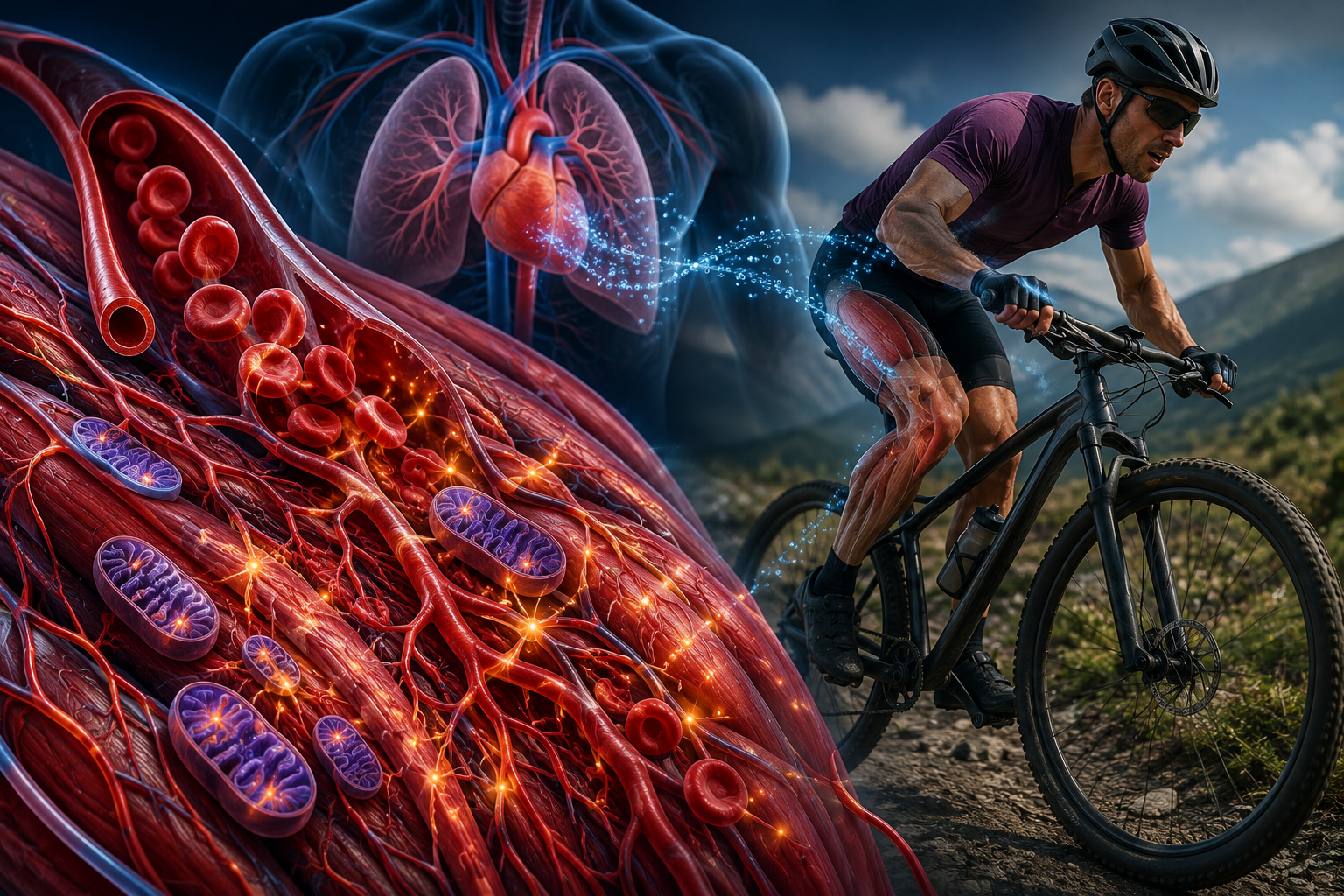
In traditional endurance physiology, maximum oxygen uptake (VO2max) has long been considered the gold standard metric for aerobic performance. However, elite cardiovascular performance is not determined solely by how much oxygen your lungs can inhale or how much blood your heart can pump. True physical stamina hinges on the balance between oxygen delivery and muscle oxygen utilization—the cellular efficiency with which skeletal muscle extracts, transfers, and processes oxygen at the mitochondrial level.
While central cardiac output sets the upper ceiling for oxygen transport, peripheral adaptations inside the muscle tissue dictate your actual metabolic threshold.
  ┌─────────────────────────────────────────────────────────┐
  │                 CENTRAL DELIVERABILITY                  │
  │   Lungs & Heart: Pulmonary Diffusion + Cardiac Output   │
  └────────────────────────────┬────────────────────────────┘
                               │ (Arterial Delivery)
                               ▼
  ┌─────────────────────────────────────────────────────────┐
  │                PERIPHERAL UTILIZATION                   │
  │  Capillary Density ──► Myoglobin ──► Mitochondria (ATP) │
  └─────────────────────────────────────────────────────────┘
Here is a scientific deep dive into how central delivery differs from peripheral extraction, and how plant-based micronutrients directly enhance microvascular capillary density and mitochondrial efficiency.
Central Oxygen Delivery vs. Peripheral Oxygen Utilization
To understand endurance limits, we can examine the classic Fick Equation:
Where Q represents cardiac output (oxygen delivery) and (a-vO2 difference) represents the arterial-venous oxygen difference (muscle oxygen utilization).
1. Oxygen Delivery (Central Factors)
Oxygen delivery involves the convective transport of oxygen from ambient air down into muscle capillaries. It relies on:
Pulmonary Diffusion: Oxygen binding to hemoglobin in pulmonary capillaries.
Stroke Volume & Cardiac Output: The volume of oxygenated blood ejected by the left ventricle per minute.
Hemoglobin Mass: Total oxygen-carrying capacity of blood plasma.
2. Muscle Oxygen Utilization (Peripheral Factors)
Delivery is useless if working skeletal muscle fibers cannot pull oxygen out of the microcirculation. Utilization depends entirely on:
Capillary Density: The number of functional capillaries surrounding individual muscle fibers, dictating red blood cell transit time and surface area for gas exchange.
Myoglobin Concentration: Intracellular transport proteins that ferry oxygen from the cell membrane across the cytoplasm to the mitochondria.
Mitochondrial Density & Enzyme Activity: The volume of mitochondria and enzymes (such as citrate synthase and cytochrome c oxidase) capable of driving oxidative phosphorylation to resynthesize ATP.
While central cardiac output can take months or years of heavy aerobic base building to shift significantly, peripheral muscle oxygen utilization can be dramatically optimized through targeted training structures and plant-based nutrition protocols.
The Role of Plant-Based Micronutrients in Oxygen Extraction
Emerging sports nutrition research highlights that whole-food plant matrices provide unique inorganic compounds, polyphenols, and antioxidants that directly target peripheral muscle oxygenation.
1. Inorganic Dietary Nitrates (NO3) and Vasodilation
Phytonutrient-dense foods such as red beetroot, arugula, spinach, and Swiss chard are rich in inorganic nitrate. Upon ingestion, the nitrate-nitrite-nitric oxide (NO) pathway elevates systemic levels of nitric oxide without relying on nitric oxide synthase.
Microvascular Perfusion: Nitric oxide selectively dilates resistance arterioles within active Type I and Type II muscle fibers, increasing localized blood flow and capillary transit time.
Reduced Oxygen Cost of Work: Clinical trials demonstrate that acute and chronic dietary nitrate supplementation reduces the O2 cost of submaximal exercise, meaning muscles produce the same mechanical power output while consuming less oxygen.
2. Dietary Polyphenols and Capillary Density
Flavonoids and polyphenols found in dark berries, cocoa, pomegranate, and green tea stimulate vascular endothelial growth factor (VEGF).
VEGF is the primary signaling protein responsible for angiogenesis—the synthesis of new capillary branches surrounding muscle tissue. Higher capillary-to-fiber ratios shorten the physical diffusion distance that oxygen must travel from blood vessels into cellular mitochondria.
  [ Dietary Nitrates ] ──► Nitric Oxide (NO)  ──► Vasodilation & Increased Transit Time
  [ Plant Polyphenols] ──► VEGF Expression    ──► Angiogenesis & Increased Capillary Density
  [ Antioxidant Matrix]──► ROS Neutralization ──► Preserved Mitochondrial Membrane Integrity
3. Mitochondrial Efficiency and Uncoupling Control
Mitochondria generate cellular energy by driving protons across the inner mitochondrial membrane via the electron transport chain. Excessive reactive oxygen species (ROS) produced during intense exercise can damage mitochondrial membranes, leading to proton leakage and uncoupled respiration.
Plant-based diets deliver high concentrations of endogenous antioxidants (such as Vitamin E, Vitamin C, and bioflavonoids) that quench free radicals, protecting the structural integrity of mitochondrial cristae. Furthermore, plant-rich dietary patterns improve mitochondrial respiration efficiency, increasing the P/O ratio (the amount of ATP synthesized per atom of oxygen reduced).
Practical Application: How to Optimize Muscle Oxygenation
To maximize peripheral oxygen utilization alongside central cardiac adaptations:
Prioritize Zone 2 Endurance Base: Sustained, low-intensity continuous exercise (60%-70% of HRmax) provides the physiological stimulus required for mitochondrial biogenesis and capillary network growth. Learn how to structure this by reviewing a recent post on Benefits of Heart Rate Training.
Leverage Nitrate-Rich Meal Timing: Consume nitrate-dense whole foods (e.g., 500 ml of fresh beetroot juice or a large arugula salad) 2 to 3 hours prior to prolonged training sessions to peak circulating plasma nitrite levels.
Embrace Whole Plant Foods Over Isolated Extracts: Whole plant matrices provide synergistic micronutrient profiles that enhance bioavailability and vascular response. Read more on The Food Matrix Effect.
Address Key Micronutrient Gaps: Ensure adequate intake of non-heme iron and supporting cofactors to maintain ideal hemoglobin mass and myoglobin synthesis. Check my protocol on 9 Essential Supplements for Vegan Endurance Athletes.
Comparing Central vs. Peripheral Adaptations
| Physiological Parameter | Central Delivery (Q) | Peripheral Utilization (a-vO2 diff) |
| Primary Anatomical Site | Heart, Lungs, Main Arteries | Microvascular Capillaries & Skeletal Muscle |
| Key Physiological Markers | Stroke Volume, Cardiac Output, Hemoglobin | Capillary Density, Myoglobin, Mitochondria |
| Primary Training Stimulus | High-Intensity Intervals (Zone 4/5) | Long Slow Distance (Zone 2) & High Volume |
| Nutritional Drivers | Hydration, Plasma Volume, Electrolytes | Inorganic Nitrates, Polyphenols, Antioxidants |
| Impact on Performance | Establishes Total Aerobic Ceiling (VO2max) | Determines Fractional Utilization & Fatigue Threshold |
Elevate Your Athletic Capacity
Unlocking elite performance requires looking beyond cardiac output alone. By understanding the distinction between central oxygen delivery and peripheral muscle oxygen utilization, you can fine-tune both your training zones and your nutritional strategy to maximize aerobic efficiency at the cellular level.
Ready to optimize your nutrition and endurance programming with custom, evidence-based strategies? Explore our Exercise and Nutrition Coaching Options or learn how our Hybrid Online Coaching can help you achieve sustainable, high-performance results.
References
Jones, A. M. (2014). Dietary nitrate supplementation and exercise performance. Sports Medicine, 44(Suppl 1), 35–45.
Lundby, C., & Jacobs, R. A. (2016). Adaptations of skeletal muscle mitochondria to exercise training. Experimental Physiology, 101(1), 17–22.
Montero, D., Cathomen, A., Jacobs, R. A., Haider, T., Turner, D., Kalus, U., Lundby, C., & Lundby, C. (2015). Haematological rather than skeletal muscle adaptations contribute to the increase in peak oxygen uptake induced by moderate endurance training. The Journal of Physiology, 593(20), 4677–4688.
Popov, L. D. (2020). Mitochondrial biogenesis: An update. Journal of Cellular Biochemistry, 121(3), 2177–2185.
Ross, M., Kargl, C. K., Ferguson, R., Gavin, T. P., & Hellsten, Y. (2023). Exercise-induced skeletal muscle angiogenesis: impact of age, sex, angiocrines and cellular mediators. European Journal of Applied Physiology, 123(7), 1415–1432.