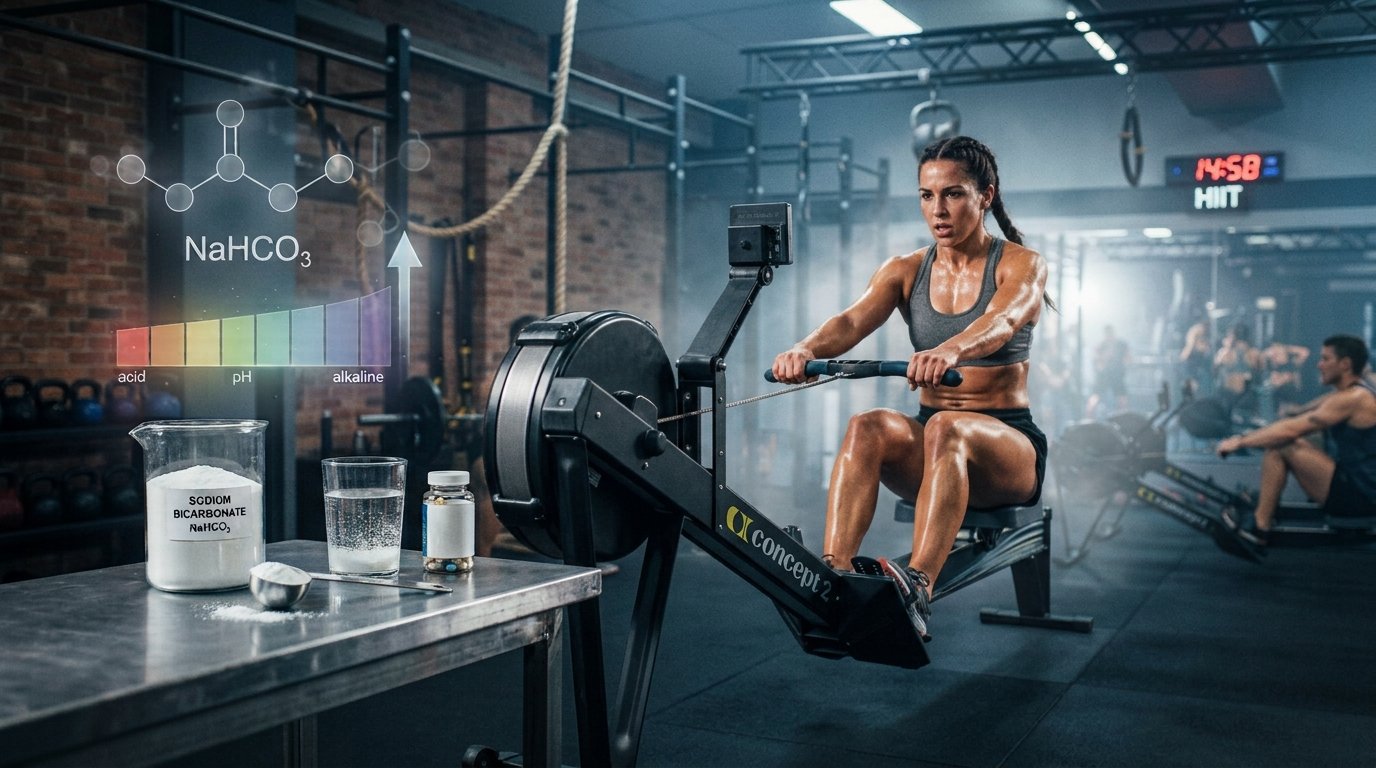
During supramaximal high-intensity interval training (HIIT), sprint interval workouts, or repeated high-load resistance training sets, the rapid rate of anaerobic glycolysis creates an intense bioenergetic bottleneck. As skeletal muscle cells break down muscle glycogen to generate rapid ATP, intracellular accumulation of hydrogen ions (H+) dramatically lowers muscular pH from a resting ~ 7.1 down to acidic levels near 6.4-6.5. This sudden surge in intracellular acidosis impairs key glycolytic enzymes like phosphofructokinase (PFK), disrupts sarcoplasmic reticulum calcium (Ca2+) release, and leads to rapid fatigue.
While physiological fatigue is inevitable during all-out efforts, ergogenic sodium bicarbonate loading serves as one of the most thoroughly validated interventions in sports nutrition for expanding work capacity. By artificially elevating extracellular bicarbonate HCO₃⁻ levels in blood plasma, sodium bicarbonate enhances the proton gradient across cell membranes, driving acidic hydrogen ions out of working muscle fibers and preserving peak power output during grueling training sessions.
Biomechanics & Bioenergetics: The Extracellular Efflux Mechanism
              THE EXTRACELLULAR HYDROGEN ION EFFLUX MECHANISM
│                                                                        │
│  Rapid Anaerobic Glycolysis ──► Intracellular Accumulation of H+ Ions  │
│                                           │                            │
│                                           ▼                            │
│  Sodium Bicarbonate Ingestion──► Elevates Blood Plasma HCO3- & pH      │
│                                           │                            │
│                                           ▼                            │
│  MCT1/MCT4 Transporters    ──► Drives Rapid Efflux of H+ into Blood    │
│                                           │                            │
│                                           ▼                            │
│  Preserved Intracellular pH──► Maintains PFK Activity & Power Output   │
The human body relies on distinct internal and external buffering systems to combat metabolic acidosis:
Intracellular vs. Extracellular Buffering: Intracellular buffering relies primarily on carnosine (synthesized from beta-alanine) and phosphate compounds within the cytoplasm. Extracellular buffering relies on blood plasma bicarbonate HCO₃⁻, which neutralizes systemic acidity.
Monocarboxylate Transporter (MCT) Kinetics: Hydrogen ions and lactate exit working muscle fibers via monocarboxylate transporters (MCT1 and MCT4). Elevating extracellular HCO₃⁻ creates a steep concentration and pH gradient between muscle cells and blood plasma, accelerating the rate at which MCTs shuttle H+ ions out of the cell.
Enzymatic & Mechanical Preservation: By blunting the drop in intracellular pH, sodium bicarbonate protects PFK activity, preserves actin-myosin cross-bridge cycling, and delays the onset of muscular failure during 1-10 minutes high-intensity exercise efforts.
Head-to-Head: Intracellular vs. Extracellular Buffering Modalities
| Ergogenic Buffer | Site of Action | Active Compound / Mechanism | Time to Maximal Saturation | Ideal Exercise Duration |
| Sodium Bicarbonate | Extracellular (Blood Plasma) | Expands plasma HCO₃⁻ to pull H+ out of cells | 60-180 minutes acute loading | 30 seconds to 12 minutes (HIIT / Sprints) |
| Beta-Alanine | Intracellular (Muscle Cytoplasm) | Elevates muscle carnosine density to buffer localized H+ | 4-10 weeks daily dosing (3.2-6.4 g/day) | 1-4 minutes sustained maximal efforts |
| Sodium Citrate | Extracellular (Blood Plasma) | Converts to bicarbonate in liver to raise systemic pH | 90-120 minutes acute loading | High-intensity repeated interval sessions |
—–
The Plant-Based Stacking Advantage: Dual-Buffer Synergy
While sodium bicarbonate handles extracellular H+ removal, pairing it with plant-forward dietary buffering strategies creates a comprehensive multi-layer defense against fatigue:
                       DUAL-BUFFER STACKING FOR PLANT ATHLETES
│                                                                                       │
│  Beta-Alanine Supplementation ──► Increases Muscle Carnosine (Intracellular Buffer)   │
│                                             +                                         │
│  Sodium Bicarbonate Loading   ──► Increases Plasma Bicarbonate (Extracellular Buffer) │
│                                             +                                         │
│  Alkaline Plant Foods & Nitrate──► Reduces Acid Load & Improves Vasodilation          │
Intracellular/Extracellular Stacking (Beta-Alanine + Bicarbonate): Combining long-term beta-alanine supplementation (intracellular carnosine accumulation) with acute sodium bicarbonate loading (extracellular HCO₃⁻ expansion) yields an additive performance benefit, allowing athletes to complete significantly higher total work volume during high-intensity intervals.
Mitigating Dietary Acid Load: Plant-rich diets (abundant in potassium, magnesium, and organic malate/citrate salts from leafy greens, root vegetables, and fruits) present a lower Potential Renal Acid Load (PRAL). This alkaline dietary base preserves baseline systemic buffering reserves, allowing acute bicarbonate loading to act even more efficiently during grueling sessions.
Actionable Bicarbonate Dosing & Gastrointestinal Mitigation Protocol
The primary obstacle with traditional sodium bicarbonate supplementation is gastrointestinal (GI) distress (cramping, bloating, or osmotic diarrhea) caused by rapid carbon dioxide (CO2) production in the stomach. Follow this evidence-based protocol to eliminate GI discomfort:
Precision Dosing Target: Consume 0.2-0.3g of sodium bicarbonate per kilogram of body mass (e.g., 14-21g for a 70kg athlete).
Split Dosing Window: Divide the total calculated dose into 3-4 equal micro-doses taken every 20-30 minutes, starting 120-180 minutes prior to training.
Co-Ingest with High-Carbohydrate Meals: Take each micro-dose alongside a light, high-carbohydrate, low-fat meal or blended smoothie (e.g., oats with banana or a plant-protein blend) to slow gastric emptying and prevent rapid osmotic shifts.
Consider Enteric-Coated Capsules or Hydrogels: Utilizing enteric-coated capsules or modern hydrogel-encapsulated sodium bicarbonate allows the active compound to bypass the acidic stomach environment intact, releasing smoothly in the small intestine without generating stomach gas.
Integrating Buffering Protocols with Training & Nutrition
Maximizing anaerobic performance requires coordinating your supplementation with structured conditioning, metabolic flexibility, and recovery telemetry:
Intracellular Buffer Deep Dive: Learn how carnosine drives muscle endurance in Beta-Alanine & Carnosine: The Plant-Based Advantage.
Synergistic Ergogenic Supplements: Explore complementary performance enhancers in Creatine and Beta-Alanine for Plant-Based Athletes.
Vascular Stacking & Nitric Oxide: Combine extracellular buffering with dietary nitrates via Nitric Oxide Beyond Beets: Vascular Stacking.
Zone 2 & Lactate Clearance: Build your underlying aerobic base to handle interval fatigue in Zone 2 Cardio Plant-Based Athlete’s Guide.
Pre-Workout Fueling Smoothie: Pair your acute dosing protocol with our High-Protein Berry-Spinach Anabolic Recovery Smoothie.
Ready to fine-tune your ergogenic buffering protocols, high-intensity interval programming, and athletic performance with evidence-based coaching? Explore how Online Fitness Coaching can help you achieve your goals today!
References
Grgic, J., Grgic, I., Pedisic, Z., Saunders, B., Bishop, D. J., Schoenfeld, B. J., & Del Coso, J. (2021). Effects of sodium bicarbonate supplementation on muscular strength and muscular endurance: A systematic review and meta-analysis. Sports Medicine, 51(7), 1443–1457.
Lancha Junior, A. H., Painelli, V. D. S., Saunders, B., & Artioli, G. G. (2015). Nutritional strategies to modulate intracellular and extracellular buffering capacity during high-intensity exercise. Journal of the International Society of Sports Nutrition, 12, Article 86.
McNaughton, L. R., Gough, L., Deb, S., Boegman, A., Sparks, S. A., & McNaughton, S. A. (2016). Recent developments in the use of sodium bicarbonate as an ergogenic aid. Current Sports Medicine Reports, 15(4), 233–244.