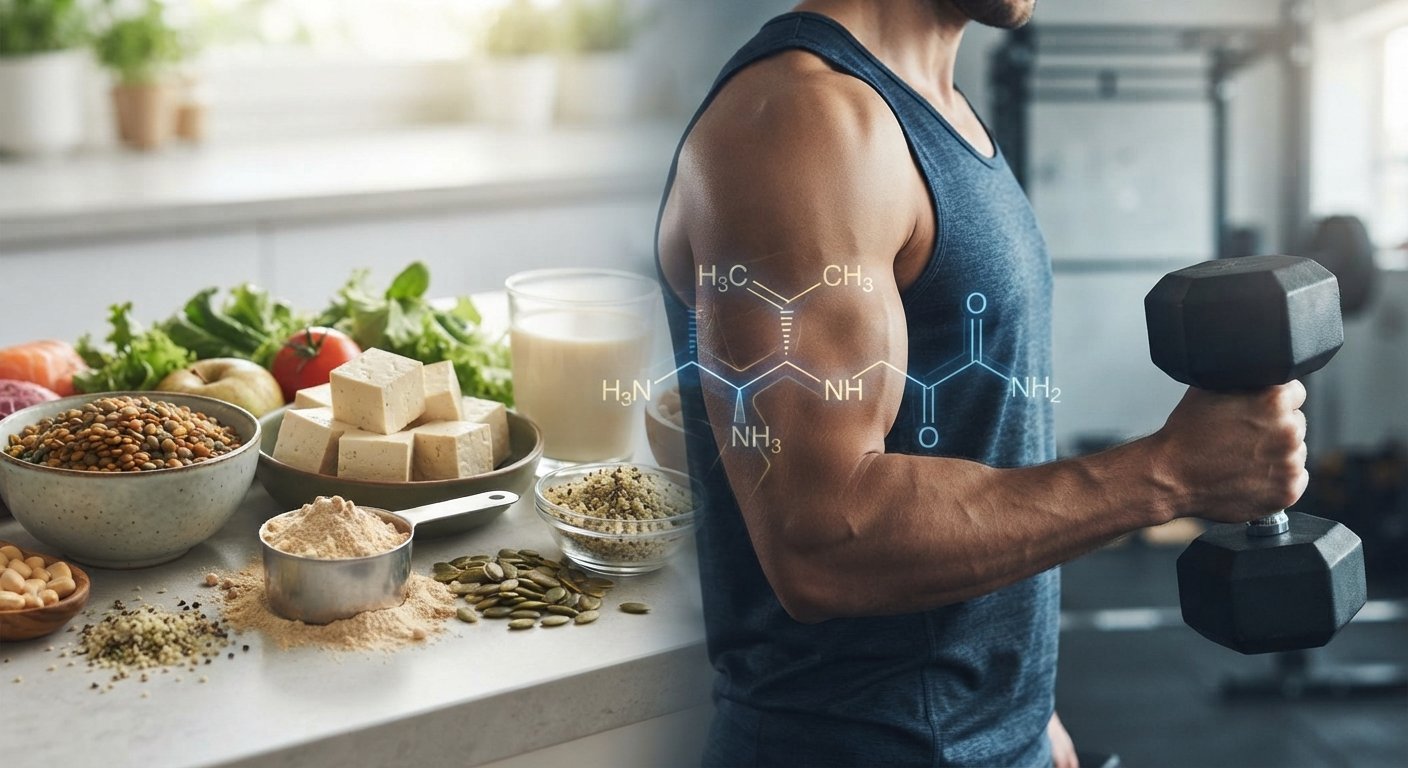
For decades, the standard response to the perennial question—“Where do you get your protein on a plant-based diet?”—was simply to point toward a long list of whole foods like beans, lentils, tofu, and nuts. However, serious athletes and lifters understand that when the goal is optimizing muscle hypertrophy and body composition, mastering vegan protein requires looking far beyond raw gram counts. Simply hitting a total daily protein target is only half the battle; driving maximal muscle protein synthesis (MPS) requires understanding the molecular triggers that signal muscle cells to grow.
The physiological key to unlocking an omnivore-equivalent hypertrophic response lies in mastering the leucine threshold. By overcoming the limiting amino acids inherently present in single plant sources, strategically blending complementary protein isolates, and adjusting per-meal dose kinetics, plant-powered lifters can trigger the exact same intracellular anabolic machinery (mTORC1) as whey or egg protein.
The Molecular Mechanism: The Leucine Trigger & mTORC1 Activation
                   THE LEUCLINE TRIGGER FOR MPS ACTIVATION
│                                                                         │
│  Ingested Protein ──► Sestrin2 Sensor Detects Intracellular Leucine     │
│                              │                                          │
│                              ▼                                          │
│  Sustained Level 3.0g ──► Relieves GATOR2 Inhibition & Activates mTORC1 │
│                              │                                          │
│                              ▼                                          │
│  Downstream Cascade ──► Phosphorylates p70S6K & 4E-BP1 ──► Drives MPS   │
The human body does not store excess amino acids for later use in muscle building; it relies on episodic surges in blood amino acid levels (hyperaminoacidemia) to signal muscle tissue repair:
The Sestrin2 Leucine Sensor: Intracellular sensor proteins (specifically Sestrin2) act as the primary gating mechanism for mTORC1 (mammalian target of rapamycin complex 1). Only when intracellular leucine concentration reaches a critical threshold—typically 2.7-3.5g of leucine per meal—does Sestrin2 release its inhibition on mTORC1, turning on the muscle-building engine.
Anabolic Resistance in Hard Training & Aging: Heavy mechanical loading (and advancing age) elevates the leucine threshold required to initiate MPS. A meal containing only 1.5g of leucine may satisfy baseline health needs, but it fails to trigger optimal muscle protein accretion.
The Limiting Amino Acid Profile of Plant Foods
Unlike animal proteins, which possess a complete essential amino acid (EAA) profile that closely mimics human skeletal muscle, individual plant foods often feature one or more limiting amino acids:
                 COMPLEMENTARY AMINO ACID PROFILE MATRIX
│                                                                           │
│  Legumes & Pulses  ──► High Lysine & Threonine │ LOW Methionine & Cysteine│
│  Grains & Cereals  ──► High Methionine & Cysteine│ LOW Lysine             │
│                                                                           │
│  Pea + Rice Blend  ──► Complete EAA Spectrum = Omnivore Equivalent MPS    │
Legumes (Soy, Lentils, Beans): Naturally rich in lysine and threonine, but lower in sulfur-containing amino acids (methionine and cysteine).
Grains & Seeds (Brown Rice, Hemp, Oats): Naturally rich in methionine and cysteine, but lower in lysine.
The Blending Solution: Combining pea protein isolate with brown rice protein isolate at a 70:30 or 60:40 ratio creates a complete amino acid profile that matches the EAA density and leucine content of whey protein.
Head-to-Head: Whole Food vs. Blended Isolate Protein Kinetics
| Protein Source | Leucine Content per 30g Protein | Digestion & Absorption Rate | Key Limiting Amino Acid | Strategy to Reach ≥3.0g Leucine |
| Whey Isolate (Standard) | 3.3g (11%) | Rapid (8-10g/hr) | None (Complete) | 30g single serving |
| Soy Protein Isolate | 2.4g (8%) | Moderate (6-8g/hr) | Methionine (Minor) | Increase dose to 38-40g |
| Pea + Rice Blend (70/30) | 2.7-3.0g (9%) | Fast-to-Moderate | None (Synergistic) | 32-35g single serving |
| Cooked Lentils (Whole) | 1.4g (6.5%) | Slow (3-4g/hr due to fiber) | Methionine | Consume 1.5 cups paired with rice |
—–
Actionable Strategy: The 4-Step Anabolic Plant Protein Blueprint
Target 1.6-2.2g Protein per kg Bodyweight Daily: Distribute your total intake across 3-5 distinct meals per day to ensure repeated MPS triggers.
Anchor Main Meals Around 3.0g Leucine: Ensure each main feeding contains a minimum of 35-40g of plant protein from whole foods (tofu, tempeh, edamame, seitan) or 32-35g from high-quality blended isolates.
Leverage Free-Form Amino Acid Fortification: If consuming lower-leucine plant meals (such as plain grain bowls), bolster the anabolic response by fortifying with 1.5-2.0g of free-form L-leucine or branched-chain amino acids (BCAAs).
Account for Matrix Digestion Rates: Because intact plant cell walls slow gastric emptying, cook legumes thoroughly or blend protein sources to maximize intestinal amino acid bioaccessibility.
Integrating Plant Protein Science with Training & Performance
Mastering your protein matrix serves as the structural foundation for your entire physical development:
Foundation Hypertrophic Guide: Align your leucine targets with progressive overload mechanics in How to Build Vegan Muscle: The Complete Science-Backed Guide.
Addressing Common Protein Myths: Debunk industry misconceptions by reading Plant-Based Protein Myths Debunked.
Daily Intake Recommendations: Calculate your exact protein requirements based on training volume in How Much Protein Do You Really Need?.
High-Leucine Anabolic Recipe: Try our expertly formulated High-Protein Berry-Spinach Anabolic Recovery Smoothie or our seasonal High-Protein Autumn Pumpkin Spice Recomp Smoothie.
Synergistic Micronutrient Matrix: Learn how whole foods enhance absorption in Bioavailability & Polyphenol Matrix: Whole Foods vs. Supplements.
Ready to optimize your protein synthesis, macro ratios, and athletic performance with evidence-based coaching? Explore how Online Fitness Coaching can help you achieve your goals today!
References
Berrazaga, I., Micard, V., Gueugneau, M., & Walrand, S. (2019). The role of the anabolic properties of plant- versus animal-based protein sources in supporting muscle mass maintenance: A critical review. Nutrients, 11(8), Article 1825.
Gorissen, S. H. M., Crombag, J. J. R., Senden, J. M. G., Waterval, W. A. H., Bierau, J., Verdijk, L. B., & van Loon, L. J. C. (2018). Protein content and amino acid composition of commercially available plant-based protein isolates. Amino Acids, 50(12), 1685–1695.
Joy, J. M., Lowery, R. P., Wilson, J. M., Purpura, M., DeSouza, E. O., Wilson, S. M., Kalman, D. S., Dudeck, J. E., & Jäger, R. (2013). The effects of 8 weeks of whey or rice protein supplementation on body composition and exercise performance. Nutrition Journal, 12, Article 86.
Morton, R. W., Murphy, K. T., McKellar, S. R., Schoenfeld, B. J., Henselmans, M., Helms, E., Aortic, A. A., Rebello, C., Devries, M. C., Banfield, L., Phillips, S. M., & Phillips, S. M. (2018). A systematic review, meta-analysis and meta-regression of the effect of protein supplementation on resistance training-induced gains in muscle mass and strength in healthy adults. British Journal of Sports Medicine, 52(6), 376–384.
van Vliet, S., Burd, N. A., & van Loon, L. J. C. (2015). The skeletal muscle anabolic response to plant versus animal protein consumption. The Journal of Nutrition, 145(9), 1981–1991.