Recovery Doesn’t Start After Birth
Postpartum recovery is often framed as something that begins after delivery.
Physiologically, that’s incorrect.
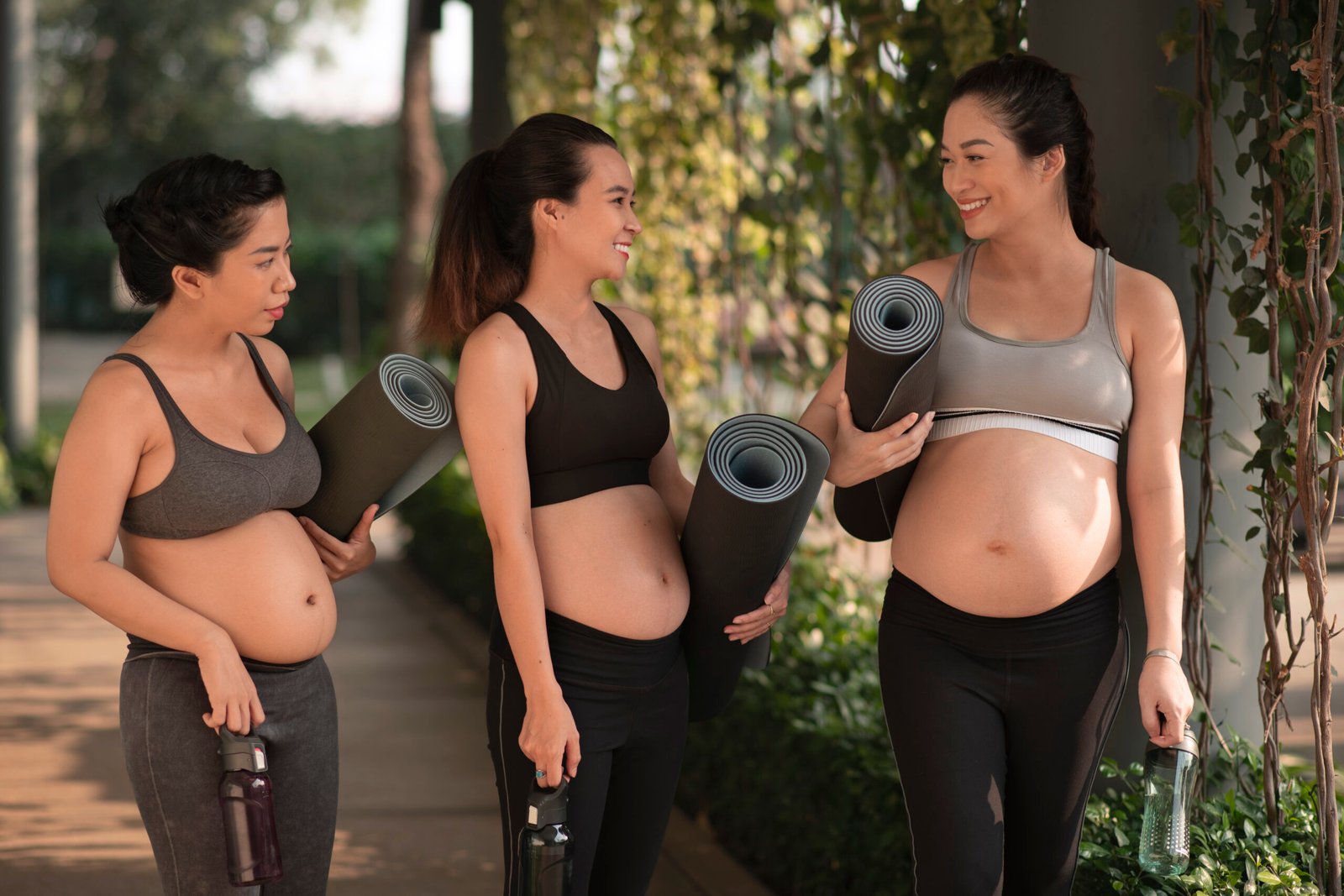
The strength, connective tissue capacity, aerobic base, and stress tolerance a woman carries into childbirth largely determine how well she recovers afterward. Pregnancy is not a pause in training adaptation—it is a highly specific loading phase that can either preserve capacity or accelerate deconditioning.
Avoidance-based fitness advice during pregnancy doesn’t protect women. It often leaves them less resilient.
Pregnancy Is a Stress Test, Not a Fragile State
Pregnancy imposes substantial physiological load:
- Increased cardiac output
- Altered respiratory mechanics
- Progressive musculoskeletal strain
- Elevated metabolic demand
Exercise—when appropriately scaled—improves the body’s ability to tolerate these changes, rather than exacerbating them.
Systematic reviews show that prenatal exercise reduces the risk of gestational diabetes, hypertensive disorders, excessive weight gain, and depressive symptoms, without increasing adverse pregnancy outcomes.
Avoidance, not movement, is the greater risk.
Consistency Beats Intensity During Pregnancy
Pregnancy is not the time for maximal loading—but it is the time for consistent exposure.
The same principle highlighted in a previous post applies here: repeated, manageable stimuli preserve adaptation better than sporadic intensity.
Consistent prenatal training helps maintain:
- Muscle mass and neuromuscular coordination
- Tendon and connective tissue tolerance
- Aerobic efficiency
- Autonomic nervous system regulation
These qualities form the baseline capacity postpartum training builds upon.
➡️ Why Consistency Beats Optimization Every Time
Fear-Based Advice Creates Deconditioning
Many pregnant women are told to:
- “Just walk”
- “Listen to your body” (without context)
- “Avoid anything challenging”
While well-intentioned, this advice often results in chronic underloading.
Deconditioning during pregnancy increases:
- Postpartum fatigue
- Injury risk during return to exercise
- Pelvic floor dysfunction persistence
- Psychological distress
The stress of childbirth does not occur in isolation—it compounds whatever capacity remains.
This mirrors what we see under high life stress more broadly: when stress is high and capacity is low, recovery suffers.
➡️ Why “More Discipline” Fails Under High Life Stress
Pelvic Floor: Load Is Not the Enemy
Avoiding load does not protect the pelvic floor—graded load does.
Research indicates that strength training and impact preparation during pregnancy, when properly coached, can improve pelvic floor coordination and reduce postpartum symptoms.
The pelvic floor responds like other tissues:
- Too little load → loss of capacity
- Appropriate load → improved function
Training should emphasize:
- Breathing mechanics
- Trunk and hip strength
- Progressive loading tolerance
Stress, Recovery, and the Postpartum Reality
Sleep disruption, hormonal shifts, and cognitive load peak postpartum.
Women who maintained training consistency during pregnancy:
- Return to activity sooner
- Report lower perceived exertion
- Demonstrate better mood regulation
This aligns with broader stress-recovery models showing that capacity buffers stress, while deconditioning amplifies it.
➡️ Cold Exposure and Recovery: Helpful or Hormetic Hype?
The Takeaway
Training during pregnancy does not guarantee an easy postpartum recovery—but it sets the ceiling for one.
Avoidance lowers that ceiling.
Consistency raises it.
When training respects physiology, manages stress, and preserves capacity, postpartum recovery becomes a progression—not a rebuild from zero.
References
Bø, K., & Nygaard, I. E. (2020). Is physical activity good or bad for the female pelvic floor? Medicine & Science in Sports & Exercise, 52(1), 1–8.
Davenport, M. H., Meah, V. L., Ruchat, S. M., Davies, G. A., Skow, R. J., Barrowman, N., … Mottola, M. F. (2019). Impact of prenatal exercise on maternal harms, labour and delivery outcomes: A systematic review and meta-analysis. British Journal of Sports Medicine, 53(2), 81–89.
Meeusen, R., Duclos, M., Foster, C., Fry, A., Gleeson, M., Nieman, D., Raglin, J., Rietjens, G., Steinacker, J., & Urhausen, A. (2013). Prevention, diagnosis, and treatment of the overtraining syndrome. European Journal of Sport Science, 13(1), 1–24.