
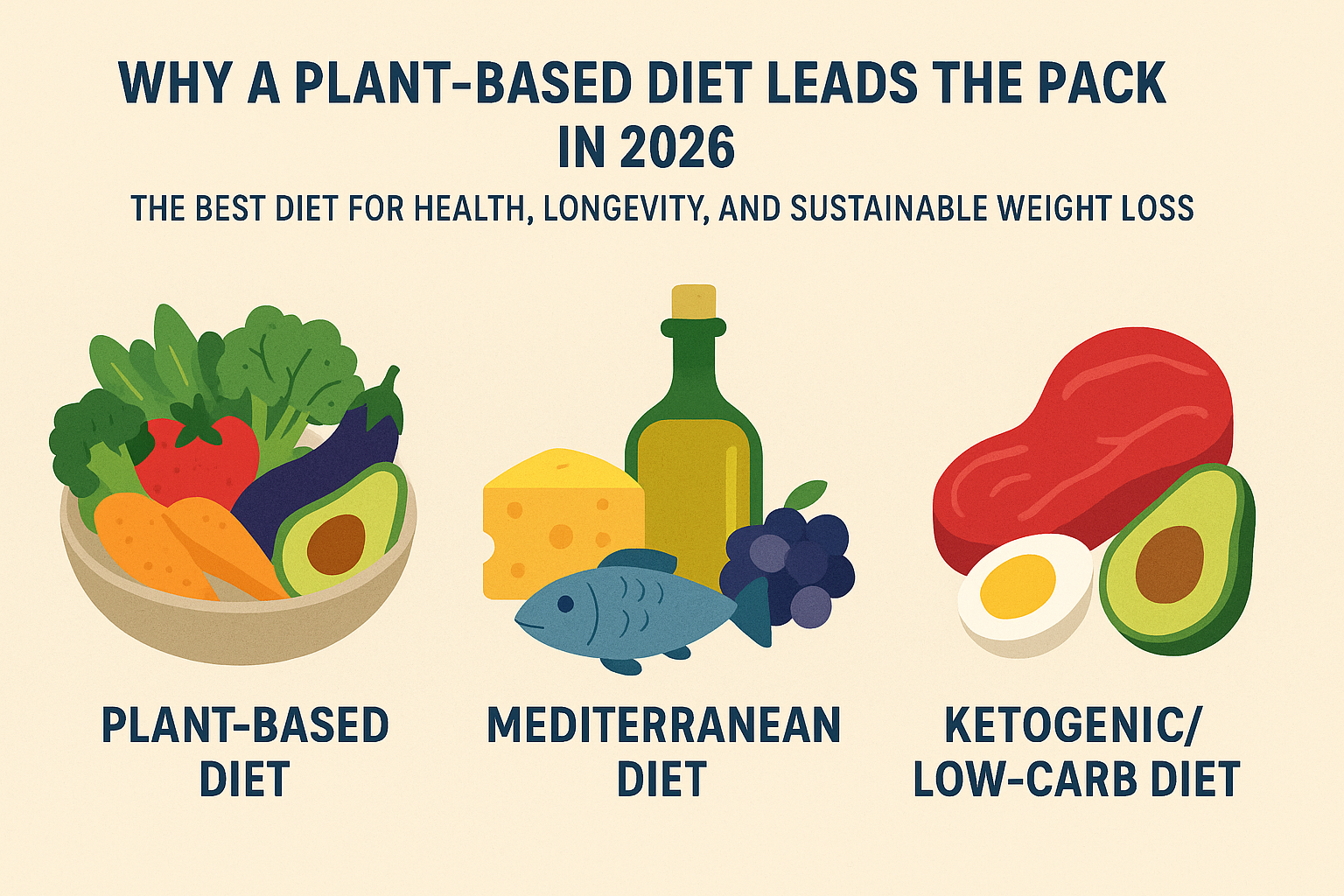
As we move into 2026, the conversation around the “best diet” has shifted from quick fixes to long-term health, vitality, and sustainable body composition. People don’t just want to lose a few pounds — they want to reduce chronic disease risk, increase healthy lifespan, improve performance, and maintain results without fighting their food environment every day.
When you look at the data through that lens, one pattern stands out: a well-designed, whole-food plant-based diet.
Below is a forward-looking comparison of the most prominent diets heading into 2026 — plant-based, Mediterranean, and ketogenic/low-carb — and why plant-based eating often emerges as the most effective, sustainable, and health-protective approach.
1. Plant-Based Diets: The Case for a Health and Longevity Powerhouse
A “plant-based diet” today isn’t just a trend — it’s one of the most studied dietary patterns in modern nutrition science. Recent long-term research shows that people who consistently follow plant-focused eating patterns experience:
Lower all-cause mortality, cardiovascular disease, and cancer mortality.
Reduced incidence of major chronic diseases (type 2 diabetes, cardiovascular disease, cancer).
Better metabolic health (improved glucose regulation, blood pressure, lipid profiles) and lower inflammation risk.
Lower risk of death in high-risk individuals when diet emphasizes whole, minimally processed plant foods vs. “unhealthy” plant-based patterns.
A recent large prospective analysis (17 years follow-up) found that individuals in the highest quintile of a plant-based diet index (PDI) had ~17% lower risk of all-cause mortality compared to lowest quintile.
What sets plant-based eating apart is the combination of nutrient density, fiber-rich appetite control, and low calorie density — a trio that supports better health and effortless caloric moderation without counting or restricting (when done as whole-food, minimally processed). Many meta-analyses now show that adherence to a “healthy plant-based diet index” (hPDI) is associated with lower risk of death, while an “unhealthy plant-based diet” index (uPDI)—rich in refined grains, sugars, processed plant-based foods—is associated with higher mortality.
Even better: whole-food plant-based diets often deliver these improvements without requiring calorie restriction and without the downsides associated with highly restrictive diets.
Why plant-based diets excel:
High in fiber, antioxidants, polyphenols, vitamins, and minerals
Naturally low in saturated fat and dietary cholesterol
Support beneficial gut microbiota and reduce chronic inflammation risk
Improve endothelial function and cardiovascular risk factors
Promote satiety with fewer calories — easier weight regulation
Align with emerging “longevity diet” principles based on large cohort/nutrition-mortality data
For people wanting not just years of life, but quality years — fewer chronic diseases, better metabolic health, preserved function — the evidence keeps stacking up.
2. Mediterranean Diet: A Strong Runner-Up — Especially for Flexibility
The Mediterranean diet remains one of the most consistently validated dietary patterns, with decades of data showing reduced cardiovascular events and long-term health benefits. For example, the landmark PREDIMED trial demonstrated that people at high cardiovascular risk who followed a Mediterranean-style diet (with extra-virgin olive oil or nuts) had about a 30% reduction in major cardiovascular events compared to a low-fat control diet.
Its strength lies in being:
Plant-forward (vegetables, fruits, legumes, whole grains, nuts)
Rich in healthy fats (olive oil, nuts), herbs, minimal processed food
Low to moderate in fish, modest dairy, occasional meat — more flexible than restrictive diets
Evidence-based for both cardiovascular disease prevention and metabolic health
It’s flexible and highly sustainable — a reason many clinicians still recommend it for “real-world” healthy eating over decades.
But compared to a whole-food plant-based approach, the Mediterranean diet often brings:
Higher dietary fat and more calories per gram of food
Lower overall fiber intake (depending on choices)
Less dramatic changes in weight or cardiometabolic markers in some studies (especially compared with more plant-dense diets)
Still, for many people, especially those who want flexibility, cultural compatibility, or enjoy fish/dairy moderately — the Mediterranean diet remains an excellent choice. But in head-to-head comparisons, the plant-based model often yields stronger improvements, especially when the goal is long-term disease risk reduction and optimal longevity.
3. Ketogenic and Low-Carb Diets: Big Promises, Mixed Long-Term Outcomes
Ketogenic diets continue to have a dedicated following, especially among individuals seeking fast short-term weight loss or improved glycemic control. Indeed, a recent meta-analysis of randomized controlled trials showed that ketogenic diet interventions can produce reductions in weight, BMI, triglycerides, blood glucose, and blood pressure over relatively short periods.
However, when it comes to long-term health and sustainability, there are important caveats:
The same analyses report increases in total cholesterol and LDL (“bad”) cholesterol in many individuals — potentially raising cardiovascular risk.
Although short-term improvements in some metabolic markers are real (triglycerides, weight, glycemic control), these benefits have not been shown to translate consistently into reductions in long-term disease incidence, mortality, or cardiovascular events.
High risk of nutrient deficiencies, particularly in micronutrients and fiber, given avoidance of many vegetables, whole grains, and legumes; this may produce digestive issues, bone health trade-offs, kidney stone risk, and other long-term health consequences.
Adherence is challenging over time — and for many people, the restrictive nature makes it unsustainable as a “long-term lifestyle diet.” Many clinical reviews conclude that long-term safety and efficacy remain uncertain and more research is needed.
For short-term goals or therapeutic contexts (e.g., rapid weight loss, certain metabolic or neurologic conditions), keto may still have a place. But as a “lifelong diet for health, resilience, and longevity,” it struggles to match the robust evidence base now accumulating for plant-forward and Mediterranean diets.
Weight Loss: Why Plant-Based Approaches Often Win Without Trying
Multiple observational and interventional studies suggest that plant-based diets — especially those emphasizing whole, minimally processed foods — support healthy weight loss and maintenance, often without explicit calorie restriction. The high fiber content, lower energy density, and better satiety per calorie all contribute to a natural caloric moderation. Meta-analyses of cohort studies show improved weight and metabolic profiles among higher-plant-diet adherents.
By contrast:
Keto diets tend to produce faster early weight loss, but a significant portion may be water and glycogen loss rather than sustainable fat loss.
The increase in LDL cholesterol and potential nutrient gaps may compromise long-term metabolic health, especially if maintenance is poor.
Mediterranean-style diets often yield slower, more gradual weight changes — which can be positive for long-term adherence, but may not satisfy those seeking more dramatic results.
If the goal is leaner, healthier, and more metabolically efficient body composition over years — instead of quick fixes — plant-based eating aligns extremely well.
The Bottom Line: Why Plant-Based Eating Leads Into 2026
Looking at the full picture — health, performance, longevity, and sustainable weight control — the plant-based model stands out for several reasons:
✔ Most consistent evidence for reducing chronic disease and early mortality across large, well-conducted cohort studies and meta-analyses.
✔ Superior nutrient density and dietary fiber compared to many alternative diets.
✔ Lower calorie density for effortless weight control — easier to maintain a healthy weight over time.
✔ Improved metabolic markers across the board — glycemic control, blood pressure, lipid profile, inflammation, etc.
✔ Better long-term adherence than severely restrictive diets — especially when flexibility, variety, and practicality matter.
✔ Strong alignment with emerging longevity research showing plant-based dietary patterns correlate with better healthspan into older age.
It’s not about dogma or perfection — it’s about building a diet centered on plants, rich in whole foods, and easy to live with for decades.
A Mediterranean diet remains an excellent second option, especially for those wanting a more flexible model. Keto and low-carb diets can serve short-term roles, but struggle to match the long-term health benefits seen in plant-dense, nutrient-rich eating patterns.
Final Thought
As new research continues to emerge, one pattern has become increasingly clear: When you prioritize whole plant foods, your health, longevity, and body composition tend to follow.
Going into 2026, plant-based eating isn’t just a trend — it’s one of the most evidence-backed, sustainable, and forward-thinking nutrition strategies available.
References
Satija, A., & Hu, F. B. (2018). Plant-based diets and cardiovascular health. Trends in Cardiovascular Medicine, 28(7), 437–441.
Barnard, N. D., Levin, S. M., & Yokoyama, Y. (2018). A structured plant-based diet improves body weight and metabolic control. Nutrition & Diabetes, 8(1), 1–9.
Campbell, T. C., & Campbell, T. M. (2006). The China Study. BenBella Books.
Dinu, M., Abbate, R., Gensini, G. F., Casini, A., & Sofi, F. (2017). Vegetarian, vegan diets and multiple health outcomes: A systematic review. Critical Reviews in Food Science and Nutrition, 57(17), 3640–3649.
Estruch, R., et al. (2013). Primary prevention of cardiovascular disease with a Mediterranean diet. New England Journal of Medicine, 368(14), 1279–1290.
Hallberg, S. J., et al. (2018). Long-term effects of a ketogenic diet on weight and metabolic health. Diabetes Therapy, 9(2), 583–612.
Kahleová, H., et al. (2020). A plant-based diet improves insulin sensitivity and liver fat. JAMA Network Open, 3(11), e2025458.
Key, T. J., Appleby, P. N., & Rosell, M. S. (2014). Health effects of vegetarian and vegan diets. Proceedings of the Nutrition Society, 65(1), 35–41.
Kirkpatrick, C. F., et al. (2019). Review of current evidence regarding ketogenic diets. Journal of Clinical Lipidology, 13(5), 689–699.
Longo, V., & Anderson, R. M. (2022). Nutrition, longevity, and disease: From molecular mechanisms to interventions. Cell, 185(9), 1455–1470.
Masood, W., et al. (2021). Ketogenic diet. StatPearls Publishing.
Rolls, B. J. (2017). Dietary energy density and obesity. The American Journal of Clinical Nutrition, 106(4), 685–693.
Sabaté, J., Wien, M., & Haddad, E. (2019). Vegetarian diets and cardiovascular risk reduction. Progress in Cardiovascular Diseases, 61(1), 54–61.
Tomova, A., et al. (2019). The effects of vegetarian and vegan diets on gut microbiota. Nutrients, 11(10), 1–17.
Turner-McGrievy, G. M., et al. (2015). Comparative adherence to plant-based diets. Nutrients, 7(11), 5512–5624.