
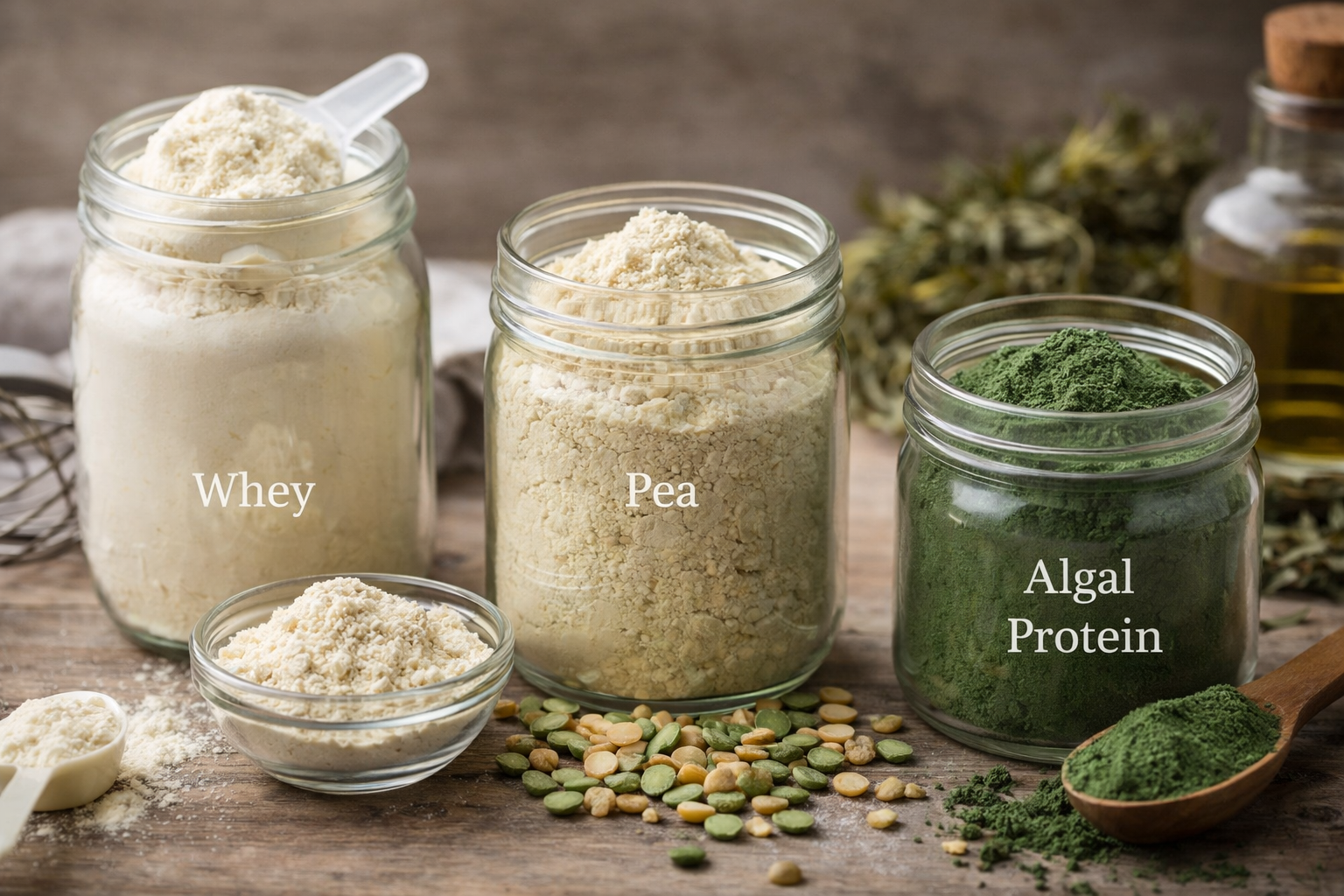
In 2026, the “Carbon-Conscious Athlete” has replaced the “Mass-at-all-Costs” bodybuilder. As we fine-tune our biological software for longevity, we are increasingly looking at the metabolic cost of our supplements—not just to our bodies, but to the planet.
Every scoop of protein is a vote for a specific trophic pathway. Choosing between Whey, Pea, and Algal protein isn’t just about the amino acid profile; it’s about the resource load and the long-term “Double Win.”
The Whey Paradox: Upcycled Byproduct or Methane Burden?
Whey has long been the “Gold Standard” due to its high leucine content and rapid absorption. Historically, it was marketed as a sustainable “upcycled” byproduct of the cheese industry. However, mid-2020s Life Cycle Assessments (LCA) have shifted the perspective.
While whey utilizes a stream that might otherwise be wasted, it remains tethered to the industrial dairy system. Dairy production accounts for roughly 3 times the greenhouse gas (GHG) emissions of plant-based alternatives. For the athlete focused on “silencing” systemic inflammation, the methane burden and land-use intensity of whey make it a high-transgression choice for the environment.
The Pea Baseline: Low Input, High Trophic Yield
Pea protein has emerged as the reliable workhorse of plant-based performance. Unlike dairy, peas are nitrogen-fixing legumes—meaning they naturally enrich the soil rather than depleting it.
The environmental data is stark: Producing 100g of pea protein emits roughly 0.4–0.8 kg CO2eq, a fraction of the emissions associated with animal-derived sources. For athletes, this represents a metabolic profit: high-quality protein with a minimal environmental footprint.
➡️ Plant-Based Protein Myths: Can Plants Really Build Muscle?
The Algal Frontier: Bypassing the Middle-Animal
If pea protein is the workhorse, algae is the game-changer. Algae can be grown in closed-loop vertical systems or bioreactors that require zero arable land and use significantly less water than traditional crops.
Algae effectively “bypasses the middle-animal,” capturing CO2 directly through photosynthesis and converting it into a 70% protein-dense biomass rich in essential minerals and DHA. This is the pinnacle of the “Double Win”: optimizing your cellular health while actively contributing to carbon neutrality.
The Decision: Aligning Your Supplement with Your Identity
Choosing your protein source is an epigenetic decision. By opting for low-impact, high-nutrient sources like pea and algae, you are practicing Regenerative Fitness. You are silencing the environmental stress signals that contribute to global (and personal) inflammation.
➡️ Why Identity Is the Missing Link in Long-Term Health Change
References
Lee, S., et al. (2025). Comparison of water and land use, and greenhouse gas (GHG) emissions across various protein sources. Sustainable Food Systems Journal, 14(2), 45–60.
Ostaiza-Cárdenas, J., Tobar, A. C., Costa, S. C., Calero, D. S., López-Carrera, A., Bermúdez, F. G., & Orellana-Manzano, A. (2025). Epigenetic modulation by life-style: Advances in diet, exercise, and mindfulness for disease prevention and health optimization. Frontiers in Nutrition, 12, 1632999.
Saini, R. K., & Keum, Y. S. (2024). Omega-3 and omega-6 polyunsaturated fatty acids: Dietary sources, metabolism, and biological importance. International Journal of Molecular Sciences, 25(8), 4342.
World Resources Institute. (2026, January 9). In the quest for protein, don’t forget plants.
Wu, S., Menut, P., Miao, S., & Turchiuli, C. (2025). Algae protein creates sustainable alternatives for various food matrices: From function to nutrition. Comprehensive Reviews in Food Science and Food Safety, 24(5), 70264.