If you could pick one measure that predicts how well and how long you’ll live, research increasingly points to muscle — specifically muscle strength and mass — over traditional markers like body weight or even cholesterol.
A growing body of evidence shows that stronger, healthier muscle is linked to lower mortality, reduced disease risk, and better metabolic and functional health. In short: muscle is now viewed as a vital sign of healthy aging.
Muscle Strength Is a Predictor of Longevity
Large, long-term studies show that higher muscle strength is consistently associated with lower all-cause mortality — even after adjusting for factors like physical activity or muscle mass alone.
In a 25-year prospective study, men with higher strength had a significantly lower risk of death, regardless of other factors.
In a diverse cohort of the very old (90+), greater muscle strength was progressively linked with lower mortality risk.
Analysis of U.S. older adults showed that low muscle strength predicted higher mortality independent of muscle mass.
These findings emphasize that strength — not just mass — is a critical biomarker of long-term health.
Muscle Loss With Age and Its Dangers
Muscle naturally declines with age — a process called sarcopenia — but strength usually deteriorates faster than mass. This loss is strongly linked to disability, frailty, and mortality in older adults.
Beyond strength, reduced muscle also affects:
Metabolic health: Muscle is the primary tissue for glucose uptake, making it essential for insulin sensitivity and blood sugar control.
Functional independence: Weaker muscles correlate with slower gait, poorer balance, and higher fall risk.
Inflammation and aging: Active muscle secretes “myokines” that mitigate systemic inflammation — a core driver of chronic disease. (Emerging evidence supports this role, even if the exact mechanisms are still under study.)
Why Strength Training Is So Potent
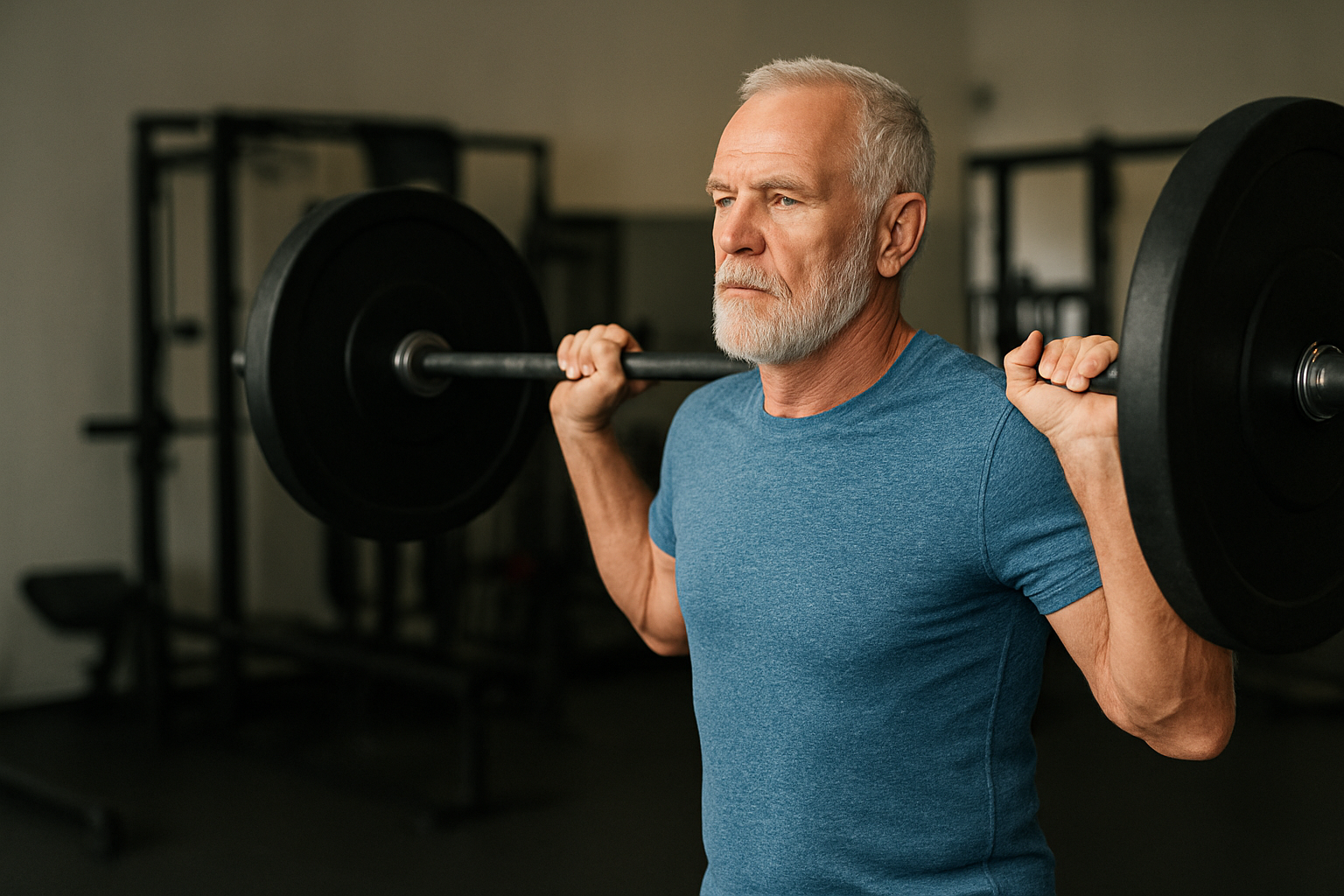
Resistance training (weights, resistance bands, bodyweight work) has some of the most compelling evidence for positive aging outcomes:
1. Improves Muscle Strength and Quality
RCTs and meta-analyses find that resistance training significantly increases muscle strength in older adults.
Strength improvements translate into better mobility, reduced risk of falls, and greater functional independence.
2. Enhances Metabolic and Cardiovascular Health
Research shows resistance training improves glucose metabolism, reduces fat mass, and enhances insulin sensitivity — key factors in metabolic disease prevention.
3. Reduces Markers of Chronic Disease and Inflammation
Another study finds training can lower systemic inflammation and factors associated with metabolic syndrome in older adults.
4. Improves Quality of Life for Older Adults
Intervention studies show that strength training improves quality-of-life measures in older adults, especially those with sarcopenia.
Putting It Into Practice: A Longevity-Focused Strength Training Plan
Frequency
Aim for 2–3 days per week of resistance training targeting all major movement patterns.
Essential Movements
Lower body: squats, deadlifts/hip hinges, lunges
Push: bench/press variations or push-ups
Pull: rows, pull-ups
Core stability: anti-rotation and loaded carries
Intensity
Train with enough load to challenge strength — including heavier efforts where safe and appropriate. Even modest progress across weeks yields significant health benefits.
Functional Power
Include movements that build power (e.g., kettlebell swings, medicine ball throws) to offset the rapid decline in explosive strength that accompanies aging.
Lifestyle Synergies
Prioritize protein intake (1.6–2.2 g/kg/day) to support muscle adaptation.
Stay active throughout the week — muscle thrives in a movement-rich environment.
Conclusion: Muscle as a Vital Sign
Muscle strength and mass are powerful predictors of long-term health outcomes — including mortality, independence, and quality of life. Strength training isn’t simply about aesthetics or performance; it’s a foundational intervention for extending healthspan and lifespan.
By training consistently and progressively, you invest in a body that stays capable, resilient, and vibrant well into later decades.
References
Arai, H., Chen, L., Chen, R., … & Woo, J. (2024). Association of muscle strength with all-cause mortality in the oldest old: Prospective cohort study from 28 countries. Journal of Cachexia, Sarcopenia and Muscle.
Chung, P.-H., Chou, C.-H., Chien, K.-Y., & Wu, Y.-T. (2021). Effects of resistance training on muscle strength, insulin-like growth factor-1, and IGF-binding protein-3 in healthy elderly subjects: A systematic review and meta-analysis of randomized controlled trials. Experimental Gerontology, 144, 111180.
Domaszewski, P., Konieczny, M., & Pakosz, P. (2024). Resistance training enhances metabolic and muscular health and reduces systemic inflammation in middle-aged and older adults with type 2 diabetes: A meta-analysis. Diabetology International.
Fernández-Lázaro, D., Fernández-Lázaro, C. I., Mielgo-Ayuso, J., Navascués, L. J., & Córdova, A. (2023). Effects of strength training on quality of life of older adults with sarcopenia: A systematic review. Geriatrics, 8(4), 49.
Gholami, M., Behtash, M., Torkmandi, H., & Gholami, F. (2019). Resistance training improves metabolic health markers in older individuals regardless of training frequency. Aging Clinical and Experimental Research, 31(6), 861–868.
Li, R., Xia, J., Zhang, X., Gathirua-Mwangi, W. G., Guo, J., Li, Y., … & Song, Y. (2018). Associations of muscle mass and strength with all-cause mortality among US older adults. Medicine & Science in Sports & Exercise, 50(3), 458–465.
Newman, A. B., Kupelian, V., Visser, M., Simonsick, E. M., Goodpaster, B. H., Nevitt, M., … & Harris, T. B. (2006). Strength, but not muscle mass, is associated with mortality in the Health, Aging and Body Composition Study cohort. The Journals of Gerontology Series A: Biological Sciences and Medical Sciences, 61(1), 72–77.