
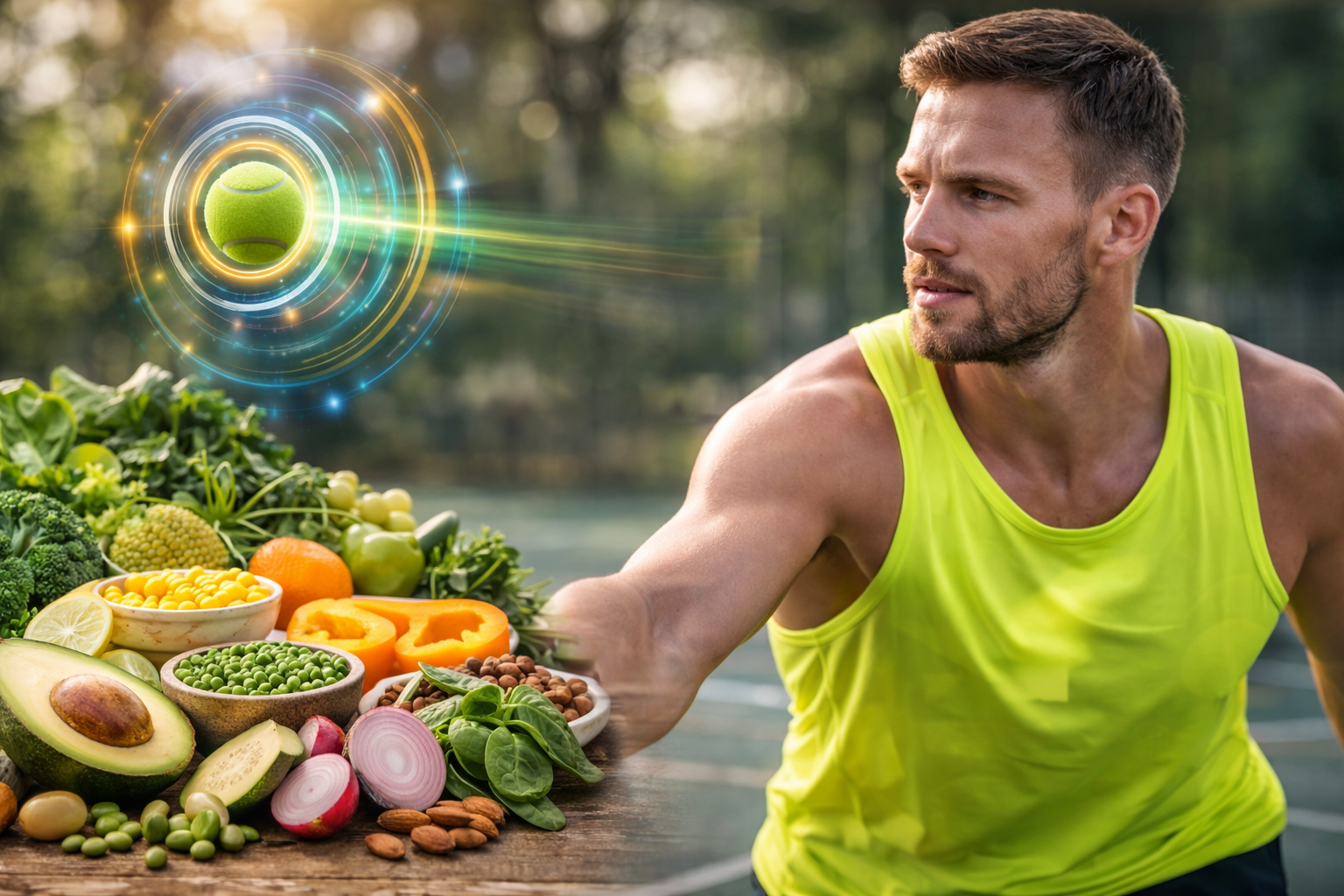
In the high-stakes world of 2026 athletics, we’ve finally moved past the “muscle-only” era. We now know that your physical ceiling is often dictated by your biological software—specifically, how fast your brain can process visual data and trigger a motor response.
If you’re a split-second behind reading a pass or reacting to a defender, it doesn’t matter how much you bench. This is where Athletic Processing Speed becomes the ultimate performance differentiator. And according to recent neuroscience, the best way to upgrade that speed is through two specific plant-based “neuro-pigments”: Lutein and Zeaxanthin.
The Science: Neural Efficiency and the Macular Link
Lutein and Zeaxanthin are xanthophyll carotenoids found heavily in dark leafy greens. While long celebrated for eye health, 2024 and 2025 research has confirmed they are actually “brain fuel.” They accumulate in the brain’s gray and white matter, particularly in areas responsible for visual-spatial processing and executive function.
When these pigments are high, your Critical Flicker Fusion (CFF)—a metric for how fast your visual system can distinguish individual signals—increases. These nutrients act as bioactive modifiers, reducing “neural noise” and silencing inflammatory pathways that otherwise slow down neural transmission. This allows for a higher signal-to-noise ratio and faster temporal processing.
➡️ Heart Rate Variability (HRV): Useful Tool or Overhyped Metric?
The “Double Win”: Reaction Time and Stress Mitigation
For the plant-based athlete, this is a “Double Win.” Not only do these carotenoids boost reaction speed, but choosing them from sustainable food matrices helps bypass the environmental deterioration associated with industrial animal agriculture.
A landmark study demonstrated that 6–12 months of supplementation with 10mg Lutein and 2mg Zeaxanthin significantly lowered serum cortisol and improved “visual range”—the ability to see clearly through atmospheric haze and glare on the field.
Top Plant-Based Sources for Brain Speed
To optimize your processing speed, focus on these “Software Upgrades”:
Kale & Spinach: The highest concentrations of Lutein.
Orange Peppers & Corn: The best sources of Zeaxanthin.
Avocados: These contain healthy fats that significantly increase the absorption of these fat-soluble carotenoids.
➡️ Do Continuous Glucose Monitors Help Non-Diabetic Athletes?
References
Azhdari, M., & Talepour Ardakani, H. (2025). Nutrigenomics and food safety in chronic disease prevention: From bioactive nutrients to contaminants. Iranian Journal of Diabetes and Obesity, 17(4), 283–290.
Singar, S., Nagpal, R., Arjmandi, B. H., & Akhavan, N. S. (2024). Personalized nutrition: Tailoring dietary recommendations through genetic insights. Nutrients, 16(16), 2673.
Parekh, R., Hammond, B. R., Jr., & Chandradhara, D. (2024). Lutein and zeaxanthin supplementation improves dynamic visual and cognitive performance in children: A randomized, double-blind, parallel, placebo-controlled study. Advances in Therapy, 41(4), 1496–1511.
Wu, S., Menut, P., Miao, S., & Turchiuli, C. (2025). Algae protein creates sustainable alternatives for various food matrices: From function to nutrition. Comprehensive Reviews in Food Science and Food Safety, 24(5), 70264.