
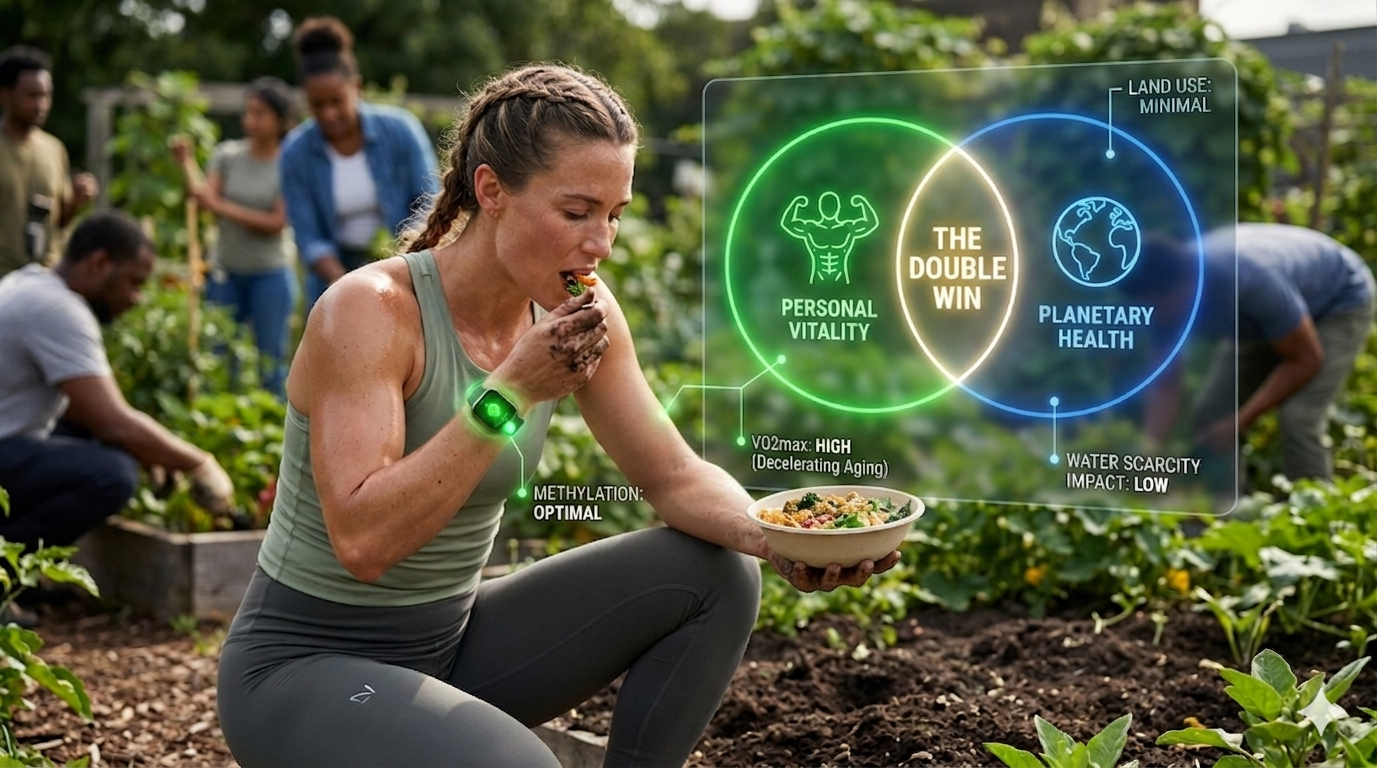
In 2026, the conversation about human optimization is fundamentally shifting. We are moving past the outdated view that high-performance nutrition and sustainable living are separate pursuits. Instead, we are recognizing that the blueprint for maximizing your vitality is identical to the blueprint for minimizing your ecological footprint.
This alignment is what I call The “Double Win.”
The emerging research of the mid-2020s has confirmed a powerful symmetry: when you fuel your body optimally, you almost inherently reduce the environmental resource load required to sustain that vitality. Your pursuit of longevity and performance is also a significant biological contribution to the earth.
The Science: Personal Vitality is Synonymous with Sustainability
For years, mainstream and scientific circles debated the environmental cost of different diets. However, landmark research released in late 2025 by the EAT-Lancet Commission has provided definitive, multi-perspective data.
This 2025 report confirmed that widespread adoption of a “Planetary Health Diet” could prevent up to 15 million premature deaths annually while cutting food-related greenhouse gas emissions by more than half.
The data is clear: what is optimal for human metabolism is also optimal for environmental systems. By focusing on minimally processed plants, you automatically reduce the transgression of key “planetary boundaries,” including freshwater use and land system change.
➡️ The Gut–Muscle Axis: How Microbiome Health Influences Strength and Recovery
The Plant-Based Lens: Efficiency on Every Level
Why is a plant-forward diet the defining feature of the “Double Win”? It comes down to trophic efficiency.
Lower Resource Density: Consuming plants directly accesses the initial source of solar energy. Transitioning to a plant-rich diet could free up land equivalent to the size of India.
Mitigating Metabolic Toxicity: Whole plant foods are rich in fiber and polyphenols. New 2026 research identifies high-protein plant sources as the most efficient way to fuel a human body while respecting planetary limits.
The Gut-Brain Connection: A high-fiber, plant-diverse microbiome supports the mental clarity required for long-term behavior change. By fostering microbial diversity, you are supporting the same ecological diversity required for a stable climate.
➡️ Fiber Performance Enhancer: The Most Underrated Edge
The Behavioral Win: Adopting the “Double Identity”
Understanding the “Double Win” provides a powerful motivational strategy. You are no longer navigating the fragile landscape of willpower; you are aligning your daily habits with a dual identity:
You are a Regenerative Fitness Enthusiast.
This identity shift allows you to make decisions that feel cohesive, not sacrificial. When a meal helps you silence an aging gene and conserve water, you experience a high level of “Buy-In” rather than mere compliance. You are optimizing your personal metabolic profit while simultaneously paying down the ecological debt.
➡️ Why Identity Is the Missing Link in Long-Term Health Change
References
Carbon Brief. (2025, October 2). EAT-Lancet report: Three key takeaways on climate and diet change.
Rockström, J., Loken, B., Barilla, S., Fan, S., Zurayk, R., Wood, A., … & Willett, W. (2025). The EAT–Lancet Commission on healthy, sustainable, and just food systems: Planetary boundaries and food system transformation. The Lancet, 406(10512), 1625–1700.
Liang, J., Zhao, Y., Cheng, Y., Hu, Z., Yuan, Y., Xiao, J., Farag, M. A., Cai, X., Cao, H., & Yue, T. (2026). Polyphenols, epigenetics, and methionine metabolism: Unlocking therapeutic potential. Critical Reviews in Food Science and Nutrition, 66(5), 950–965.
MRC Epidemiology Unit. (2025, October 3). EAT-Lancet Commission report warns that food systems breach planetary limits. University of Cambridge.
Stockholm Resilience Centre. (2025, October 3). EAT-Lancet 2025: Global food transformation needed to save millions of lives.