
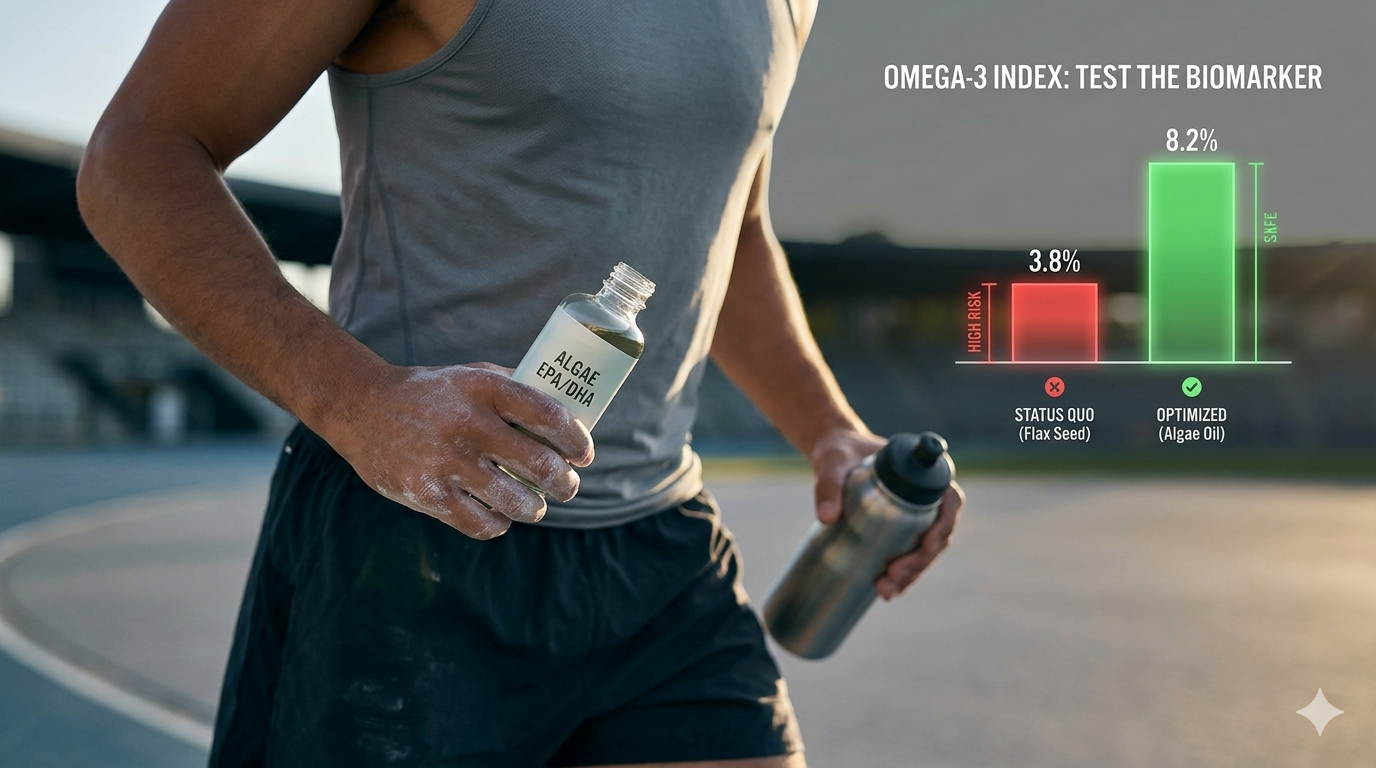
In 2026, the conversation about human optimization is shifting. We are moving past simple calorie counting and diving into the “biological software” that runs your metabolism. While many athletes prioritize metrics like VO₂max for longevity, one critical variable remains almost universally ignored in the plant-based community: The Omega-3 Index.
As a functional practitioner, I often see dedicated vegan athletes presenting with unexplained fatigue and joint stiffness despite a “perfect” whole-food diet. Their blood sugar is great, but their Omega-3 Index—a measure of red blood cell EPA and DHA—is often in the high-risk “Anemic” category (under 4.0%). This isn’t just a deficiency; it’s a metabolic bottleneck.
The Science: Defining Metabolic Anti-Inflammation
The Omega-3 Index measures the percentage of EPA (eicosapentaenoic acid) and DHA (docosahexaenoic acid) in your red blood cell membranes. Unlike a standard blood test, this is the gold standard for long-term, tissue-level cellular health.
An optimized target is >8.0%. At this level, your cell membranes are fluid and efficient at nutrient transfer. Crucially, they are equipped to synthesize Specialized Pro-resolving Mediators (SPMs)—the “cleanup crew” that terminates the inflammatory response after a hard workout.
➡️ VO₂max for Longevity: Why Your Cardiorespiratory Fitness Predicts Lifespan and Healthspan
The Plant-Based Crisis: The Conversion Trap
For plant-based athletes, the confusion lies in “ALA.” Flax, chia, and hemp seeds provide ALA (alpha-linolenic acid). While ALA is healthy, it must be converted by the liver into EPA and DHA to protect your joints and brain.
The 2024 data is clear: Humans are remarkably inefficient at this. The conversion rate of ALA to DHA is often less than 0.5%. Relying solely on seeds to build your Omega-3 Index is a strategy that ignores human physiology.
The Brain-Body Axis: Preventing “Neuro-Burnout”
A low Omega-3 Index doesn’t just hurt your knees; it hurts your drive. DHA makes up a massive portion of your brain’s structure. Recent neurobiological studies show that low DHA levels lead to neuro-inflammation, which directly down-regulates dopamine D2 receptors. This is why you might feel an inexplicable loss of “zest” or motivation—your brain’s reward hardware is physically struggling.
Optimization Action Plan
Test, Don’t Guess: Order an Omega-3 Index test. If you are under 8%, your recovery is being throttled.
Bypass the Fish: To hit optimized levels without the ecological footprint of overfishing, use algae-derived EPA/DHA (minimum 500mg daily). It is the “Double Win”—protecting your personal vitality and the planet’s oceans simultaneously.
Optimize the Gut: A healthy microbiome ensures these fatty acids are absorbed efficiently.
➡️ The Gut–Muscle Axis: How Microbiome Health Influences Strength and Recovery
References
Harris, W. S., Tintle, N. L., Imamura, F., Qian, F., Korat, A. V., Marklund, M., … & Mozaffarian, D. (2024). Blood n-3 fatty acid levels and total and cause-specific mortality: A pooled analysis of 17 prospective cohort studies. Nature Communications, 15(1), 4342.
Saini, R. K., & Keum, Y. S. (2024). Omega-3 and omega-6 polyunsaturated fatty acids: Dietary sources, metabolism, and biological importance. International Journal of Molecular Sciences, 25(8), 4342.
Subash, S., & Essa, M. M. (2024). Neuroprotective effects of long-chain polyunsaturated fatty acids on neurodegenerative diseases. Journal of Clinical Medicine, 13(5), 1241.
Volkow, N. D., Wise, R. A., & Baler, R. (2024). The dopamine motive system: Implications for lifestyle burnout and anhedonia. Molecular Psychiatry, 29(1), 114–128.