Most people believe fat loss is driven by how aggressively they can cut calories. Eat less, lose more—right?
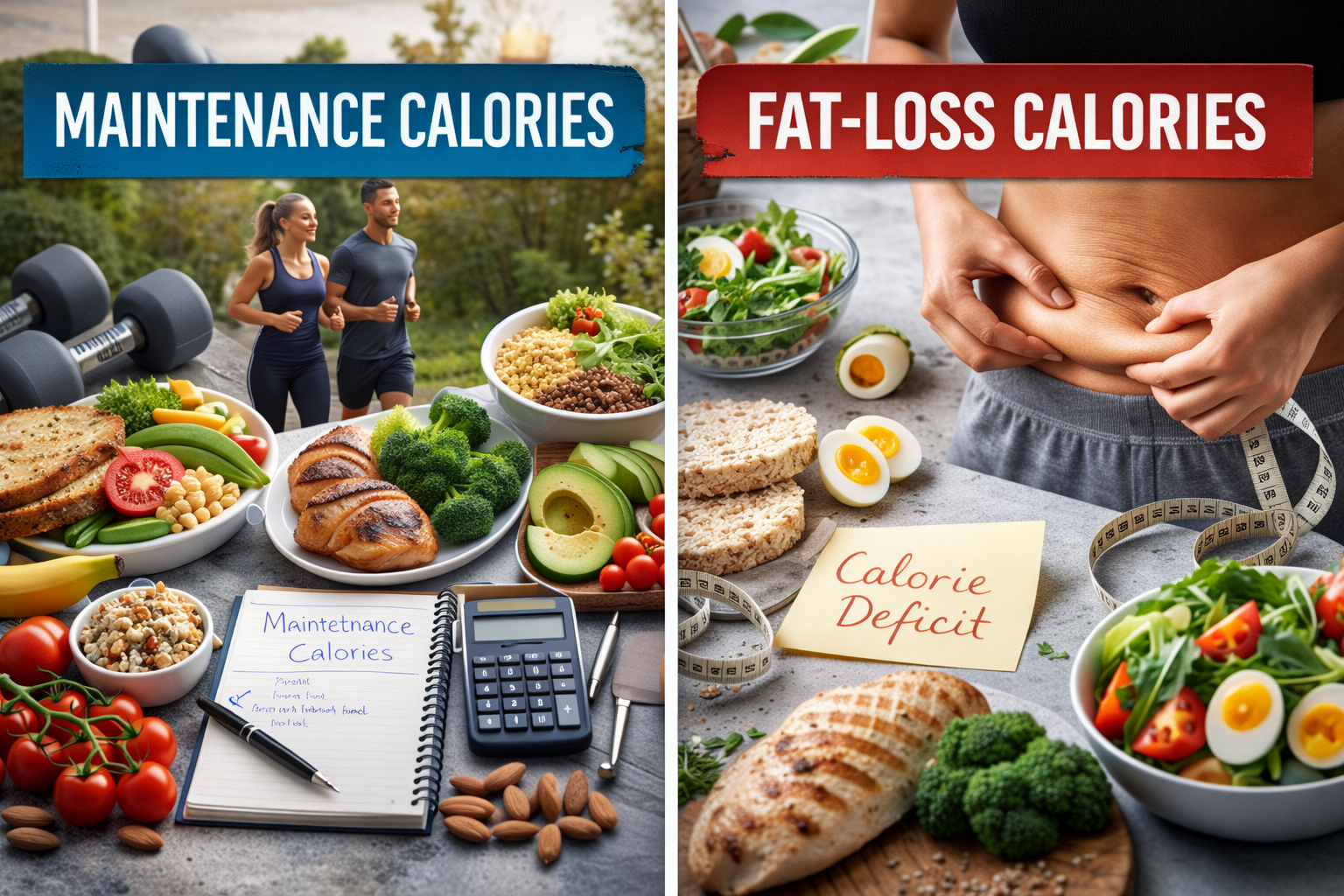
In reality, maintenance calories—demonstrating the ability to hold body weight while fueling training, recovery, and daily life—are far more predictive of long-term success than any short-term deficit.
Fat-loss calories may create change. Maintenance calories determine whether that change lasts.
➡️ Why Aggressive Fat Loss Backfires
Fat Loss Is Easy. Maintenance Is the Skill.
Nearly anyone can lose weight temporarily by slashing calories. What’s rare is maintaining body composition without chronic hunger, metabolic slowdown, or rebound weight gain.
Research consistently shows that most weight regain occurs after the dieting phase—not during it. This is because prolonged caloric restriction triggers adaptive responses including:
- Reduced resting energy expenditure
- Increased hunger hormones (ghrelin)
- Decreased satiety hormones (leptin)
- Lower spontaneous physical activity
These adaptations persist well beyond the diet itself.
👉 Maintenance calories are where these adaptations are either reinforced—or reversed.
Maintenance Calories Support Metabolic Health
Remaining in long-term energy deficits increases the risk of low energy availability, a condition linked to hormonal disruption, poor bone health, impaired immune function, and reduced performance.
Maintenance intake allows:
- Normalization of thyroid output
- Restoration of leptin signaling
- Improved insulin sensitivity
- Stable training output and recovery
In athletes and active adults, maintaining adequate energy intake is strongly associated with better performance outcomes and reduced injury risk.
Diet Adherence Depends on Maintenance Phases
Adherence—not willpower—is the strongest predictor of fat-loss success.
A large review published in The American Journal of Clinical Nutrition found that rigid dieting approaches increase dropout rates and weight regain compared to flexible strategies that include planned maintenance phases.
Maintenance calories:
- Reduce psychological fatigue
- Normalize food relationships
- Improve social and lifestyle compatibility
- Increase long-term compliance
Without maintenance phases, fat-loss calories eventually become unsustainable.
➡️ The Psychological Cost of Chronic Dieting
Performance Suffers When Maintenance Is Ignored
Chronic caloric deficits impair strength, power, endurance, and neuromuscular performance. Even recreational trainees experience declining output when energy intake remains suppressed too long.
Maintenance calories allow athletes and active individuals to:
- Train with intent instead of survival
- Preserve lean mass
- Maintain glycogen availability
- Support recovery between sessions
This is especially critical for clients prioritizing longevity, not just aesthetics.
Maintenance Calories Prevent the “Yo-Yo” Cycle
Weight cycling—repeated loss and regain—is associated with increased cardiometabolic risk and poorer psychological health.
By spending more time at maintenance than in deficit, individuals:
- Reduce rebound weight gain
- Improve metabolic efficiency
- Build confidence in food autonomy
- Exit the binge-restrict cycle
Fat loss should be a temporary phase. Maintenance should be the default.
Practical Takeaway
If your program only teaches how to eat less—but not how to maintain—it’s incomplete.
The most successful body-composition transformations are built on:
- Short, intentional fat-loss phases
- Long, well-supported maintenance phases
- Adequate fueling for training and life
- A metabolism that isn’t constantly under threat
Fat-loss calories change the scale.
Maintenance calories change outcomes.
➡️ Recovery for Fat Loss: Why It’s the Missing Variable in Most Programs
References
Dulloo, A. G., Jacquet, J., Montani, J. P., & Schutz, Y. (2015). Adaptive thermogenesis in human body weight regulation: More of a concept than a measurable entity? Obesity Reviews, 16(Suppl 1), 1–15.
Hall, K. D., Heymsfield, S. B., Kemnitz, J. W., Klein, S., Schoeller, D. A., & Speakman, J. R. (2012). Energy balance and its components: Implications for body weight regulation. The American Journal of Clinical Nutrition, 95(4), 989–994.
Johnston, B. C., Kanters, S., Bandayrel, K., Wu, P., Naji, F., Siemieniuk, R. A. C., … Guyatt, G. (2014). Comparison of weight loss among named diet programs in overweight and obese adults. The American Journal of Clinical Nutrition, 100(2), 541–554.
Loucks, A. B., Kiens, B., & Wright, H. H. (2011). Energy availability in athletes. Journal of Sports Sciences, 29(Suppl 1), S7–S15.
Mettler, S., Mitchell, N., & Tipton, K. D. (2010). Increased protein intake reduces lean body mass loss during weight loss in athletes. Medicine & Science in Sports & Exercise, 42(2), 326–337.
Mountjoy, M., Sundgot-Borgen, J., Burke, L., Ackerman, K. E., Blauwet, C., Constantini, N., … Budgett, R. (2018). IOC consensus statement on relative energy deficiency in sport (RED-S). British Journal of Sports Medicine, 52(11), 687–697.
Rosenbaum, M., & Leibel, R. L. (2010). Adaptive thermogenesis in humans. International Journal of Obesity, 34(Suppl 1), S47–S55.