
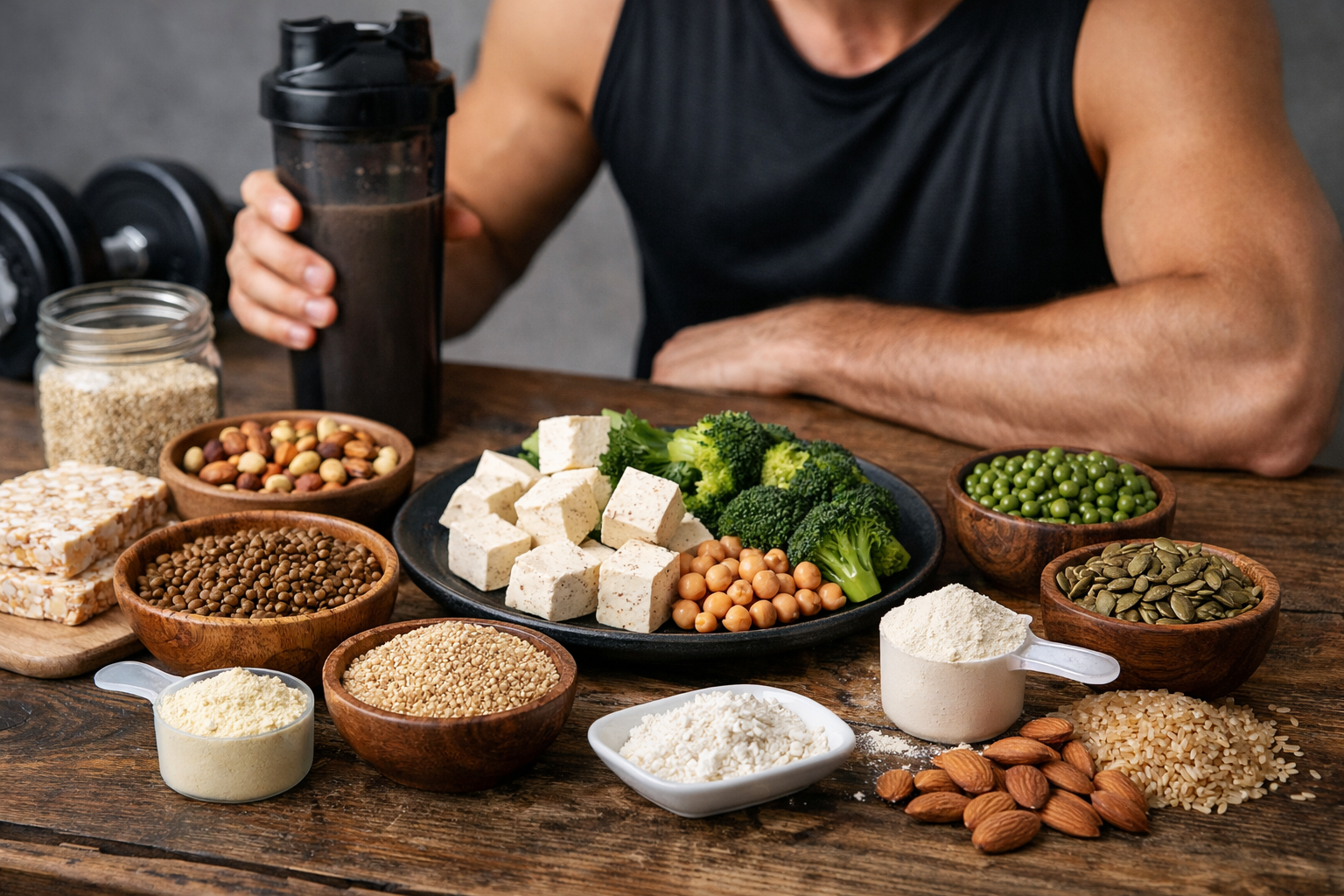
Leucine Threshold on a Plant-Forward Diet: What Actually Matters for Muscle Growth
Muscle growth is not driven by protein intake alone. It is regulated by a nutrient-sensing system that responds to specific amino acids—most notably leucine. For athletes and active individuals following a plant-forward diet, understanding how leucine works matters far more than debating plant versus animal protein in abstract terms.
➡️ Can Plants Really Build Muscle?
This article explains what leucine thresholds actually represent, how they regulate muscle protein synthesis (MPS), and how plant-forward diets can reliably meet these requirements when structured correctly.
Why Leucine Is the Primary Trigger for Muscle Protein Synthesis
Leucine is a branched-chain amino acid (BCAA) with a unique signaling role in skeletal muscle. Unlike most amino acids, leucine directly activates the mechanistic target of rapamycin complex 1 (mTORC1), which initiates translation and upregulates muscle protein synthesis.
Without sufficient leucine, increases in total protein intake do not proportionally increase MPS. This phenomenon led to the concept of the leucine threshold—the minimum leucine dose required in a meal to maximally stimulate muscle protein synthesis.
➡️ Plant Protein Quality and Muscle Building
Controlled human studies indicate that approximately 2.5–3.0 g of leucine per meal is sufficient to maximize MPS in young, healthy adults, both at rest and following resistance exercise.
Once this threshold is reached, additional leucine does not further increase synthesis, making threshold attainment more important than excessive protein intake.
Leucine Density: Where Plant Proteins Differ
Plant proteins are often described as “lower quality” due to differences in amino acid composition. From a leucine perspective, this critique has partial merit but is frequently overstated.
On average:
- Animal-based proteins contain approximately 10–12% leucine by protein weight
- Many whole-food plant proteins contain 6–8% leucine.
Lower leucine density does not mean plant proteins are ineffective—it means that larger portions or higher total protein intakes may be required to reach the same leucine threshold.
Importantly, several plant protein isolates (e.g., soy, pea, potato, corn) demonstrate leucine contents and digestion kinetics that can approach those of animal proteins when consumed in adequate doses.
Can a Plant-Forward Diet Reach the Leucine Threshold?
Yes—consistently and without extreme strategies.
A modeling study examining resistance-trained individuals consuming entirely plant-based diets found that when energy needs were met, per-meal leucine intake ranged from ~2.7 to 2.9 g, sufficient to maximize MPS.
The same study demonstrated that daily leucine intake frequently exceeded 8 g per day, distributed across meals, despite the absence of animal protein.
➡️ 10 Nutritional Supplements for Endurance Athletes
These findings reinforce a critical point:
Leucine adequacy on plant-forward diets is a function of total protein, energy intake, and food selection—not dietary ideology.
Plant Proteins, Blends, and Muscle Protein Synthesis
Single-source plant proteins may be limited by one or more essential amino acids. However, research shows that blended plant proteins improve amino acid availability and MPS outcomes.
For example:
- Wheat protein ingestion increases MPS in a dose-dependent manner, despite lower leucine content
- Blended plant protein isolates stimulate MPS similarly to whey protein when total leucine and essential amino acids are matched
This supports a pragmatic strategy: optimize amino acid profiles through diversity and dose, rather than seeking a single “perfect” protein source.
Leucine Supplementation: When It Helps—and When It Doesn’t
Adding free leucine to protein can enhance the MPS response of lower-leucine proteins, particularly in plant-based contexts. However, leucine alone does not sustain muscle protein synthesis in the absence of other essential amino acids.
Leucine functions as a trigger, not a building block. Without sufficient total protein and essential amino acids, MPS cannot be maintained.
Therefore, leucine supplementation is best viewed as a strategic amplifier, not a substitute for adequate protein intake.
Protein Distribution Matters More Than Daily Totals
Muscle protein synthesis is a transient process. Once stimulated, it returns to baseline within hours—even if amino acids remain elevated. For this reason, evenly distributing protein (and leucine) across meals is more effective than skewing intake toward one large feeding.
Evidence suggests that consuming protein in 3–4 evenly spaced meals, each meeting the leucine threshold, optimizes daily MPS more effectively than uneven intake patterns.
What Actually Matters for Muscle Growth on a Plant-Forward Diet
For individuals training with progressive resistance:
- Hitting the leucine threshold per meal
- Meeting total daily protein needs
- Ensuring sufficient total energy intake
- Distributing protein evenly across the day
- Pairing nutrition with resistance training
These factors—not protein source dogma—determine hypertrophic outcomes.
When these fundamentals are met, plant-forward diets are fully capable of supporting muscle growth comparable to omnivorous patterns.
Key Takeaway
Leucine thresholds are not a limitation of plant-forward diets—they are a planning consideration. When protein intake, meal distribution, and training stimulus are aligned, plant-forward athletes can reliably stimulate muscle protein synthesis and support long-term strength and hypertrophy.
The science is clear: muscle responds to signals, not labels.
References
Churchward-Venne, T. A., Burd, N. A., Mitchell, C. J., West, D. W. D., Philp, A., Marcotte, G. R., Baar, K., & Phillips, S. M. (2012). Supplementation of a low-protein mixed macronutrient beverage with leucine or essential amino acids: Effects on muscle protein synthesis at rest and following resistance exercise in young men. The Journal of Physiology, 590(11), 2751–2765.
Gorissen, S. H. M., Horstman, A. M. H., Franssen, R., Kouw, I. W. K., Wall, B. T., & van Loon, L. J. C. (2016). Ingestion of wheat protein increases in vivo muscle protein synthesis rates in healthy older men in a dose-dependent manner. The Journal of Nutrition, 146(9), 1651–1659.
Gorissen, S. H. M., & van Loon, L. J. C. (2018). The muscle protein synthetic response to food ingestion. Meat Science, 144, 38–43.
Goldman, D. M., Berkowitz, S. A., & Katz, D. L. (2024). Completely plant-based diets that meet energy requirements for resistance training can supply sufficient protein and leucine to maximize skeletal muscle hypertrophy and strength: A modeling study. Nutrients, 16(8), Article 1122.
Lim, C. L., Janssen, T. A. J., Currier, B. S., Porter, J. W., Palacios, O. M., & Phillips, S. M. (2024). Muscle protein synthesis in response to plant-based protein isolates with or without added leucine compared with whey protein in young adults. Current Developments in Nutrition, 8(5), Article 102384.
Morton, R. W., Murphy, K. T., McKellar, S. R., Schoenfeld, B. J., Henselmans, M., Helms, E., Aragon, A. A., Devries, M. C., Banfield, L., Krieger, J. W., & Phillips, S. M. (2018). A systematic review, meta-analysis and meta-regression of the effect of protein supplementation on resistance training–induced gains in muscle mass and strength in healthy adults. British Journal of Sports Medicine, 52(6), 376–384.
Tang, J. E., Moore, D. R., Kujbida, G. W., Tarnopolsky, M. A., & Phillips, S. M. (2009). Ingestion of whey hydrolysate, casein, or soy protein isolate: Effects on mixed muscle protein synthesis at rest and following resistance exercise in young men. Journal of Applied Physiology, 107(3), 987–992.
van Vliet, S., Burd, N. A., & van Loon, L. J. C. (2015). The skeletal muscle anabolic response to plant- versus animal-based protein consumption. The Journal of Nutrition, 145(9), 1981–1991.
Wolfe, R. R. (2017). Branched-chain amino acids and muscle protein synthesis in humans: Myth or reality? Journal of the International Society of Sports Nutrition, 14, Article 30.