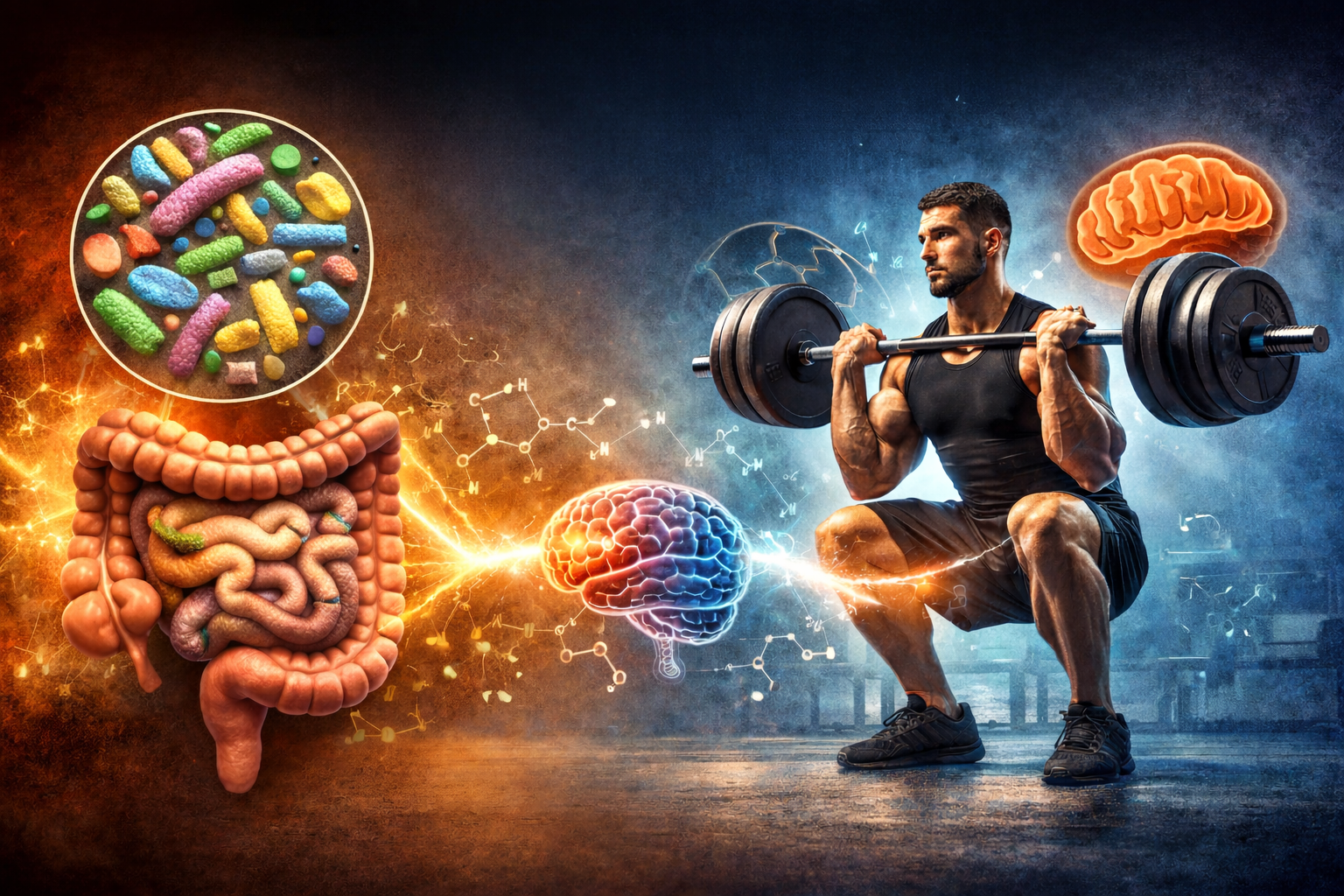
If you’re chasing strength gains, better recovery, and improved performance, you probably pay close attention to your training program, nutrition quality, sleep, and recovery habits. But there’s a powerful system you might be overlooking — one that acts almost like a “hidden coach” behind the scenes of your physiology: the gut–muscle axis.
This concept refers to the bi-directional relationship between your gut microbiome and skeletal muscle function — and research suggests it plays a meaningful role in strength outcomes, recovery efficiency, inflammation regulation, and metabolic adaptation.
Let’s break down what the gut–muscle axis is, how it works, and practical ways to support it.
➡️ Why Recovery Is the Missing Variable in Most Fat-Loss Programs
What Is the Gut–Muscle Axis?
The gut–muscle axis describes how trillions of microorganisms in the gastrointestinal (GI) tract interact with skeletal muscle — not just passively, but through active biochemical signaling.
Microbes in your gut influence:
- Digestive efficiency
- Nutrient absorption
- Inflammatory pathways
- Energy metabolism
- Immune regulation
…and these factors, in turn, affect how your muscles respond to training stimuli.
Research shows that the gut microbiome can directly influence muscle mass and function through metabolites, hormonal signaling, and interactions with the nervous system
How Gut Microbes Influence Strength and Recovery
1. Short-Chain Fatty Acids (SCFAs) and Muscle Metabolism
Microbiota ferment dietary fibers into SCFAs such as acetate, propionate, and butyrate. These compounds:
- Improve insulin sensitivity
- Reduce low-grade inflammation
- Support mitochondrial function
- Influence skeletal muscle energy pathways
SCFAs are not just metabolic byproducts — they function as signaling molecules that can enhance muscle energy metabolism and recovery.
➡️ Plant-Forward Doesn’t Mean Vegan Only
2. Microbial Modulation of Inflammation
Training, especially at high intensity or volume, induces microtrauma and an inflammatory response. A balanced gut microbiome helps regulate this process, preventing chronic inflammation that can slow recovery.
Studies show that athletes with higher gut microbial diversity tend to exhibit lower inflammatory markers and better recovery profiles than less active individuals.
3. Amino Acid Utilization and Protein Metabolism
Protein is essential for muscle protein synthesis (MPS), but absorption and effective use depend on intestinal function and microbiome composition. Certain gut bacteria can increase amino acid bioavailability, which supports efficient MPS and better strength outcomes.
Exercise Itself Modulates the Microbiome
The relationship between the gut and muscle isn’t one-way. Exercise also shapes the microbiome, promoting microbial diversity and beneficial shifts in community structure.
Studies have demonstrated that regular physical activity increases gut microbial richness, which in turn:
- Enhances SCFA production
- Improves immune resilience
- Supports metabolic health
This suggests a positive feedback loop: better fitness supports a healthier microbiome and a healthier microbiome supports training adaptation.
➡️ Maximizing Your Cardio Training
Practical Implications for Strength and Recovery
Improve Gut Diversity Through Diet
A plant-rich, fiber-diverse eating pattern feeds beneficial bacteria that produce SCFAs and other metabolites conducive to muscle function.
Focus on:
- Legumes
- Whole grains
- Vegetables
- Fruits
- Fermented foods (e.g., kefir, sauerkraut)
This dietary pattern complements other performance nutrition goals and supports gut ecosystem diversity.
Consider Probiotics Strategically
Certain probiotic strains have been associated with reduced markers of muscle damage and faster recovery, though supplementation should be evidence-informed and individualized.
Support Training With Consistent Movement
Both aerobic and resistance training are beneficial for the gut–muscle axis. Even habitual movement patterns (NEAT) may influence microbiome signaling and recovery kinetics.
Summary
The gut–muscle axis is an emerging but increasingly supported concept that connects digestive ecology with muscular performance. A robust and diverse microbiome:
✔ Improves metabolic signaling
✔ Reduces inflammatory burden
✔ Enhances protein metabolism
✔ Supports recovery
…all of which contribute meaningfully to strength and training adaptation.
In other words, taking care of your gut isn’t just about digestion — it’s about recovering faster, adapting better, and performing stronger.
References
Bäckhed, F., Ding, H., Wang, T., Hooper, L. V., Koh, G. Y., Nagy, A., Semenkovich, C. F., & Gordon, J. I. (2004). The gut microbiota as an environmental factor that regulates fat storage. Proceedings of the National Academy of Sciences of the United States of America, 101(44), 15718–15723.
Barton, W., Penney, N. C., Cronin, O., Garcia-Perez, I., Molloy, M. G., Holmes, E., Shanahan, F., Cotter, P. D., & O’Sullivan, O. (2018). The microbiome of professional athletes differs from that of more sedentary subjects in composition and particularly at the functional metabolic level. Gut, 67(4), 625–633.
Chen, Y., Huang, W. C., Chiu, C. C., Chang, Y. K., Huang, C. C., & Tsai, Y. J. (2019). Exercise, gut microbiota, and metabolic disorders. Current Opinion in Endocrinology, Diabetes and Obesity, 26(5), 314–319.
Clark, A., Mach, N., & Fröhlich, J. (2022). The gut–muscle axis: Implications for skeletal muscle adaptation and exercise performance. Advances in Nutrition, 13(2), 531–545.
Dalton, A., Mermier, C., Zuhl, M., & Schneider, S. (2019). Exercise influence on the microbiome–gut–brain axis. Gut Microbes, 10(5), 555–568.
Lahiri, S., Kim, H., Garcia-Perez, I., Reza, M. M., Martin, K. A., Kundu, P., Cox, L. M., Selkrig, J., Posma, J. M., Zhang, H., et al. (2019). The gut microbiota influences skeletal muscle mass and function in mice. Science Translational Medicine, 11(502), eaao2786.
Scheiman, J., Luber, J. M., Chavkin, T. A., MacDonald, T., Tung, A., Pham, L. D., Wibowo, M. C., Wurth, R. C., Punthambaker, S., Tierney, B. T., et al. (2019). Meta-omics analysis of elite athletes identifies a performance-enhancing microbe that functions via lactate metabolism. Nature Medicine, 25(7), 1104–1109.