
Why Your Microbiome Shapes Your Fitness
For years, fitness culture has obsessed over training volume, macros, supplements, and recovery tools. But a growing body of research suggests something far more foundational may be shaping performance behind the scenes: your gut microbiome.
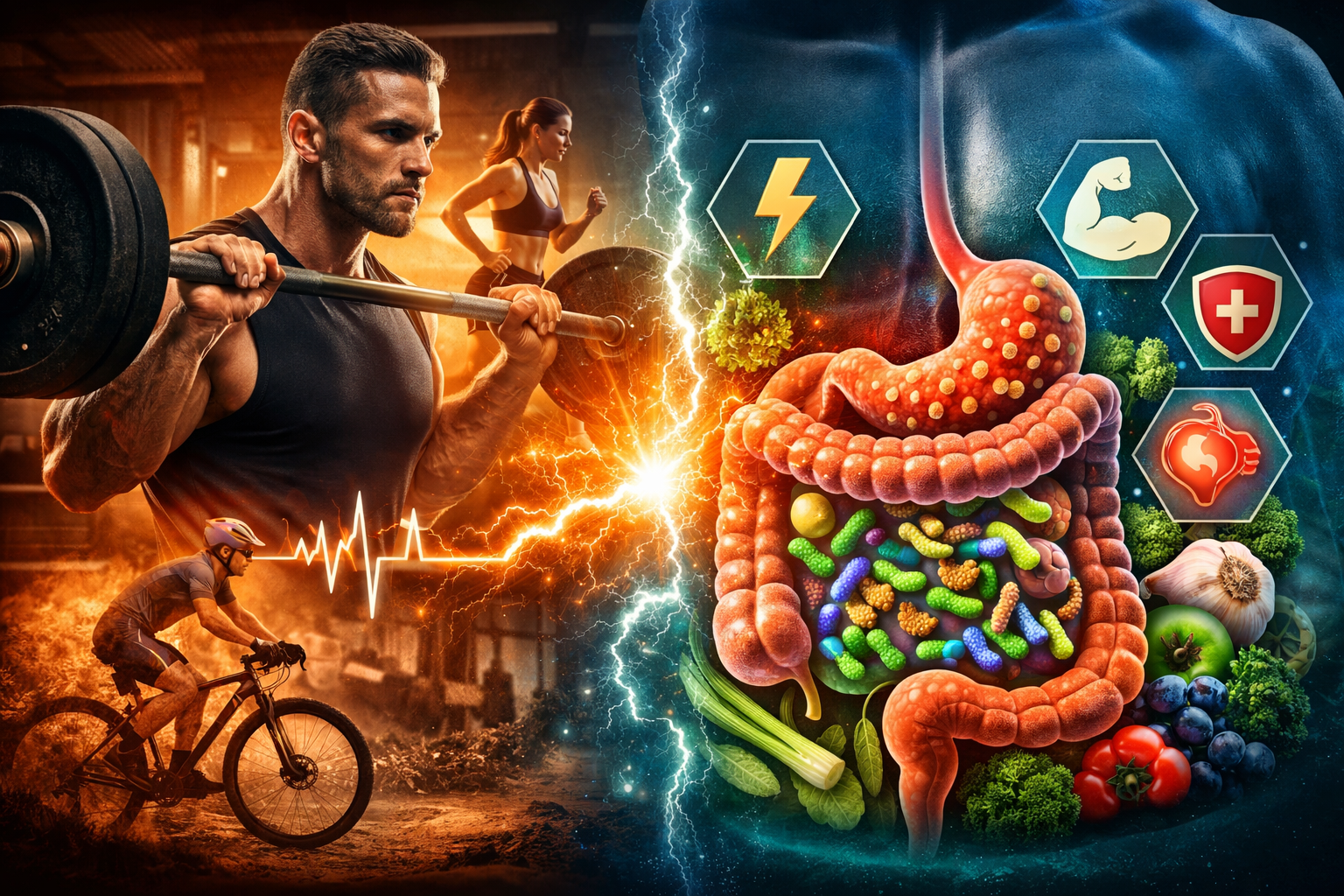
The gut doesn’t just digest food. It influences energy availability, inflammation, immune resilience, recovery speed, injury risk, and even mental focus. In many ways, gut health is becoming the invisible strength training program athletes never realized they were running.
The Gut–Performance Connection
Your gut microbiome consists of trillions of bacteria that help regulate metabolism, immune function, and inflammation. Exercise itself alters gut bacterial diversity, while gut health determines how effectively your body adapts to training stress.
Athletes with healthier, more diverse microbiomes tend to demonstrate:
Better carbohydrate utilization
Lower systemic inflammation
Improved recovery markers
Reduced gastrointestinal distress during training and competition
One notable discovery is Veillonella, a bacterium shown to metabolize exercise-produced lactate into short-chain fatty acids (SCFAs), which may enhance endurance capacity.
➡️ Why More High Performers Are Eating Mostly Plant-Based
Energy Availability Starts in the Gut
Fuel doesn’t matter if it can’t be absorbed.
Gut bacteria assist in breaking down fiber into SCFAs like butyrate, which support intestinal integrity and mitochondrial efficiency—key for sustained energy output.
Low microbial diversity has been associated with:
Poor glycogen replenishment
Increased fatigue
Blood sugar instability
This is especially relevant for endurance athletes and high-volume trainers relying on consistent energy delivery.
➡️ Benefits of a Vegan Diet for Athletes and Non-Athletes
Recovery, Inflammation, and Injury Risk
Training adaptation occurs after the workout—during recovery. Chronic inflammation delays this process and raises injury risk.
A balanced microbiome helps regulate inflammatory signaling pathways by:
Modulating cytokine production
Supporting gut barrier integrity (preventing “leaky gut”)
Reducing endotoxin-driven immune activation
Gut Health and the Immune System
Roughly 70% of the immune system resides in the gut-associated lymphoid tissue (GALT). When gut health declines, immune resilience often follows.
This matters for:
Training consistency
Illness-related downtime
Overtraining syndrome risk
Athletes training hard while under-fueling fiber or over-consuming ultra-processed foods may unknowingly suppress immune defenses.
➡️ Balanced Nutrition: What It Actually Means
What Athletes Can Actually Do (Actionable Steps)
1. Prioritize Fiber-Rich Plants
Aim for 30–50g of fiber per day from whole plant foods. Diversity matters more than perfection.
2. Eat the “Nutrition Garden”
Consume a wide spectrum of colors to support microbial diversity.
3. Include Fermented Foods
Tempeh, sauerkraut, kimchi, and non-dairy yogurts can support microbial balance.
4. Time Probiotics Strategically
Probiotics may be helpful during:
High training stress
Travel
Antibiotic use
5. Reduce Ultra-Processed Foods
Highly processed diets reduce microbial diversity and impair gut barrier function.
➡️ The Ultra-Processed Food Problem
Why Plant-Based Diets Align Naturally with Gut Health
Plant-based diets consistently show higher microbiome diversity, greater SCFA production, and lower inflammation markers compared to animal-heavy diets.
This doesn’t require perfection—plant-forward consistency is enough to drive meaningful physiological change.
The Big Picture
Strength training builds muscle.
Conditioning builds capacity.
Gut health determines how well your body adapts to both.
Ignoring the microbiome is like training without recovery—it works for a while, then quietly breaks down.
Athletes and active individuals looking for sustainable performance gains should view gut health not as a wellness trend, but as foundational infrastructure for fitness.
References
Belkaid, Y., & Hand, T. W. (2014). Role of the microbiota in immunity and inflammation. Cell, 157(1), 121–141.
Clarke, S. F., Murphy, E. F., O’Sullivan, O., Lucey, A. J., Humphreys, M., Hogan, A., … Shanahan, F. (2014). Exercise and associated dietary extremes impact on gut microbial diversity. Gut, 63(12), 1913–1920.
Karl, J. P., Hatch, A. M., Arcidiacono, S. M., Pearce, S. C., Pantoja-Feliciano, I. G., Doherty, L. A., & Soares, J. W. (2018). Effects of psychological, environmental and physical stressors on the gut microbiota. Frontiers in Microbiology, 9, 2013.
Koh, A., De Vadder, F., Kovatcheva-Datchary, P., & Bäckhed, F. (2016). From dietary fiber to host physiology: Short-chain fatty acids as key bacterial metabolites. Cell, 165(6), 1332–1345.
Scheiman, J., Luber, J. M., Chavkin, T. A., MacDonald, T., Tung, A., Pham, L. D., … Kostic, A. D. (2019). Meta-omics analysis of elite athletes identifies a performance-enhancing microbe. Nature Medicine, 25(7), 1104–1109.
Tomova, A., Bukovsky, I., Rembert, E., Yonas, W., Alwarith, J., Barnard, N. D., & Kahleova, H. (2019). The effects of vegetarian and vegan diets on gut microbiota. Frontiers in Nutrition, 6, 47.