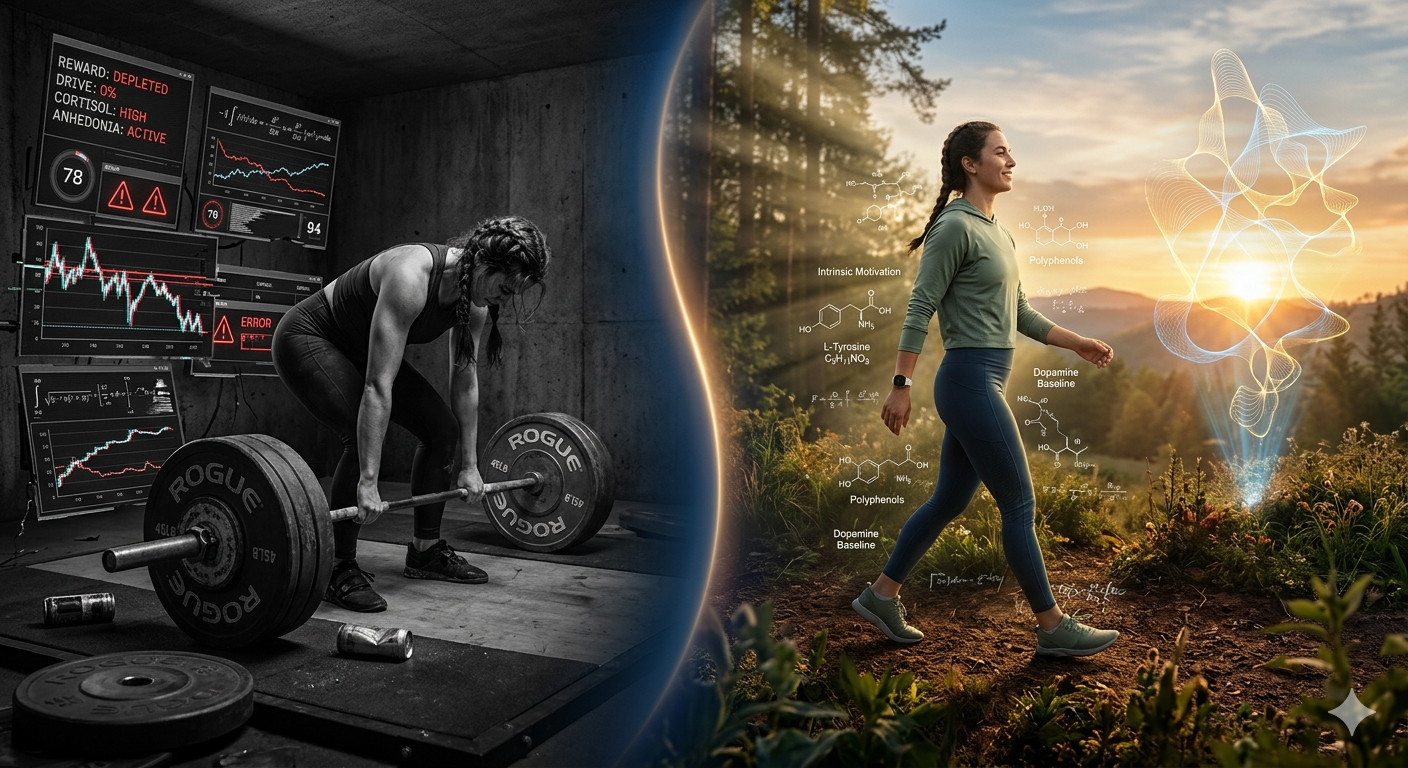
In 2026, the limiting factor for most athletes isn’t their muscular strength or aerobic capacity—it’s their neurobiology. We are living in an era of “hyper-stimulation,” where wearable data, social media comparison, and high-intensity “grind” culture have overextended our reward pathways.
If you’ve ever felt a sudden, inexplicable loss of motivation despite having a “perfect” plan, you aren’t lazy. You are likely experiencing dopamine depletion. For the lifelong athlete, managing this neurotransmitter is the difference between a decade of progress and a recursive cycle of burnout.
The Science: Understanding the Dopamine Baseline
Dopamine is the molecule of pursuit and anticipation, not just pleasure. Recent neurobiological research has highlighted the concept of the “Dopamine Baseline”—the steady state of dopamine that determines our drive and “zest” for life.
When we stack too many “peaks”—pre-workout stimulants, high-energy playlists, and constant checking of fitness trackers—we trigger a subsequent “crash” below our baseline. Over time, this leads to anhedonia, where the very activities that used to bring us joy (like a heavy lifting session) feel like a chore. Research in Molecular Psychiatry confirms that chronic over-stimulation of the mesolimbic pathway leads to down-regulation of D2 receptors, effectively “numbing” our ability to feel motivated .
➡️ How to Train Smarter With Fitness Wearables
The Plant-Based Lens: Precursors and Gut Health
How does a plant-forward lifestyle support dopamine regulation? It’s about providing the raw materials and protecting the environment where they are synthesized.
Tyrosine and Phenylalanine: These are the amino acid precursors to dopamine. While found in animal products, plant sources like pumpkin seeds, lima beans, and almonds provide these precursors alongside fiber, preventing the massive insulin spikes that can interfere with large neutral amino acid (LNAA) transport across the blood-brain barrier.
The Microbiome-Brain Axis: Up to 50% of the body’s dopamine is produced in the gut. A plant-diverse diet rich in polyphenols protects the enteric nervous system, ensuring that the “bottom-up” signals to your brain remain clear and consistent.
Antioxidant Support: Intense training creates oxidative stress. Anthocyanins (found in berries) have been shown to protect dopaminergic neurons from oxidative damage, preserving your “neurological stamina”.
➡️ The Gut–Muscle Axis: How Microbiome Health Influences Strength and Recovery
Behavioral Strategy: The “Dopamine Fast” for Athletes
To stay in the game for life, you must stop “layering” rewards. If you need a stimulant, a loud playlist, and a public social media post just to get through a workout, you are training your brain to ignore the intrinsic value of the movement itself.
Become an Intrinsic Athlete.
This means occasionally training in silence, without a tracker, or in a fasted state. By lowering the “peak,” you prevent the “crash.” This identity shift—moving from someone who “needs” external motivation to someone who finds value in the process—is the ultimate safeguard against burnout.
➡️ Motivation and Fitness Success: Why Motivation Alone Isn’t Enough
References
Liang, J., Zhao, Y., Cheng, Y., Hu, Z., Yuan, Y., Xiao, J., Farag, M. A., Cai, X., Cao, H., & Yue, T. (2026). Polyphenols, epigenetics, and methionine metabolism: Unlocking therapeutic potential. Critical Reviews in Food Science and Nutrition, 66(5), 950–965.
Subash, S., Essa, M. M., Al-Adawi, S., Memon, M. A., Akbar, M., & Guillemin, G. J. (2024). Neuroprotective effects of berry fruits on neurodegenerative diseases. International Journal of Molecular Sciences, 25(8), 4342.
Vetrani, C., Morelli, G., Capaldo, B., & Vitale, M. (2025). Epigenetic modulation by lifestyle: Advances in diet, exercise, and mindfulness for disease prevention and health optimization. Frontiers in Nutrition, 12, 1632999.
Volkow, N. D., Wise, R. A., & Baler, R. (2024). The dopamine motive system: Implications for drug addiction and lifestyle burnout. Molecular Psychiatry, 29(1), 114–128.