
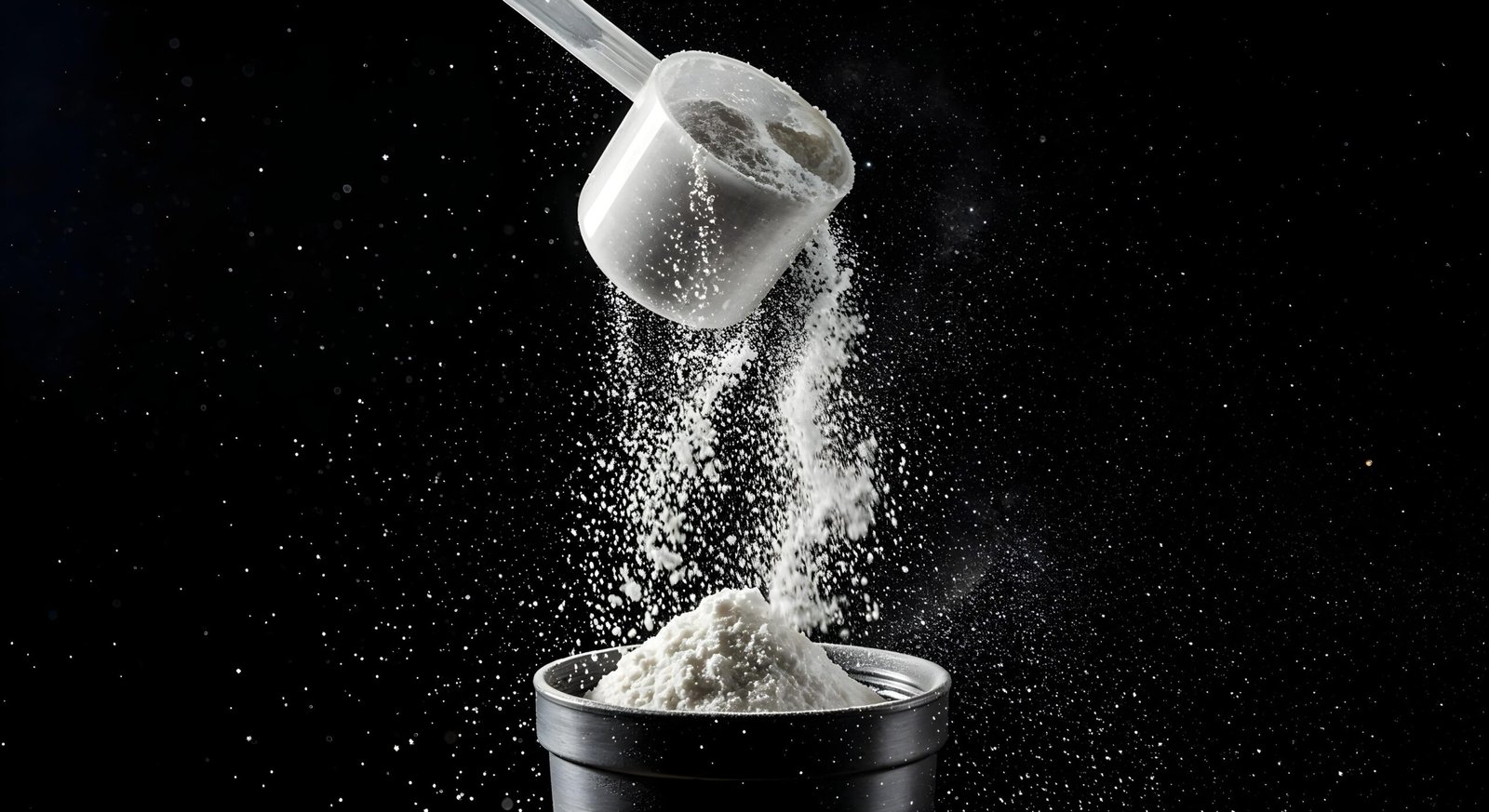
Creatine is one of the most extensively researched supplements in sports nutrition. Yet among plant-based athletes, it remains widely misunderstood—often dismissed as unnecessary or framed as “only for bodybuilders.” The reality is far more nuanced.
For individuals consuming fully plant-based diets, creatine supplementation may offer unique advantages for physical performance, brain health, and long-term functional capacity. This article examines what the evidence actually shows—separating myth from mechanism.
What Is Creatine—and Why Plant-Based Athletes Start at a Disadvantage
Creatine is a nitrogen-containing compound synthesized endogenously from arginine, glycine, and methionine. It plays a central role in rapid ATP regeneration via the phosphocreatine system, particularly during high-intensity or repeated efforts.
Dietary creatine is found almost exclusively in animal products, including meat and fish. As a result, individuals following vegetarian or vegan diets consistently show lower baseline muscle creatine stores compared to omnivores.
This matters because lower baseline stores are associated with greater responsiveness to supplementation, meaning plant-based athletes often experience equal—or larger—performance benefits when creatine is introduced.
Performance Benefits: Not Just for Power Athletes
Creatine’s most well-established role is in improving high-intensity performance, strength, and lean mass accrual. Meta-analyses consistently demonstrate improvements in maximal strength, repeated sprint ability, and training volume when creatine monohydrate is combined with resistance training.
➡️ How Often Should You Strength Train
Importantly for endurance and hybrid athletes, creatine may also:
- Improve repeated high-power surges (e.g., climbing, sprint finishes)
- Reduce perceived fatigue during interval sessions
- Support greater training quality over time
These effects are particularly relevant in sports requiring both aerobic capacity and anaerobic repeatability—including cycling, CrossFit, soccer, and mountain biking.
Cognitive Performance: An Underappreciated Benefit
Creatine’s role is not limited to skeletal muscle. The brain relies heavily on ATP availability, and creatine contributes to cerebral energy buffering.
➡️ The Rise of Mental Fitness Training
Research has shown that creatine supplementation can improve:
- Short-term memory and reasoning ability
- Cognitive performance under sleep deprivation
- Mental fatigue resistance
These effects appear stronger in individuals with low baseline creatine intake, including vegetarians and vegans.
For plant-based professionals, students, coaches, and athletes managing high cognitive loads, this represents a meaningful—yet often overlooked—benefit.
Creatine, Aging, and Longevity
While creatine is not a “longevity supplement” in the simplistic sense, it plays a supportive role in several determinants of healthy aging.
Creatine supplementation has been shown to:
- Enhance resistance-training adaptations in older adults
- Support muscle mass and strength preservation
- Improve functional performance and reduce fall risk
Given that cardiorespiratory fitness and muscular strength are strong predictors of all-cause mortality, creatine’s indirect role in supporting training quality and muscle function may contribute to healthier aging trajectories.
For plant-based adults aging into their 40s, 50s, and beyond, creatine may help offset the combined challenges of sarcopenia, reduced training tolerance, and lower dietary creatine exposure.
Safety, Dosing, and Common Myths
Creatine monohydrate is one of the safest supplements ever studied. Long-term trials show no adverse effects on kidney function in healthy individuals, even with multi-year use.
Evidence-based dosing:
- 3–5 g per day
- No loading phase required
- Timing is flexible; consistency matters most
Myths such as dehydration, cramping, or kidney damage are not supported by high-quality evidence when creatine is used appropriately.
Why Creatine Makes Particular Sense for Plant-Based Athletes
For omnivores, creatine supplementation “tops off” existing stores. For plant-based athletes, it replaces a missing dietary compound entirely.
This makes creatine one of the rare supplements that is:
- Well-studied
- Low-cost
- Mechanistically sound
- Particularly relevant to plant-based populations
Rather than contradicting plant-based principles, creatine supplementation aligns with a performance- and longevity-focused approach to nutrition.
➡️ More High Performers Are Eating Mostly Plant-Based
Final Takeaway
Creatine is not just a strength supplement, nor is it incompatible with plant-based nutrition. For plant-based athletes, it represents a strategic, evidence-backed tool supporting performance, cognitive resilience, and long-term physical capacity.
When used intelligently, creatine helps bridge the gap between ethical food choices and optimal physiological function—without compromising either.
References
Burke, D. G., Chilibeck, P. D., Parise, G., Candow, D. G., Mahoney, D., & Tarnopolsky, M. A. (2003). Effect of creatine and weight training on muscle creatine and performance in vegetarians. Medicine & Science in Sports & Exercise, 35(11), 1946–1955.
Candow, D. G., Chilibeck, P. D., Forbes, S. C., & Little, J. P. (2014). Effect of creatine supplementation and resistance training on muscle strength and health in older adults. Applied Physiology, Nutrition, and Metabolism, 39(11), 1236–1244.
Delanghe, J., De Slypere, J. P., De Buyzere, M., Robbrecht, J., Wieme, R., & Vermeulen, A. (1989). Normal reference values for creatine, creatinine, and carnitine are lower in vegetarians. Clinical Chemistry, 35(8), 1802–1803.
Kreider, R. B., Kalman, D. S., Antonio, J., Ziegenfuss, T. N., Wildman, R., Collins, R., … Lopez, H. L. (2017). International Society of Sports Nutrition position stand: Safety and efficacy of creatine supplementation in exercise, sport, and medicine. Journal of the International Society of Sports Nutrition, 14(18).
McMorris, T., Harris, R. C., Swain, J., Corbett, J., Collard, K., Dyson, R. J., … Williams, C. (2007). Effect of creatine supplementation on cognitive performance and mood during extended periods of sleep deprivation. Journal of Sports Sciences, 25(1), 65–71.
Rae, C., Digney, A. L., McEwan, S. R., & Bates, T. C. (2003). Oral creatine monohydrate supplementation improves brain performance: A double-blind, placebo-controlled, cross-over trial. Proceedings of the Royal Society B: Biological Sciences, 270(1529), 2147–2150.