Plant-based athletes often hear two competing messages: “You’re missing key performance nutrients” or “You don’t need supplements at all.” The truth, as usual, sits in the middle.
➡️ The Hidden Cost of Chronic Energy Deficit in Endurance Athletes
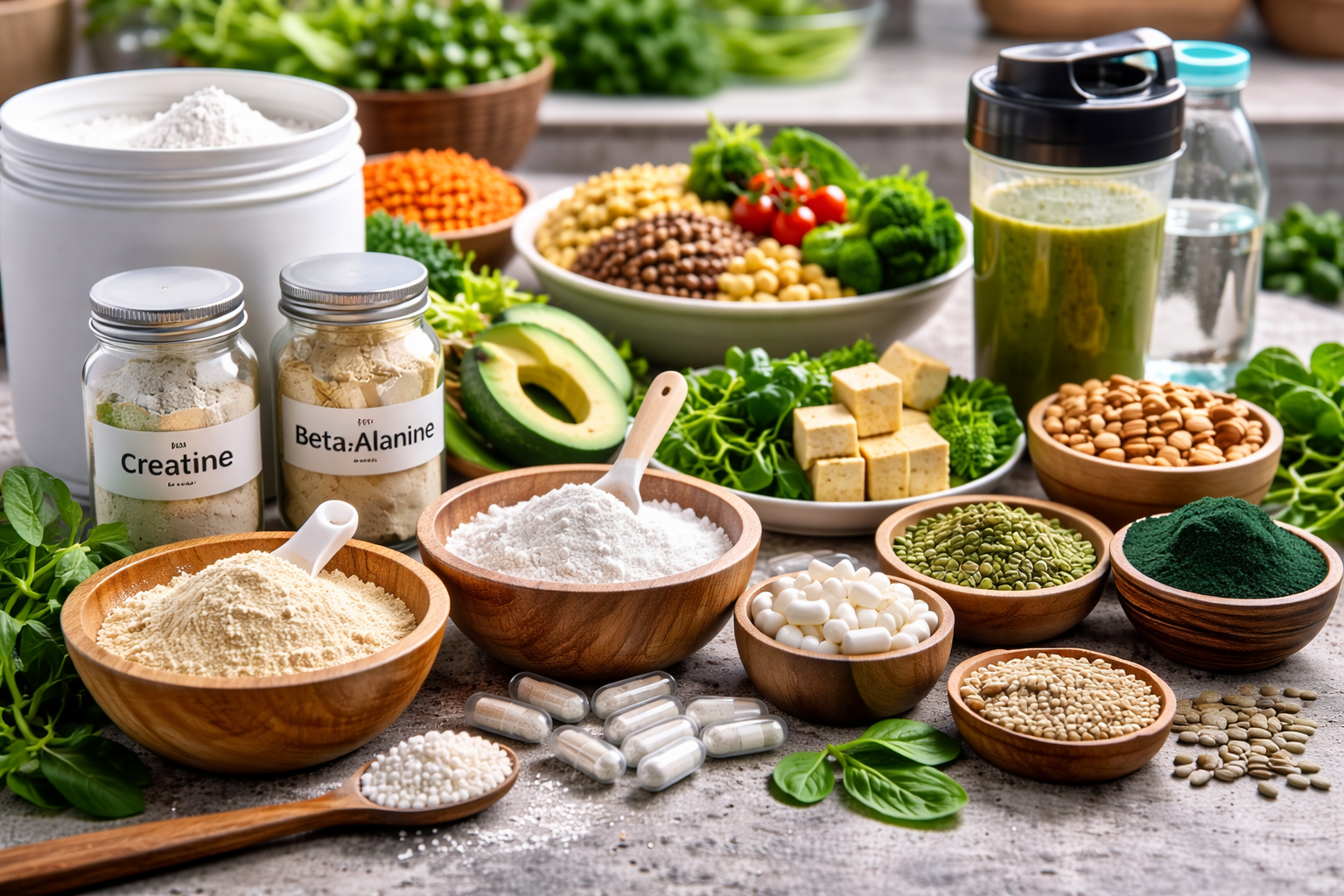
Creatine and beta-alanine are two of the most studied ergogenic aids in sports nutrition. For plant-based athletes—who naturally consume less dietary creatine and carnosine—their relevance deserves a closer, evidence-based look.
This article breaks down what these supplements actually do, who benefits, and when they’re unnecessary.
Creatine: The Strongest Case for Plant-Based Athletes
Creatine supports rapid ATP regeneration during short, high-intensity efforts such as sprinting, resistance training, and repeated hard intervals.
Why Creatine Matters More for Plant-Based Athletes
Dietary creatine is found almost exclusively in animal products. As a result, vegetarians and vegans consistently show lower baseline muscle creatine stores compared to omnivores.
When supplemented, plant-based athletes often experience greater relative improvements in strength and power.
Performance Benefits
- Increased strength and power output
- Improved repeated sprint performance
- Enhanced lean mass gains during resistance training
These effects are well established across athletic populations.
➡️ Strength Training for Endurance Athletes: What Actually Transfers
Practical Takeaway
Creatine monohydrate is:
- Safe
- Effective
- Low-cost
- Highly relevant for plant-based athletes
Dose: 3–5 g/day (no loading required)
Beta-Alanine: Context Matters
Beta-alanine increases intramuscular carnosine, which helps buffer hydrogen ions during high-intensity exercise lasting ~1–4 minutes.
When Beta-Alanine Helps
Beta-alanine is most useful for:
- Repeated high-intensity efforts
- Events requiring sustained anaerobic capacity
- Sports with frequent surges (e.g., track cycling, CrossFit-style training)
Meta-analyses show small-to-moderate benefits in these contexts.
When It Doesn’t
For steady-state endurance (e.g., long-distance running or cycling), beta-alanine offers minimal benefit.
➡️ Why Fitness Advice Fails Outside the Lab
Plant-Based Considerations
Because carnosine is found in animal foods, plant-based athletes may start with lower muscle carnosine levels—but performance gains remain task-specific, not universal.
Dose: 3.2–6.4 g/day, split to reduce paresthesia (tingling)
What Supplements Aren’t Doing the Work For You
Neither creatine nor beta-alanine can compensate for:
- Chronic low energy availability
- Poor carbohydrate intake
- Inadequate total protein
- Poor recovery practices
➡️ Why Maintenance Calories Matter More Than Fat-Loss Calories
This is especially relevant for plant-based endurance athletes, where underfueling—not supplementation—is often the limiting factor.
Supplementation should support training, not substitute for nutrition fundamentals.
Evidence-Based Recommendation Summary
| Supplement | Worth It? | Best For |
|---|---|---|
| Creatine | ✅ Yes | Strength, power, repeated sprints |
| Beta-Alanine | ⚠️ Maybe | High-intensity, anaerobic efforts |
| Both | ❌ Not universal | Context matters |
—–
References
Bemben, M. G., & Lamont, H. S. (2005). Creatine supplementation and exercise performance: Recent findings. Journal of Strength and Conditioning Research, 19(2), 452–457.
Burke, D. G., Chilibeck, P. D., Parise, G., Candow, D. G., Mahoney, D., & Tarnopolsky, M. (2003). Effect of creatine and weight training on muscle creatine and performance in vegetarians. American Journal of Clinical Nutrition, 78(2), 256–261.
Hobson, R. M., Saunders, B., Ball, G., Harris, R. C., & Sale, C. (2012). Effects of β-alanine supplementation on exercise performance: A meta-analysis. Journal of Physiology, 590(16), 3969–3977.
Kreider, R. B., Kalman, D. S., Antonio, J., Ziegenfuss, T. N., Wildman, R., Collins, R., … Lopez, H. L. (2017). International Society of Sports Nutrition position stand: Safety and efficacy of creatine supplementation in exercise, sport, and medicine. Journal of the International Society of Sports Nutrition, 14, 18.
Saunders, B., Elliott-Sale, K., Artioli, G. G., Swinton, P. A., Dolan, E., Roschel, H., … Sale, C. (2017). β-alanine supplementation to improve exercise capacity and performance: A systematic review and meta-analysis. Sports Medicine, 47(4), 759–775.