
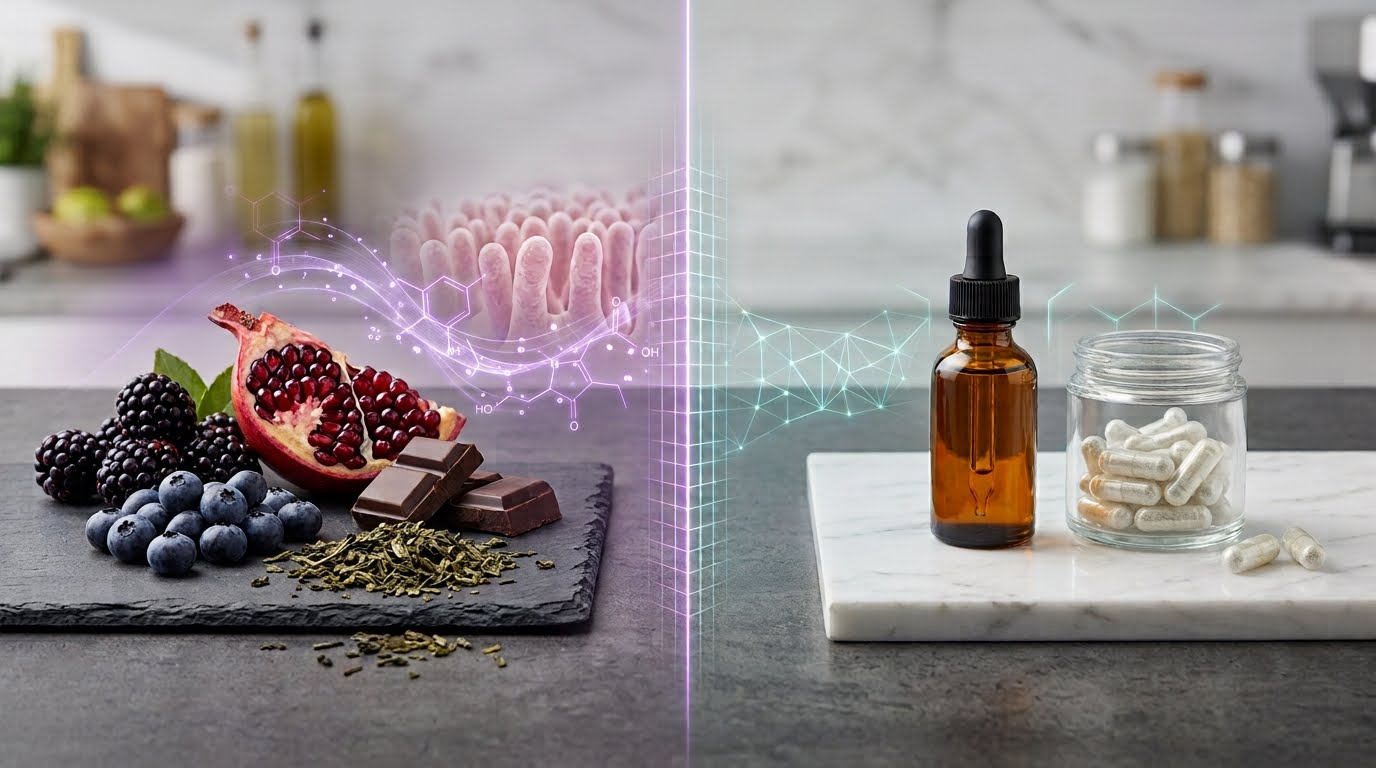
In sports nutrition and healthspan optimization, consumers often reduce nutrition to a simple numbers game: counting milligrams of isolated vitamins on a supplement label. However, biological systems do not process nutrients as isolated chemical entities in a vacuum. The physiological impact of a nutrient depends heavily on its bioavailability and polyphenol matrix—the complex physical and chemical structure of whole plant foods that dictates how effectively micronutrients are liberated, solubilized, absorbed, and utilized by human cells.
While high-dose synthetic supplements flood the gastrointestinal tract with isolated molecules that often compete for intestinal transporters or get excreted rapidly, whole plant foods deliver vitamins, minerals, and polyphenols bound within a cellular fiber network. This natural food matrix protects sensitive bioactives through gastric transit, provides synergistic co-factors, and leverages gut microflora metabolism for sustained, long-term systemic absorption.
The Food Matrix Effect: Bioaccessibility vs. Bioavailability
                   THE THREE PHASES OF NUTRIENT UPTAKE
│                                                                          │
│  1. Liberation / Bioaccessibility  ──► Release from cellular plant walls │
│  2. Intestinal Absorption          ──► Uptake across enterocyte membrane │
│  3. Bioavailability                ──► Active reach to target tissues    │
To understand why synthetic isolates often fail to match the health outcomes of whole plants, we must separate nutrient content from systemic utilization:
Bioaccessibility: The fraction of a nutrient or polyphenol that is released from the food matrix during digestion and becomes available for intestinal uptake.
Intestinal Transporter Kinetics: Isolated mega-doses of synthetic vitamins can saturate competitive enterocyte transporters (e.g., high-dose ascorbic acid downregulating sodium-dependent vitamin C transporters, SVCT1). In contrast, whole foods release nutrients gradually, preserving transporter efficiency.
Glycosides vs. Aglycones: Plant polyphenols naturally exist as glycosides (bound to sugar moieties). Intestinal enzymes (like lactase-phlorizin hydrolase) or colonic microflora cleave these sugars, yielding bioactive aglycones that cross cell membranes smoothly.
Head-to-Head: Whole Plant Matrix vs. Isolated Synthetic Supplements
| Physiological Factor | Whole-Food Plant Matrix | Isolated Synthetic Supplement |
| Release Kinetics | Sustained, gradual release via dietary fiber breakdown | Rapid spike in plasma levels followed by swift renal excretion |
| Synergistic Co-Factors | Natural pairing (e.g., Vitamin C + non-heme iron + organic acids) | Single isolated compound lacking complementary co-enzymes |
| Intestinal Receptor Impact | Maintains steady transporter affinity without saturation | Risks receptor down-regulation and competitive transport inhibition |
| Gut Microbiome Action | Fiber-bound polyphenols ferment into active colonic metabolites | Minimal microbial fermentation; may disturb gut microflora balance |
| Oxidative Risk | Balanced antioxidant network neutralizes pro-oxidant shifts | High-dose synthetic antioxidants can act as pro-oxidants |
—–
Synergistic Mechanisms: How Whole Plants Multiply Absorption
                     PLANT MATRIX SYNERGY IN ACTION
│                                                                       │
│  Whole Spinach / Legumes   ──► Non-Heme Iron (Fe³⁺)                   │
│                                      │                                │
│                                      ▼                                │
│  Natural Ascorbate (Citrus)──► Reduces Fe³⁺ to Fe²⁺ (DMT1 Transport)  │
│                                      │                                │
│                                      ▼                                │
│  Organic Acid Matrix      ──► Chelates Iron & Prevents Phytate Binding│
The whole-food advantage stems from multi-compound synergy operating within a single meal:
Iron Bioavailability Enhancement: Non-heme iron (
Fe³⁺) in plant foods is reduced to the absorbable ferrous state (Fe²⁺) by natural vitamin C and organic malic/citrate acids present in whole fruits and vegetables, expanding uptake via divalent metal transporter 1 (DMT1).Fat-Soluble Carotenoid Solubilization: Lycopene, lutein, and beta-carotene locked inside chromoplasts require the presence of natural dietary lipids (like those in walnuts, hemp seeds, or avocados) to form mixed micelles, increasing bioaccessibility by over 300%.
Colonic Polyphenol Fermentation: Nearly 90-95% of ingested dietary polyphenols pass through the small intestine unabsorbed. Bound to insoluble cell wall fiber, they reach the colon where specialized gut microbes ferment them into low-molecular-weight phenolic acids (e.g., valerolactones) that exert systemic anti-inflammatory protection.
Actionable Whole-Food Matrix Protocol
Pair Iron with Natural Vitamin C: Eat non-heme iron sources (lentils, black beans, spinach) alongside fresh bell peppers, citrus, or broccoli rather than taking isolated iron pills that cause gastrointestinal distress.
Combine Fat-Soluble Carotenoids with Healthy Fats: Always serve raw or lightly cooked colorful vegetables (carrots, tomatoes, kale) with a whole-food fat source (chia seeds, tahini, or avocado) to drive micellar solubilization.
Prioritize Intact Fibrous Plants over Extracts: Choose whole berries, intact grains, and green tea over concentrated polyphenol extracts, ensuring the fiber matrix delivers bioactives safely to your colonic microflora.
Integrating Nutrition Science with Training & Recovery
Maximizing micronutrient bioavailability supports every aspect of athletic performance, body composition, and longevity:
Targeted Supplement Essentials: Learn when isolated supplements are necessary for plant-based lifters in The Top 5 Essential Supplements for Vegan Athletes to Boost Performance.
Cellular Autophagy & Repair: Discover how plant bioactives stimulate cellular recycling in Spermidine & Autophagy Activation: How Plant Compounds Stimulate Cellular Cleanup.
Whole Foods vs. Processed Analogues: Examine structural food processing in Processed Vegan Meats vs Whole Foods: Performance & Health Audit.
Seasonal Whole-Food Fueling: Enjoy nutrient-dense seasonal recipes like our High-Protein Autumn Pumpkin Spice Recomp Smoothie.
Ready to optimize your nutrition matrix, micronutrient absorption, and athletic performance with evidence-based coaching? Explore how Online Fitness Coaching can help you achieve your goals today!
References
Capuano, E., & Janssen, A. E. M. (2021). Food matrix and macronutrient digestion. Annual Review of Food Science and Technology, 12, 193–212.
D’Archivio, M., Filesi, C., Di Benedetto, R., Gargiulo, R., Giovannini, C., & Masella, R. (2010). Bioavailability of the polyphenols: Status and controversies. International Journal of Molecular Sciences, 11(4), 1321–1342.