
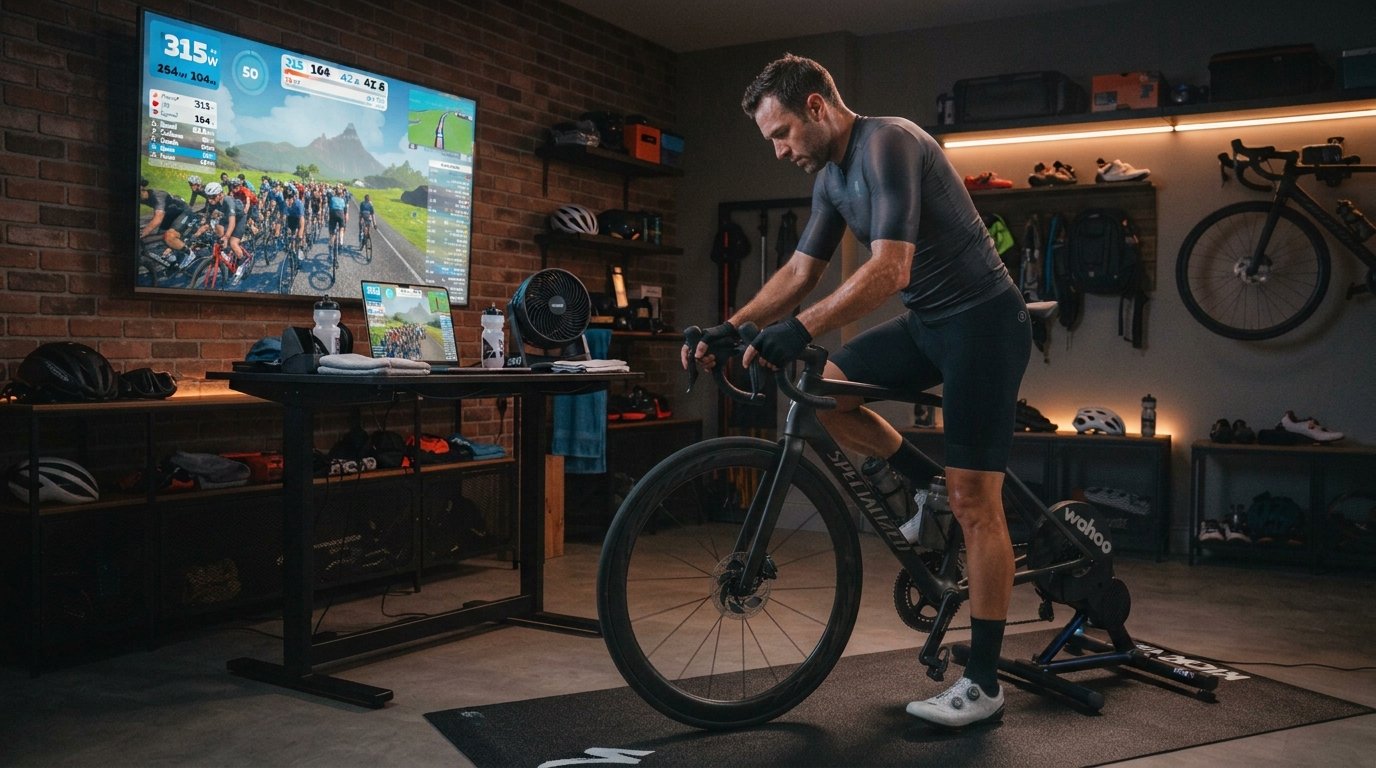
As autumn rain and dropping temperatures signal the end of long outdoor weekend rides, endurance athletes and cross-country mountain bikers face the annual migration indoors. Dialing in your pain cave and indoor smart trainers is the single most important step for maintaining structured fitness during the winter off-season. However, moving from the open road or trail to a stationary trainer introduces unique technical and biomechanical variables that every data-driven athlete must master.
Transitioning indoors is not merely about mounting your bike to a resistance unit; it requires understanding the nuances of power meter telemetry accuracy, comparing direct-drive resistance systems against crank-based power meters, and managing erg-mode resistance curves. For plant-powered athletes maintaining high-volume aerobic baselines, mastering your indoor setup ensures that your structured threshold intervals translate directly to spring race performance.
Telemetry & Biomechanics: Direct-Drive Units vs. Crank-Based Power Meters
                      POWER MEASUREMENT TELEMETRY COMPARISON
│                                                                                │
│  Crank-Based Power Meter   ──► Measures Direct Left/Right Torque at Spindle    │
│                                           │                                    │
│                                           ▼                                    │
│  Direct-Drive Smart Trainer ──► Measures Electromagnetic Resistance at Cassette│
│                                           │                                    │
│  Variance Factor           ──► Drivetrain Friction Loss (~1.5–3.0%)            │
When analyzing training data indoors, understanding where and how your power is measured prevents frustrating discrepancies between outdoor rides and indoor sessions:
Direct-Drive Smart Trainers: Units like the Wahoo KICKR or Tacx Neo measure power directly at the internal electromagnetic flywheel and cassette interface. While highly convenient, they incorporate drivetrain mechanical loss (~ 1.5-3.0%) into their telemetry readings.
Crank-Based & Pedal-Based Power Meters: Devices like the Sigeyi AXO or SRAM power meters measure torsional force directly at the spider or spindle. Pairing an external crank-based power meter to your smart training software via ANT+ or Bluetooth ensures absolute telemetry consistency between your outdoor mountain bike and your indoor setup.
Cadence Smoothing & Erg-Mode Resistance Curves: In erg mode, smart trainers automatically adjust resistance based on your pedal speed. Heavy flywheel inertia combined with aggressive software smoothing can mask micro-dead spots in your pedal stroke, altering true neuromuscular torque engagement compared to outdoor riding.
Head-to-Head: Indoor Smart Trainer Setup vs. Outdoor Trail Riding
| Performance Parameter | Outdoor Cross-Country Riding | Indoor Smart Trainer Setup |
| Environmental Control | Variable wind, temperature, terrain, & elevation | Controlled ambient climate; requires dual high-velocity fans |
| Power Measurement Source | Crank spider, pedal spindles, or rear hub | Internal trainer electromagnetic flywheel or crank meter |
| Inertia & Momentum | Natural micro-deceleration & coasting dynamics | Simulated flywheel mass or software-adjusted inertia |
| Neuromuscular Engagement | Dynamic core stabilization & balance across terrain | Stationary stabilization; focused entirely on pedal stroke |
| Cooling & Thermoregulation | Natural convective air cooling from forward motion | Artificial cooling; sweat accumulation requires deliberate fan placement |
—–
The Plant-Based Indoor Advantage: Managing Hydration & Electrolytes Indoors
Indoor training eliminates natural convective air cooling, causing core body temperature and sweat rates to skyrocket even during moderate endurance efforts:
                    INDOOR THERMOREGULATION & HYDRATION FLOW
│                                                                             │
│  High Ambient Sweating    ──► Massive Electrolyte & Sodium Loss             │
│                                           │                                 │
│                                           ▼                                 │
│  Custom Bottle Mix        ──► 45g Maltodextrin + 45g Gatorade + 1/8 tsp Salt│
│                                           │                                 │
│  Cellular Osmolality      ──► Sustained Blood Volume & Erg-Mode Power       │
Combating Indoor Dehydration: Without outdoor airflow, sweat evaporation drops, forcing the cardiovascular system to work harder just to maintain skin blood flow and cooling. Plant-based athletes must proactively manage fluid and sodium balance.
Optimizing Intra-Workout Bottles: To sustain high-power output during indoor interval blocks, utilize custom fluid mixes—such as 45g of maltodextrin, 45g of Gatorade powder, and 1/8 teaspoon of salt per bottle—to target up to 90g of carbohydrates per hour without digestive distress.
Actionable Pain Cave Setup & Calibration Protocol
Deploy Dual High-Velocity Fans: Position one fan directed at your torso and a second oscillating fan at your lower body to replicate outdoor convective cooling and prevent premature thermal fatigue.
Perform Spindown & Zero-Offset Calibrations: Warm up your smart trainer for 10 minutes, then execute a zero-offset calibration on your crank-based power meter and a spindown test on your direct-drive trainer to guarantee telemetry alignment.
Master Erg-Mode Spiral of Death: When executing high-wattage intervals, maintain your cadence above 90 RPM prior to the interval start; letting cadence drop below 75 RPM in erg mode causes resistance to spike exponentially, stalling your momentum.
Integrating Indoor Telemetry with Science & Training
Maximizing your indoor off-season setup requires aligning your technology with structured training blocks and recovery telemetry:
Off-Season Hypertrophy Integration: Combine indoor base training with muscle building via The Off-Season Hypertrophy Block: Maximizing Plant-Powered Muscle Accretion in Colder Months.
Building Aerobic Base: Pair smart trainer intervals with low-intensity sessions outlined in Zone 2 Cardio Plant-Based Athlete’s Guide.
Tracking Autonomic Recovery: Monitor how indoor training stress impacts your nervous system using insights from Heart Rate Variability: Useful Metric or Overhyped Tech?.
High-Leucine Post-Workout Fuel: Refuel after grueling indoor interval sessions with our High-Protein Berry-Spinach Anabolic Recovery Smoothie.
Ready to optimize your indoor smart trainer setup, fine-tune your power telemetry, and elevate your off-season cycling performance with evidence-based coaching? Explore how Online Fitness Coaching can help you achieve your goals today!
References
Bouillod, A., Soto-Romero, G., Grappe, F., Bertucci, W., Brunet, E., & Cassirame, J. (2022). Caveats and recommendations to assess the validity and reliability of cycling power meters: A systematic scoping review. Sensors, 22(1), Article 386.
Coyle, E. F., Feltner, M. E., Kautz, S. A., Hamilton, M. T., Montain, S. J., Baylor, A. M., Abraham, L. D., & Petrek, G. W. (1991). Physiological and biomechanical factors associated with elite endurance cycling performance. Journal of Applied Physiology, 71(6), 2155–2164.
Passfield, L., Hopker, J. G., Jobson, S., Friel, D., & Zabala, M. (2017). Knowledge is power: Issues of measuring training and performance in cycling. Journal of Sports Sciences, 35(14), 1426–1434.